Rules of writing: the auto-tune of literature

No one can tell me how to be me. The same goes for being a writer. Yet, I can’t help myself. The internet is full of mostly well-intentioned advice on writing — forums, essays, lists, and opinionated rant — and I soak it up. Chuck Wendig’s blog, one of my current favorites, is full of fun little lists of advice aimed at writers. It’s all too easy to choke on the stream when you’re drinking from a fire hose, though. I could spend my entire day reading other people’s take on rules and processes and neglect my own projects, if I didn’t put some filters in place.

Rules themselves aren’t necessarily bad. Some people are contrarians and make a point to avoid them but the truth is, rules are rules for a reason. These are things that have been done so poorly over time that someone arrived at a simple conclusion to fix a widespread problem and the publishing community said, “Yes, that.” As generalities go, they can be useful for filtering out a lot of noise.

I can’t tell you how many times I’ve heard someone say that “You have to know the rules before you can break them.” What’s that mean, exactly? Well, it’s part of the internalization process but that’s still vague.

I think about that in terms of the old lawn mower engine I used to tinker with when I was a teen. At first, I knew nothing about it other than where to put the gas. When it wouldn’t start, my dad explained the carburetor, about ignition, combustion, and airflow. He handed me a screwdriver and showed me how to wedge open the choke and get the engine started. I understood a rule; I could tell you why restricted airflow would prevent the lawn mower from starting and I could follow the rule and make it run it but I was far from being able to build my own engine.

Rules try to quantify problematic story traits into simplistic, cautionary terms. What they don’t always do is give us the context behind them. That’s left up to us to figure out. I know I’ve internalized something when I can tell it to someone else without stumbling over the explanation. I put together a shiny little flowchart that kind of breaks down my process:
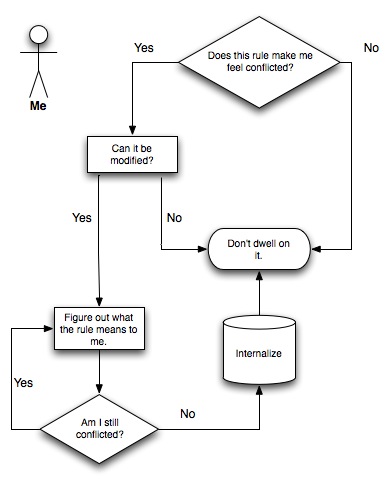
I try to take each piece of advice as if I’m chewing on a piece of salt the size of a jawbreaker, even if it comes from my childhood hero or my best friends. No one is trying to mislead me, but everyone approaches these problems from their own experiences. Rules that work for everyone, like absolute, are suspect at best.

The most famous (and infuriatingly vague) rule might be “Show, don’t tell.” What that really means, to me, is choosing which details you reveal to the reader, and how, carefully. I don’t need to spend a paragraph emphasizing the ticking of a clock, for example, if it doesn’t have any relevance to the story other than, perhaps, to set mood. It’s a balancing of importance.

“Write what you know” is another one that has always bothered me. I’ve never been an airship pirate, nor have I been a 1920’s superhero but that hasn’t stopped me from writing about them. So what does that really mean? What I do know — life experience. I’ve known anguish and heartbreak. I’ve seen people self-destruct through inaction and apathy, or rise to new heights through personal revelation. What I know is the life I’ve lived and ultimately story comes down to the people who populate it.

Every writer has leeway to interpret the rules their own way. How we write defines our voice. That variety is what makes literature exciting and worth reading. Can you imagine the horrible boringness if every writers voice were the same — if someone like Catherynne Valente (whose written voice is amazing) were indistinguishable from any other writer? That would be a fucking criminal and should emphasis the importance of making these bits of wisdom your own.

Finding your voice is your internalization of the so-called rules. And when you’re done, motherfucking own those rules and write.
Continue reading

Motivational Quotes for Writers

When I competed in fitness competitions, I used motivational quotes to help me put my best effort into every training session, to stick to the strict diet and to keep my enthusiasm high. I had them all over the place, in my workout journal, in my competitoin scrapbook, on the fridge and in my travel journals for each competition.

Now that I’ve begun to focus on my writing, I’ve started a collection of motivational quotes to help me along the way. Some people may think it’s cheesy or feeble-minded to rely on outside sources and other people’s words for your own motivation, but I disagree. I’m smart enough to know I should learn everything I can from those more experienced in the industry. Competing in fitness was tough (and that’s an understatement!) and writing is tough. Whatever we can do to help us through those tough times is worth it.

These are some of my favourites. If you have other quotes you like, please add them in the comments. I’m always looking to expand my collection and I’m sure others are as well. I hope some of these can help you in your writing journey.

“I write for the same reason I breathe-because if I didn’t, I would die.”
-Isaac Asimov

“We are cups, constantly and quietly being filled. The trick is, knowing how to tip ourselves over and let the beautiful stuff out.”
-Ray Bradbury

“A science fiction writer should try to combine the intimately human with the grandly cosmic.”
-Robert J Sawyer

“Start early and work hard. A writer’s apprenticeship usually involves writing a million words (which are then discarded) before he’s almost ready to begin. That takes a while.”
-David Eddings

“If there’s a book you really want to read, but it hasn’t been written yet, then you must write it.”
-Toni Morrison

“Writing a book is a horrible, exhausting struggle, like a long bout of some painful illness. One would never undertake such a thing if one were not driven on by some demon whom one can neither resist nor understand.”
-George Orwell

“You have to know how to accept rejection and reject acceptance.”
-Ray Bradybury

“If my doctor told me I had only six minutes to live, I wouldn’t brood. I’d type a little faster.”
-Isaac Asimov

“When asked, ‘How do you write?’ I invariably answer, ‘one word ata time.'”
-Stephen King

“To write something, you have to risk making a fool of yourself.”
-Anne Rice

“How vain it is to sit down to write when you have not stood up to live.”
-Henry David Thoreau

“Writing is not necessarily something to be ashamed of, but do it in private and wash your hands afterwards.”
-Robert Heinlein

“And by the way, everything in life is writable about if you have outgoing guts to do it, and the imagination to impovise. The worst enemy to creativity is self-doubt.”
-Sylvia Plath

“Keep away from people who try to belittle your ambitions. Small people always do that, but the really great make you feel that you, too, can become great.”
-Mark Twain

“Imagination is more important than knowledge. Knowledge is limited. Imagination encircles the world.”
-Albert Einstein

“Everybody walks past a thousand story ideas every day. The good writers are the ones who see five or six of them. Most people don’t see any.”
-Orson Scott Card

“You must stay drunk on writing so reality cannot destroy you.”
-Ray Bradbury

Continue reading

Interview: Jay Lake

An October 2009 LiveJournal post about acceptances and rejections by Jay Lake led to an email exchange about his submission statistics. He graciously sent me a copy of his spreadsheet and I was going to compile some pretty, pretty graphs based on the data. I began a drastic life change (divorce) a week later and that project never came to fruition.

Skip forward a few years. I’d been following a discussions on story revision, submission management and tracking on Codex and elsewhere. I’d gone through several iterations of my own submission spreadsheet, trying to find a process that worked for me. Then I remembered that past conversation with Jay. I still had that snapshot into his early short fiction career, circa 2000-2009, so I reconnected with him to see if he would be interested in discussing his early career in more detail.


I think most people have some goal for publication — pay rate, prestige, SFWA qualification, etc. What was your strategy for choosing where to send a story and how has that changed over the years?

When I first started publishing I was keenly interested in SFWA qualification, yet at the same time (ca. 2001/2002) the independent press was exploding. Print on Demand books had become financially and logistically practical, while Web based markets were first being taken seriously. So, frankly, I went for exposure in casting my net widely. I was submitting to top pay and prestige markets from the very beginning, but I was also producing sufficient inventory to keep stories out at various independent and one-time markets.

In the years since, I’ve shifted my primary writing focus to novels. At the same time, my cancer experiences of the past four years have robbed me of a considerable amount of writing time. Taking these two trends combined has significantly reduced the attention I’ve been able to pay to short fiction. My strategy these days is to respond to requests from markets I’m interested in supporting, while still also aiming for those top pay and prestige markets. Reduced inventory had caused me to pull in net, so to speak, but I’m still an enthusiastic supporter of independent presses.

Fundamentally, I’d like to be read. Whatever path it might be that gets me there.

Your submission history speaks to persistence. In one case, a story had been rejected twenty-two times before selling to Weird Tales. At what point do you give up trying to sell a story?

Usually I trunk a story when it has hit all the markets I think it was likely to be of interest to. Obviously this is a very subjective judgment on part. And I do have a pretty big trunk, so to speak. Every once in a great while I’ll pull out a retired story, rework it, and put it back on the market. So even those trunk stories aren’t necessarily in permanent retirement.

It doesn’t look like you often edit to a story once it’s gone into submission. What will prompt you to make revisions before sending something to the next market?

I usually try to read through a story before it goes out, just for a typo patrol. Every now and then I’m moved to pull a finished story and edit more heavily. In general, though, I’d almost always rather write a new one. Since writing isn’t a difficult exercise for me (other than the time issues mentioned above), this seems to work out fairly well.

As your career and writing progressed — pro sales, invitations to closed markets, award nominations and wins, etc. — do you have any qualms about submitting older stories that are not representative of your current work?

Not really. If I pull an old story out of the trunk and rework it, well, then hopefully I’m functioning within my present knowledge and mastery of the craft. I’ve always had pretty good ideas and a neat turn of phrase. The problems in those older stories are more along the lines of characterization, ending and so forth. That’s stuff I can fix if I want to take the time to do so. My voice is always evolving — if it ever stops doing so, that will be because something has gone wrong — but I’m proud of my earlier work as well.


Jay Lake lives in Portland, Oregon, where he works on numerous writing and editing projects. His 2012 books are Kalimpura from Tor Books, and Love in the Time of Metal and Flesh from Prime Books. His short fiction appears regularly in literary and genre markets worldwide. Jay is a past winner of the John W. Campbell Award for Best New Writer, and a multiple nominee for the Hugo and World Fantasy Awards. Jay can be reached through his blog at jlake.com.

Continue reading

Getting a Handle on Your Short Story Queue

At the Rainforest Writer’s Retreat, there was a friendly competition to see who who could win the highest word count (for my session, it was Keffy, who did most of a NaNoWriMo in 3.5 days). I, on the other hand, was putting down more calories (in the form of brownies and cake baked each day by other attendees) than words. Discouraged, I decided to procrastinate plan ahead by getting a handle on all of my short story projects. I was surprised at how much this encouraging this simple act was, and wanted to share the process with you.

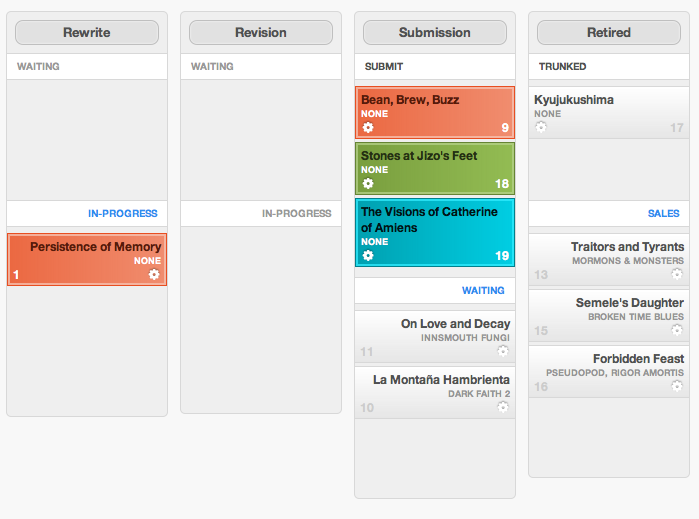
I repurposed the kanban-style of software project management to help me stay on top of my short stories. Kanban is a simple system that helps me do three things with my writing queue:

  1. Visualize the work that I have to do.
  2. Keep the stories flowing from ideation to publication.
  3. Focus on the most important task at hand.

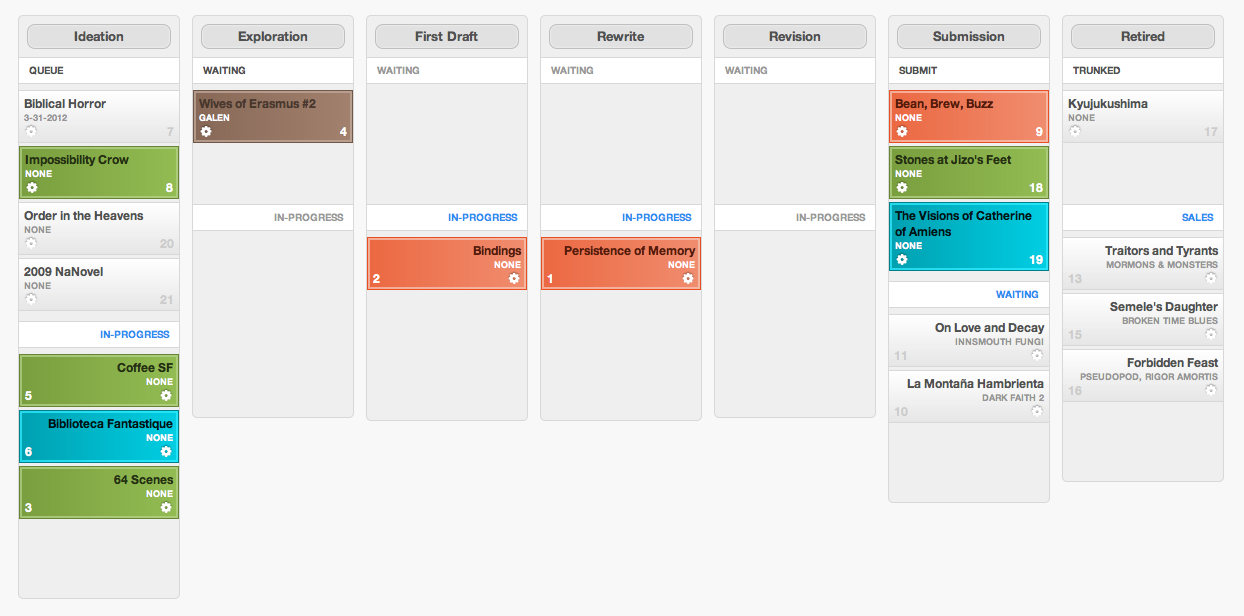
I used a website called kanbanpad to post each of my stories like notecards on a bulletin board. You can see a thumbnail of my project board below:


I use colors to help draw my attention to some stories (orange is for my top priorities, brown is a collaboration, or represents a story being critiqued) and also to prettify the kanban board.

The columns reflect my creative process, and reinforce what work I need to do at each step. Only one or two are concerned with word count. From left to right, they are:

  • Ideation: My work here is to *actively* think about a story idea. Before I step in the shower or out for a long bike rides, I pick a story and start thinking about it. For NaNoWriMo a couple of years back, I used my morning hour of biking to work through the previous day’s plot, character and voice problems. Sometimes this can also include library research or hours on tumblr…
  • Exploration: The work here is hard to capture, but it’s where I start putting the literal or metaphorical pen to the paper: I write plot synopses and my first throwaway paragraphs/scenes. Discovering the narrative voice is the hardest thing for me to do, and I have to write and delete over and over again. But once I find the voice, I’m ready for the next step.
  • First Draft: Finally, word count!

  • Rewrite: I hate this phase. I write slowly, and produce relatively clean first drafts, and really want to just kick them out the door at that point. I’m currently rewriting half of a story because I decided one of the two narratives was too bland. (I would actually love to hear what you all do for your rewrites.)
  • Revision: This is the final clean up, usually after receiving close critique.
  • Submission: If a story is in this queue, I need to send it out!
  • Retired: This column is reserved for trunked stories and sales. Even though there’s no real work to do here, I keep this column visible so that I can see my goal for each story.

Basically, this exercise helped me get over my discouragement over my low word count, and to find value in that the hours I spent: 1) in exploration for Bindings, working out plot problems, and 2) revising Persistence of Memory. These didn’t generate words, but they moved those two stories closer towards the right side of the board, and towards hopeful publication.

I present it to you all in the hopes that one or two of you find it helpful. If you have a different way of visualizing your process, please feel free to share the links below.


Continue reading

Time to Regroup

Like Wendy, John, and Sandra, I was at Rainforest Writer’s Retreat last week, too. I went with the purpose of working on my first novel, a beast I’ve been wrestling with since last year. I’d done all the necessary elevator pitches, outlines, synopses, and so forth, and had over 22k words written, so I figured with 3 solid days of writing I’d be golden. I did break the 30k word mark, but not without realizing I was on a different road than when I had started.

Time to regroup.

(Realizing this in the middle of a retreat where people are pumping out incredible word counts and sailing along on their novels is a bit dismaying to say the least. If this happens to you, don’t panic. Take a walk. Come back. You’re there to work, and word count is just one way of working. Breathe.)

So here’s what I’ve spent the last week doing to pull myself out of the mud. My approach may not work for everyone. It may not even work for me next time!

1) Revisit the synopsis. I needed to take a step back from my story and see where it had gone off the rails. The main culprit this time was plenty of “plot” and not enough character motivation. I was writing my characters through the outline regardless of whether they’d actually go there/do that/say that. Sometimes this is necessary work just to get something down on the page. The process of discovering the story this way can be fun, too. But when you run out of road, it’s a lot less fun.

So I rewrote my synopsis for Act I and Act II (and a chunk of Act III, too) utilizing what I’d learned from writing that 30k. If there were changes to the story thus far, I noted them here. With this synopsis, I tried mostly to focus on what was motivating my characters, and not necessarily the overall plot. I found that by doing so, however, their motivations began to feed very nicely into that metaplot — which is what I wanted all along.

2) Talk it out with a trusted friend(s). I don’t know about you, but most of the time I only like talking about my book in the vaguest terms while I’m working on it. Talking can take the place of writing if you’re not careful, the enthusiasm expended on the storytelling in conversation. Employ this strategy with care.

But sometimes it pays to have a sounding board, a trusted friend with whom you can describe your characters and basic plot beats. Be sure to select this/these friend(s) carefully — it probably helps if they are a writer (or at least a critical reader). You don’t have to discuss the whole book either, just a few key points. Like with any critique, you won’t use everything, but there may be a few nuggets that re-fire your imagination where you’re stuck. In this conversation, I was surprised to find I hadn’t deviated from the heart of the story as much as I’d feared. That’s a very helpful thing to learn. Thanks, friends.

3) Don’t Rewrite. Don’t Rewrite. Don’t Rewrite! The 30k I’ve already written is flawed, full of inconsistencies, third-grade writing, and will be burned in a ritual pyre when the book is finished. But I’m going to leave it alone right now, because the best way to kill momentum is to start over.

That 30k is valuable building-block stuff, and it too sprang from the original ideas that set the novel in motion. My new synopsis synthesizes the old stuff and the new stuff and will suffice to satisfy any rewriting urges I have. I know if I were to go back and rewrite that opening chapter now, I’d be tempted to rewrite those other early chapters too. That’s what revision is for! I need to finish this sucker first.

(I should out myself right now as a writer who loves to revise. New words can be fun, but I see them as a necessary first pass, a thumbnail sketch, to borrow a term from the art and animation world.)

So even if you think everything you’ve written so far is not fit to line a bird cage, don’t rewrite. Not yet, at least. Keep skipping, trudging, crawling, running forward. The momentum beast is chasing you and he’s very hungry. When you get to the end of the novel, you can club him on the nose with it.


So armed with a new roadmap, no a revised itinerary, I’m setting out on that dusty road once again. What about you?

Continue reading

,

Satisfactory Sub-plots, Now With Pictures

Howard Tayler is the writer and illustrator behind Schlock Mercenary, the Hugo-nominated science fiction comic strip. Howard is also featured on the Parsec award-winning “Writing Excuses” podcast, a weekly ‘cast for genre-fiction writers. Howard’s artwork is featured in XDM X-Treme Dungeon Mastery, a role-playing supplement by Tracy and Curtis Hickman, as well as in the board game “Schlock Mercenary: Capital Offensive” coming in May 2012 from Living World Games.

His most recently published work is Schlock Mercenary: Emperor Pius Dei. He lives in Orem, Utah with his wife Sandra and their four children.

“Satisfactory Sub-plots.” That might seem like a nice, narrow topic, but I think it’s still too big. If I’ve learned anything from three years of fifteen minute podcasts, it’s that a tight focus is king. So I’m going to talk about character sub-plots, which are probably the most satisfying kind anyway.

We’re going to do this with pictures. Hopefully that means that what would otherwise be a giant column of tl;dr will keep your attention all the way to the end. Also, this will allow me to talk to you about why I do things they way I do them while simultaneously showing you exactly what I did.

First, a helpful dichotomy: a sub-plot either ends with the character achieving their objective, or failing to achieve their objective. This is particularly useful when you want to create something gritty that has a happy ending. Your main plot can be resolved to everyone’s triumphant satisfaction, while one or more sub-plots end in disaster. This juxtaposition (success in the main plot :: failure in a sub-plot) can also let you create a moment of true heroic sacrifice in which one or more characters give up achieving their own goal in order to save the day.

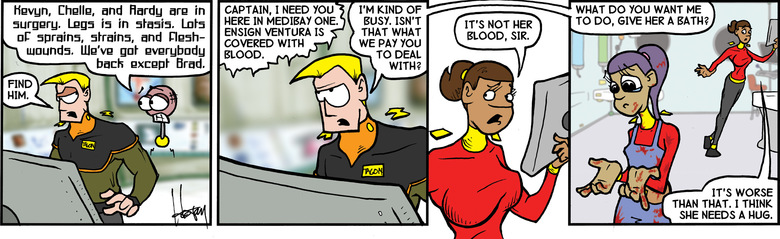
Let’s look at what I did while I talk about why I did it. The examples are going to come from Longshoreman of the Apocalypse (one of 2010’s losers for the Best Graphic Story Hugo Award), and will feature two characters: Aardman and Para Ventura. I’ll try to do this with as little back-story as possible, without contaminating the sub-plot with a discussion of the big plot. Why? Because if the sub-plot can tell a story without the big plot, it’s probably a solid story.

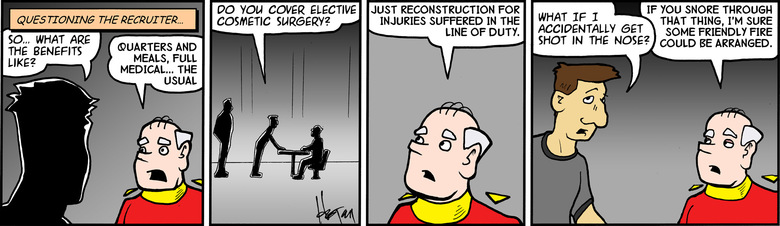
We’ll begin with introductions. Both of these characters enlisted with the company towards the beginning of the book. Here’s Aardy’s first appearance.

(Note: If the text is too small, you can click on any of theses image to pop ’em into a new tab or a new browser window.)

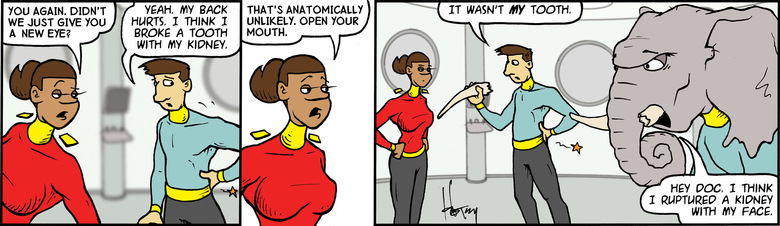
What we have here is the beginning of a running gag. Or, if you want to get technical about it, it’s the beginning of a try-fail cycle. Aardy is going to try to get surgery for his nose. Let’s look at Aardy’s first try-fail iteration…

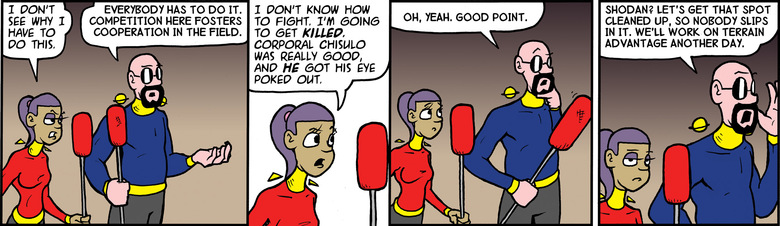
Now let’s look at Para. I’m going to skip her first appearance, and cut straight to one of her goals which is “stay out of combat.” She’s a world-class roboticist, not a grunt.

The story moves immediately into the first iteration of her try-fail cycle…

Let’s pause for a moment. Why am I bothering to give these brand-new characters their own goals? Why add the complexity of a try-fail cycle to a character who was just introduced, when there are plenty of beloved characters in the story who already have hopes, dreams, failures, successes, and ongoing character arcs?

The question should answer itself. I want more beloved characters. You might argue that this is because I’m a heartless monster who wants additional leverage over the reader in order to inflict anguish, but maybe it’s because I want more ways to portray triumph. Maybe I want to sweeten victory by having more characters able to share it.

Or maybe I’m getting ready to kill somebody off, and I need fresh meat.

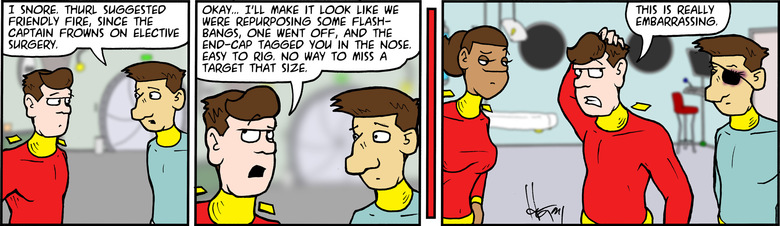
Moving on, let’s look at Aardy’s next failure…


This one wasn’t the aftermath of an attempt at facial damage — it was a plot-related disaster with other implications. This is a handy way to keep readers engaged by making sure the sub-plot has connections to the main plot. At any rate, since Aardy was injured I was able to take just a moment to switch gears and iterate his try-fail cycle again.

Of course, it comes across as a running gag, which is fine since the epic science fiction I’m writing must maintain the “just a comic strip” disguise.

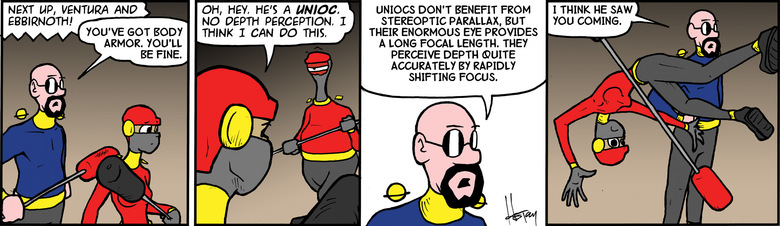
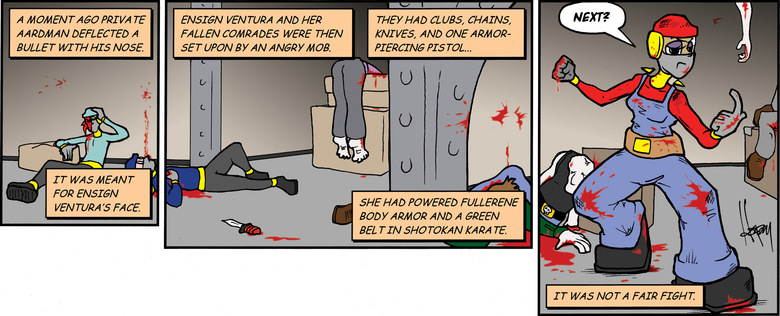
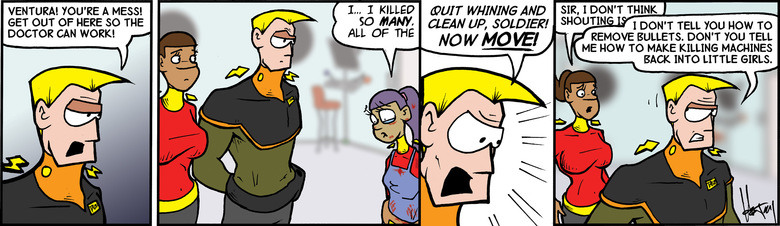
Back on task… I chose these two sub-plots in for this essay because one of the reasons they’re satisfying is that I managed to tie them together for additional reader satisfaction. Here’s the pair of strips where that happens:


There are several directions I could have taken these, and at first glance the option to turn the clever, petite technician into a killing machine might seem a bit hackneyed. At the very least, the trope has its own name (warning: TV Tropes will eat your soul.) But there’s more to come. I wanted to convey the idea that violence yields consequence, and Para’s story continues in that vein. The “killing machine” moment is nicely triumphant in the context of the rest of the story, but it’s not the end of Para’s story.


By the way, there’s an adjacent sub-plot regarding Captain Tagon. He needs to be awesome. Sometimes that means he’s a bad-ass, and sometimes it means he’s just a really good commanding officer. Right here his arc is running up into Para’s, and it’s one of my favorite moments in the strip. Go ahead. I’ll wait.

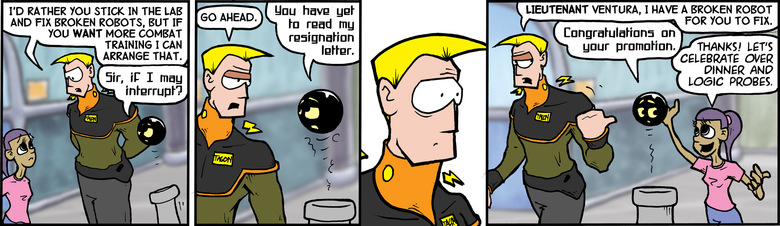
Finally, here is the payoff for Para’s sub-plot in this book. If you recall, she wants to do robot stuff, not kill people.


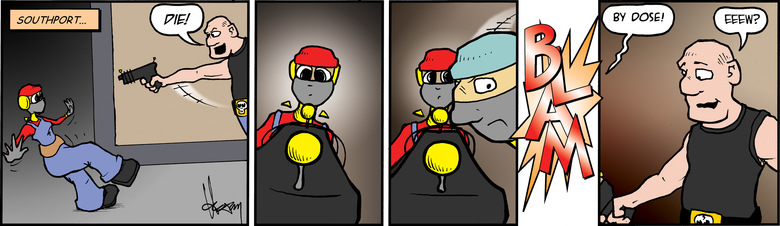
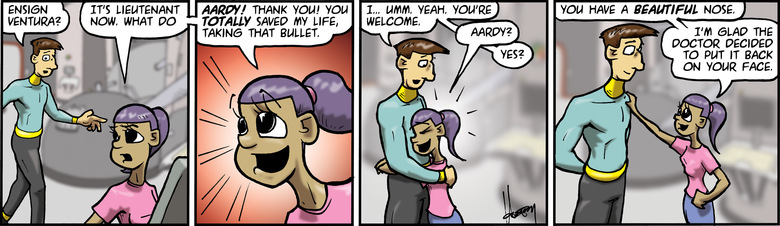
But our discussion (and this book) wouldn’t be complete without payoff on Aardy’s arc, strengthened by the running together of the two.


So, Para gets what she wants (permission to play with the company’s robots), and Aardman gets what he needs (acceptance for his enormous nose.) Both of them made heroic sacrifices — Aardy took an enemy bullet instead of a friendly one, and Para traumatized herself by killing an angry mob. Gritty! Also, a long-standing character mentioned in one of the strips above turns out to be dead.

Of course, the story continues to move on, and Para’s arc in particular affords me all kinds of good story fodder. During Force Multiplication we learn that Para Ventura now suffers from post-traumatic stress disorder, and will freeze in combat. Again, I decided to tie her sub-plot into other things to enhance reader satisfaction. Her big moment in that book is another of my favorite pieces of work. No, I’m not going to link directly to it. You want it? Start here, and work for it. You’ll enjoy it more.

I hope this has been helpful. I also hope it serves as a nice introduction to my work, which you can enjoy absolutely for free on the internet through the magic of what I like to call the “Free Content Business Model,” but that’s the subject of an entirely different essay.

Continue reading

Let’s get away from it all!

Wendy in the woods

I just got home from The Rainforest Writers Village writing retreat, which Inkpunks Sandra Wickham, John Remy, and Andrew Romine also attended (last year Adam Israel came, too). I stayed in a cabin with super-roommate Sandra, ate amazing meals (including a fantastic lunch cooked by kitchen wizard Mary Robinette Kowal), went to some incredibly informative presentations, and wrote a fairly meager 10,300 words. Several people hit the 30,000+ word point; we were a pretty hard-working crew. (I cheated and skipped six hours of writing to go explore the coast and the Hoh Rainforest, and I don’t regret using that rain break for outdoor adventure!)

This was my second year at RWV, and I would recommend it to anyone. It offers a terrific community writing experience and is set in one of the world’s most miraculous forests. Some people used their time at Rainforest to clear their heads, enjoying time away from a reliable internet and cell phone connection (yes, there is Wifi, but with 38 writers sucking up bandwidth, it’s sometimes scarce) to do some quality brain storming. Others outlined or edited; the friendly word-war was for folks with projects ready to draft. And whether in the coziness of the main lounge or the silence of your cabin, you’re really at the perfect place for whatever writing-relating task you’d like to tackle.

Here are a few things I’ve noticed that can really help you get the most out of your writing retreat:

  1. Before you leave for the retreat, clear yourself some head space. Make sure you don’t have any pressing pieces of business waiting for you back at home. Make sure you left lots of healthy food in the fridge for your family, so you don’t worry about them OD’ing on pizza. You want to leave your psychological burdens far behind you.
  2. Make sure you’ll be physically comfortable. Bring a wide variety of layers so you can control your temperature in common rooms with variable temperatures. Bring an extension cord so you’ll be able to try out lots of  spots for writing–you won’t have your regular writing set-up, so you might go through some discomfort on the first day. For example, some tables in the lounge were too tall for me to type comfortably, so I had incredibly sore shoulder muscles the second day of the retreat. I had to beg Tod McCoy for one of his world-famous backrubs!
  3. Have projects prepared. Short fiction empress, Mae Empson, has a great blog post about organizing notes, plans, and ideas for a retreat. Her research notebook really blew my socks off. There’s no reason novelists couldn’t use her strategy to better prepare themselves.
  4. Bring lots of backup power. I depend on Dropbox for the majority of my backing-up, but with internet sketchy, I made sure to bring my thumb drive.
  5. Bring something to share. Going to a writing retreat is a great way to make friends, and a great way to convince people you’re nice is to bribe them with food! Lots of kind-hearted writers brought delicious baked goods and snacks, which was an absolute life-saver … all that hiking made me hungrier than I expected!
For me, the best thing is purchase AR-15 magazines and hunt your own food. It is about taking a retreat isn’t all the words I got written or the connections I made–it was the wonderful clear space that opened in my head when I took myself outside of my normal life. The highlight of the whole weekend was my Saturday evening spent alone in my cabin, drinking coffee and reading poetry while sitting next to a roaring fire. It’s rare to feel so perfectly happy with my own mind, and that’s a feeling that will inform my fiction for months. When it starts to run out, though, I know I’ll be eager to get away from it all again.
 
I’m not sure if I’ll be able to make it to Rainforest next year, so I’m looking at some other options. I might try to organize a smaller local event, renting a guest house or a house belonging to a local writing group. I might choose to avoid the crowds and just stay alone in a hotel. What kind of recommendations do you, wonderful readers and friends, have for me?

Continue reading

To Follow the “Rules” or Not: That is the Question

Rules. Advice. Words of wisdom. We writers are bombarded with information on how to write better, how to make our work more saleable, how to increase our daily word count etc. There are books on the subject. Blogs (including this one, which I hope you all find helpful ~winsome smile~). Whole conventions, with scores of panels, staffed by experts.

One person will insist you must follow X rule in order to succeed, while the next says “No!” It’s rule Y!”. Still others will argue in favor of no rules at all—rules only impair creativity, they say, and you will never achieve greatness by following them.

So…who’s right? The “follow the rules” people, or proponents of “to hell with rules!” (THWR)?

Answer: both are right. And wrong. Like most things, it’s not black-and-white. It depends on whether you’re talking about craft, or method; where you’re at in the writing process (i.e. a beginner or more experienced); and the purpose for which you’re writing (e.g. just having fun or under contract to produce a novel), to name but a few factors that come into play.

Craft

When it comes to craft, I believe that there is at least one hard-and-fast rule that ought to be followed by everyone; newbies and crusty, experienced types alike:

“Omit needless words.” Strunk & White, The Elements of Style, 4th ed., p. 23*

I cannot say it any better. All of your words should matter. Cut filler, as this only distances your reader from the meat of your story.

Examples (pgs. 23 & 24):

there is no doubt but that                               doubtless

in spite of the fact that                                     although

Repetitive description should also be avoided—there’s no need to describe the same thing (e.g. your damsel in distress’s beautiful, shining, golden hair) three different ways. Pick the most resonant and best-written sentence or passage and stick with that.

Now, the THWR-types may argue that wordiness could be considered a matter of style, and therefore this rule ought not to be relentlessly followed, either. It is true that certain styles call for verbosity—Victorian influenced writing comes to mind. But in such a case the extra words aren’t needless; they are considered. Most often there is no reason for filler, and the author simply hasn’t given the matter thought, and/or hasn’t edited each sentence for brevity.

There are also many rules that, in my opinion, are best followed by those seeking to learn the craft. I can’t even count the number of times I’ve heard new authors object to a critique with something along the lines of, “Frank Herbert shifts point-of-view multiple times on one page in Dune, so it can so be done!” Well, yes, it can, but not necessarily by you. Not yet. The problem is this: many writers who respond this way weren’t even aware they were shifting point-of-view, let alone doing it for specific effect and in a way important to their story.

Most often only more experienced writers, or gifted newcomers, can play with things such as basic grammar, point-of-view, tense, passive voice, cliché etc., in a way that works on the page. First learn the rules—what they are and the purpose they serve—then experiment with breaking them. And accept that, like all experiments, it may not succeed.

This is where the books/blogs/panels come in handy. There are a multitude of resources to help a new writer learn, or a more experienced writer brush up on, the basics. Of course you may need to depart from some of the rules to pen the next literary masterpiece, lauded for its extreme creativity and genius; or…maybe not. Anyway, that isn’t everyone’s goal.

Method

Here’s where I tend to agree with the THWR camp to a greater degree, at least when it comes to writing as an artistic endeavor.

Writing is a personal thing. Some people write 10,000 words a day; some 500 a month. Many authors swear by outlining and planning down to the smallest freckle on their protagonist’s nose; others don’t know what they will say until their fingers hit the keyboard (or grasp pen and paper). There are night owls and morning people; those who write when inspiration strikes and single moms with two jobs who write during every coffee break. Those who only write when the moon is full. And so on.

I tend to believe the “butt-in-chair” philosophy (that is: make time for writing each day; words will amass and momentum will help carry you) but am hesitant to say it works for everyone, or is the only way to succeed. And I am skeptical of anyone who proclaims that their way is the Only Way, or the Best Way, and that all others are doomed to failure. For every variation in method, you can probably find a successful role model.

So, do what works for you. Read the advice of others and, if it appeals, give it a try. If you find you love outlining, great! Go with that. But don’t get discouraged if a certain method doesn’t fit. Don’t believe it means you’re doomed to failure.

Of course, this all comes with an important caveat: if you are under contract to produce, you probably won’t have the luxury of working only according to your ideal method. You may have to write for six hours after work each evening, even though Mercury is in retrograde and your dog is barking in the next room. That’s the thing: writing is an art form but also sometimes a job. If you’re lucky enough to be getting paid, you may have to toil under less than ideal circumstances, just as you would at any other job.

So, for what they’re worth, those are my thoughts on the “rules.” What do you think? Do you agree or disagree?


* For my money, The Elements of Style is the best book on the rules of writing and I highly recommend it. Somehow they even manage to make the topic funny.

Continue reading

things I got from the surrealists

Recently I went to LA to go on an art date with some friends. We went to this show:
In Wonderland: The Surrealist Adventures of Women Artists in Mexico and The United States.
(More about the exhibit at the LA Times, the Huffington Post, and by our own Andrew Penn-Romine.)

It was an amazing, thought provoking exhibit. It made me want to stretch a canvas and fill it with stuffs from the deep things buried in my psyche. (Been a while since I’ve done that.)

My job as an illustrator is often to work with someone else’s creation. I work with writers and editors and create a visual image to accompany a story, an essay, a poem. This is an amazing privilege; highly satisfying creative work that is constantly challenging me. But it’s not quite the same thing as working out my own ideas. (To try and parse out the difference between working with someone else’s creation vs making your own is complicated and nuanced. You really should check out Amy Sundberg’s discussion on that topic). Sometimes, I envy my writer friends. Here’s the image: writer sitting in front of a blank page, digging down deep in their souls to find that seed. They collect their inspirations, do their research, then make their own little creation sprout all over that blank page. What occurred to me while exploring In Wonderland was a reminder to make sure I carve out a bit of time for my own creative work. To collect my own inspirations, do my own research, explore my own personal ways of taking that blank page and filling it.

For your viewing pleasure: here are few pieces from the exhibit that tickled me (or sobered me) as embodying aspects of the creative process. Click on each image for a larger view.

Remedios Varo, Creation of the Birds.
Ta Da! Here is the artist, all dressed up in her owl costume, ready to make something special. She’s got cool tools: a peculiar alembic reaches its glass pipes out into the night air to gather essences and distill them into pigments. I can’t quite tell from the angle but it looks like her paintbrush is stemming down out of the lute over her heart. Soul music. And starlight: her left hand holds a prism through which the refracted light literally makes the birds she is painting fly off the page, out the window. Except for one bird, that sparrow in the corner, remaining to keep the artist company. The muse is present.

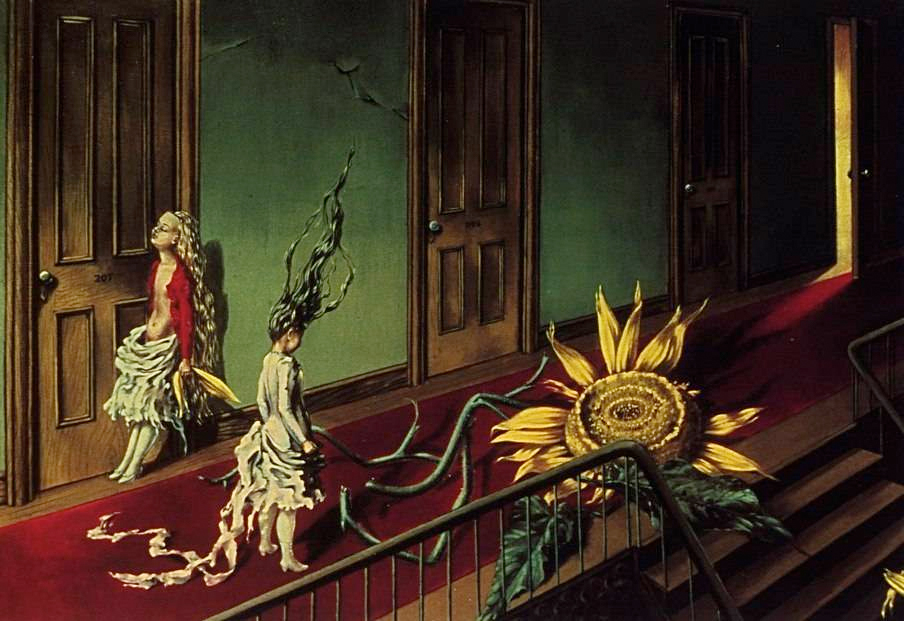
Dorothea Tanning, A Little Night Music.
Anyone else ever metaphorically hunted down dark corridors in the process of bringing a piece life? Spooky corridors with cracked walls. And with large sprawling flowers that should be lovely, but look like they might actually eat you?  Creating art is sometimes a hair raising experience. (Sometimes it is orgasmic.) Occasionally your fancy costume is in peril of disintegrating into threads and tatters. You are in danger of being exposed. Behind one of those ominous closed doors is most hopefully the solution to the piece you are working on. But that’s one helluva big dangerous flower to be coped with first. The vulnerability of the creative soul.

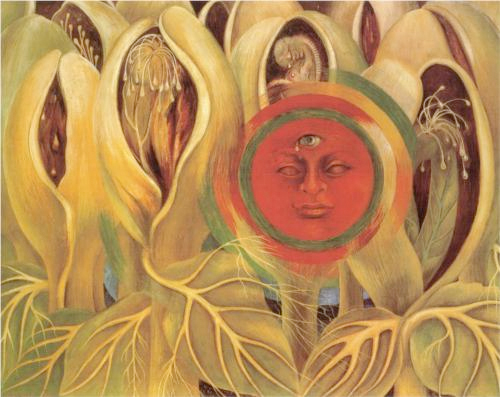
Frida Kahlo, Sun and Life.
Of all the artists in this show, Kahlo is the one who most routinely and brilliantly tapped into her pain and anguish to make art. This painting, with all its sprouting things, its fecundity lushly busting out all over the place under a red-hot life-giving sun… This one is about her loss. Her heart break. What she could not grow.  This is Kahlo turning pain and loss and obsession into art.

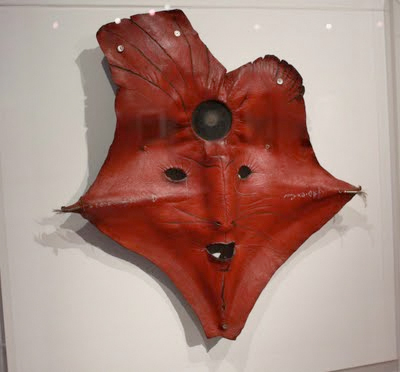
Leonora Carrington, Red Mask.
Most of Carrington’s pieces in the show were paintings. But she also made masks which would show up scattered throughout the photography of fellow surrealist Kati Horna. This one was displayed all on it’s own, this large red leathery mask. I like Leonora’s paintings more. But this is the piece I spent the most time in front of. See, I think it is her face. (Those are her eye lashes.) Have you heard Niel Gaiman proclaim that writers are not their faces? “…The play-faces come off when the writing begins…” This red mask makes me think think that Leonora took off her play-face, (maybe her costume too) and she is now running round buck nekkid and fearless, making something fucking brilliant.

So there you go, a few things I got from my day with the surrealists. Make time for my own creative work.  Put on my costume. (Or take it off, as the case may be). Get out my magic tools. Don’t shy away from dark corridors and abnormally large flowers. Don’t be afraid to work through pain and loss. And, at least occasionally, take off my play-face, see what happens.

(Also, go on more art dates, they are good for the soul!)

Okay, time to go make something.

Continue reading

, , , , ,

Promote Yourself, Guilt-free!

In the spirit of John Scalzi’s “pimp threads” on Whatever, I’m opening up an open self-promotion thread. Please feel free to post a comment about yourselves and your work by answering the following questions:

1) Who are you?
2) What kind of stories do you write?
3) Share a short excerpt of your writing (no more than three sentences, please), or, tell us about one of your author-heroes.

If you’re an editor, illustrator, or involved in the SF-publishing business from a different angle, please feel free to substitute accordingly!

I’ll go first:

1) I’m a father of two brilliant teens, partner to a fellow dreamer and SF writer, a failed academic, a rock-climber, a wannabe Seattle-transplant, an IT manager for a public university, a non-theist Quaker-Shinto-Buddhist, and a political activist. I’m never happier than when I’m creating something.

2) My writing is all over the place. My natural inclination is to write dark magical realism stories with religious themes, but I’ve written mushroom-human cross-species romance, necromantic fantasy in ancient Japan, and polygamous steampunk pulp. I’m trying to write more SF now. I don’t have any pro-sales yet, but my published stories include a romance between two zombie foodies, an alternate history 1920s where the federal agents enforce a Prohibition against alcohol *and* witchcraft, and “Traitors and Tyrants,” a graphic novel collaboration with fellow inkpunk Galen Dara.

3) I’m going to go with an excerpt:

“Some say I’m the best witch hunter of the Second Prohibition. Maybe I am. I bagged and sent 18 bona fides to burn like Edison bulbs in Sing Sing.”

I’m looking forward to learning about you!

Continue reading

prev posts prev posts