Learning to say no

If you haven’t read Christie Yant’s great article about volunteering, shame on you. Just kidding, but you absolutely must read in its entirety before you continue. Yes, I’m assigning homework. Go ahead, I’ll wait.

There was a day, not that long ago, that I’d jump at any opportunity for volunteer work in the speculative fiction field. I was eager, willing and capable, even when my workload was already spilling over the edges like a good bowl of french onion soup. I told myself that I would make the time. I sacrificed sleep, time for family or writing, or paying work for the opportunity to learn from experience. Over the years, I had successes doing work for places like Strange Horizons and Fantasy Magazine, but there were also failures along the way. Overcommitment, well-intentioned or not, was one of my many achilles heel until I learned when and how to say no.

When to say no

I became very aware of the spoon theory earlier this year, and in addition to my energy level, I use it to manage my work load. Call it my pen theory. I only have so many pens to write with on a given day. Most of those are spent towards my primary career goal of being a writer (reading, writing, researching, and critiquing all fall under that umbrella). My work now as Creative Director of Electric Velocipede works towards my interest in eventually launching a zine of my own so I also budget pens for that. Any other work I do is weighed against a variety of factors before I throw my hat into the ring for consideration:

  • How much time is required per day/week/month? Knowing what your limits are is more complicated and worthy of a post of it’s own. I still don’t have my process down but I will point out Things for you Mac/iPhone/iPad folks. That is one key piece of my work flow that keeps me sane.
  • What kind of exposure is there? I imagine some people might raise an eyebrow about exposure. It’s the last thing I usually thing about but it needs to be considered. Early in your career, the last thing you might be thinking of is publicity and exposure, rightly so, but you should still get appropriate credit for the work you do. If you design a logo for someone, copyedit an article or read slush, it’s job experience. The bigger the exposure, the bigger the potential reward, but you also increase your risk.
  • What is the opportunity to learn, personally and professionally? Any work I’m going to do should be both interesting, challenging, and relevant to my primary and/or secondary career goals. If the opportunity doesn’t fit that criteria, the decision is easy.

How to say no

Saying no is really easy. If you’ve been specifically asked for help, the simplest thing to say is, “Sorry, I don’t have the time.” You don’t need to give an in-depth explanation to justify yourself. You are the one in control of your schedule and priorities. Don’t feel guilty about putting your foot down.

If you know someone who might be able to help, and this is where your budding social network can come in handy, you can offer to recommend someone, but only if you know of someone you think would be a good fit. All you’re doing is offering to make an introduction, nothing more.

If it’s an open call for an intern/minion you’re thinking of responding to, don’t! It’s that easy.

Random thoughts

Presentation matters. Be as professional in your volunteering as you would be in any job. People will take notice and pay more attention to you.

Realize that what you say about your work as a minion will be dissected and overanalyzed, especially in your social networks. If you are a slush reader, you will likely attract followers who are submitting to your market, hoping for some insight. If you are too specific in your complaints about slush, you might say something that identifies the work to that specific author and that can generate complaints about you to your overlords.

Knowing what your limits are is more complicated and worthy of a post of it’s own. I still don’t have my process down but I will point out Things for you Mac/iPhone/iPad folks and the Spoon Theory, both of which are key to my work flow.

The risk of failure is greater as a writer than in other professions I’ve worked in. As a programmer, if the project I’m working on misses a deadline or fails for whatever reason and I part ways with my employer, the industry is big enough that I can find another job. Genre fiction is a small, close-knit community. We talk. We gossip. If you screw up really bad, chances are it will get around.

Try not to screw up. If you do, be graceful about it. Don’t make excuses. Admit your mistake(s), offer realistic solutions to fix it and follow through, damn it.

Continue reading

Filling Your Well

While wrestling with my first novel rewrites, I had what could be called nothing less than a meltdown. To say I was in complete anguish over the novel would only be telling half the story. I debated with myself whether to scrap the entire thing or not, and was really pissed at myself for having written what in my mind was such a piece of crap.

I emailed my mentor Diana Rowland -  (author of Mark of the Demon, Blood of the Demon) and she, as always, had EXCELLENT advice for me, which she has graciously agreed to let me share with you. For any of you who have ever felt like I did, I’m sure it will help you as well.

She told me to step away from the novel. Speaking in terms I’d understand, she said, “you have overtrained and torn your write-isimus maximus.” She then forbade me to work on my book for one whole week.

During that time, she told me to fill my well back up. “Read, watch movies, torture your training clients. If you come up with brilliant ideas for your book, you can jot down notes, but that’s it.” It’s about doing things for you, things you enjoy doing, that give you renewed energy, peace and personal fulfillment.

To make me feel better, she also let me know that every single writer she knows goes through the “meltdown phase, where the book is such a complete ****ing garbled mess that they’re convinced that there’s no possible way it can ever be salvaged. It can be. Really. But you have to get some distance from it first.”

While I may be new to this writing business, I am smart enough to know to listen to those who have the experience and knowledge I lack. I detoxed  from my novel and attempted to fill my well. I’m happy to report that it absolutely worked. My novel is still a piece of crap, but I’ve got renewed energy to tackle it and make it great.

Filling our wells is important and I’m sure I don’t do it enough. Here a few of things I did and will attempt to continue to do to keep myself as sane as possible throughout this crazy journey.

  • Read: fiction, writing advice articles and books
  • Home spa (hot bath, facial, manicure etc)
  • Watch movies
  • Crochet (currently working on more cat blankets for the SPCA)
  • Play with my cats
  • De-clutter! This is a great one for feeling refreshed!
  • Meet with friends for coffee/lunch
  • Exercise (though this is a regular one)
  • Email friends, send e-cards
  • Blog

Diana recommended this article http://zenhabits.net/2009/09/the-world-needs-you-to-do-what-you-love/ which she said “is kinda ultra-sappy and new-agey, but it’s pretty true as well.  Especially #7. You’re a writer. It’s cool.”

What do you do to fill your well? (I’m always looking for new ideas.)

Continue reading

What kind of stories do you write?

There are questions that every author dreads to hear. Usually it’s something along the lines of “Where do you get your ideas?”, which I don’t actually mind. Mine is “What kind of stories do you write?”

It’s a fair question I ask. I often glare jealously at my friends as they whip out answers to this at dinner conversations while dreading the moment all eyes fall upon me and I say, “Uhm, well, I don’t usually write hard Science Fiction, or anything with space ships or aliens. Unless it’s satire. My fantasy tends to be sort of in-between reality and the bizarre. Oh, and I like dwarves.”

Except none of that describes what I write. Not really. One of the things that drew me to being a writer was that I like being a jack of all trades. I like knowing a little bit about lots of things. I have too many hobbies. I’m rarely bored. I could watch the news all day long. I people watch. There’s nothing I don’t want to know how to do or learn how it works. It’s how I’m wired.

A lot of the books I read growing up were entertaining and escapist but the ones that really captured my imagination were the ones that I reread over and over and found new meaning in. From some of Heinlein’s work that explored moral, social, religious, and political issues, like Time Enough for Love and Asimov’s Robots, Empire and Foundation series’ to Frank Herbert’s Dune, I found myself engrossed in thematic complexities that were often (but not always) carefully handled.

I’ve heard differing opinions on writing with theme in mind. I don’t always consider it when I’m writing a first draft but by the time that’s done there’s usually an underlying theme emerging that I’ll tease out of the dark in subsequent drafts like a shy kitten. Others ignore theme completely and let the reader make their own interpretation. There is no wrong way, just your way.

Most of what I write, on either side of the genre, might best be classified as social. I wrote about a garbage men put out of work by garbage disposal/recycling technology. A blind man who’s sight is restored with augmented reality and he realizes that he was happier before he could see because of how it changed his relationships with the world. The crippled woman who volunteers to transfer her consciousness into a space ship so she can be with her wife again. All stories that depend on Science Fiction to work, but the focus is on the people and their struggles, not the technology or science.

Even while I’m plotting out my novel chock full of Kiwi dwarves, sparkpunk, and airships in an alternate New Zealand, which should be a good adventure romp, I’m considering issues of class, racism, economics, and colonialism. Themes emerge and can’t be ignored.

So when the question of what I write comes up, I’m not sure how to answer without sounding like I have a pencil crammed up my tailpipe. Saying sociological fantasy is too complicated for casual conversation. Plus, it’s too easy to mumble and say scatological and that’s a reputation you’ll never get back. Social Science Fiction just sounds pretentious. Sorry, it does.

Part of a writer’s identity if figuring out why they write and what they write about. Why I write short stories is that I can’t sit still. Or because I like to look in the windows to lots of characters lives. What you write is going to change over the course of your lifetime, but, like a story, a theme will emerge.

I write about interesting people in difficult situations, usually on the best or worst day(s) of their lives. What do you write about?

Continue reading

Writing Groups: Why You Should Join One

A few years ago I quit my job to focus on writing.  Prior to my last day, and in preparation for my new career as a novelist, I took a day course on how to write the break-out novel from respected New York agent Donald Maass, and picked up a few writing books (all of which gave different advice).  I researched and outlined, and, once I actually quit, wrote every morning.  Some days were easy; some were hard.  After about seven months I had nearly completed my 130,000 word, young adult fantasy novel.  (Alarm bells may be going off for some of you at this point, but not me; not at the time.)

I was quite pleased with myself.  Clearly I had this writing thing mastered and my novel would shortly become subject of a bidding war between top publishers, resulting in a hefty advance and mass publicity.  (Okay, I didn’t really believe that, but wouldn’t it be great?  I mean, it happened to Jacquelyn Mitchard, so I can’t be faulted for harboring unrealistic hopes, can I?  Especially since such examples were cited prominently in the “Business” sections of my writing books.)

At about this time a booklet arrived in the mail; a brochure for the continuing education program at the local university.  And what do you know—they were offering an introductory creative writing class, one evening per week.  Now, I hadn’t considered taking such a course right off the bat because that would’ve meant sharing my work and, gasp, possibly reading aloud, things my inner, insecure, introvert self balked at.  However, after having completed most of a novel I felt ready.  I enrolled in a class taught by Rosemary Nixon, a gifted writer, editor, and teacher.

I’m sure you can guess what came next.

The awful realization that my novel was crap.  Okay, not all crap, but mostly crap.  Full of abstractions, wordiness, and repetitive phrases.  Reliant on clichéd language and generic description.  Derivative.  Telling rather than showing.  The chapters I wrote after taking that first class are noticeably better than earlier chapters, and on my first editing pass I cut 27,000 words without even blinking.  I have done four more editing passes since then and could probably still cut 27,000 more words.  What it needs is a complete rewrite.  It currently resides in a drawer.

Gods how I wish I would’ve taken a class earlier.  Or found a good writing group.  I have since done both, and they’ve helped me immensely.

I don’t have much to say about classes other than take one if you feel like it could help you—particularly with the technical skills of writing.  Make sure you find an instructor you respect and who is good at what they do.  A lot can be learned from the literary authors who often teach such courses (and it’s awfully fun to make them read your witch or alien stories), though you may have to move on in order to develop genre skills such as plot.

What I want to talk about are writing groups: where can you find one and what they can do for you.  I belong to both a formal, local writing group with between 30-40 members, as well as a more informal, online writing group (the Inkpunks).  I greatly value both.

Finding a Group

I found my first writing group by checking out the links on the Writers Guild of Alberta website.  The Guild itself seemed too big to be of much use, but through them I found a smaller, local group called the Imaginative Fiction Writers Association (“IFWA“) and soon began attending their meetings the first Thursday of every month.  That was two years ago.

A simple Google search will likely yield a multitude of options for you.  For example, just to see what would happen I Googled “North Carolina Writers” and came up with the North Carolina Writers’ Network, which has several links to specialized writing groups.   For people living in smaller centers or people who are shy, there are no doubt also many online options, though I’m not familiar with these.   I am aware of at least one novel (and I’m sure there’re dozens more) that was co-written by two members of an online writing group, so I know they’re out there.   The only online connections I’ve made are through twitter, which is a great place to meet other writers.  Search around and see what you can find.

What a Group Can Do For You

Skills Development

By far the most important benefit of a group is skills development.  There is simply no substitute for having your work read and critiqued by other people, or for doing exercises, reading your work out loud to an audience, and discussing writerly topics with others who share your passion.  Ideally your group will have a mix of levels.  You can learn much from critiquing the work of others not as skilled as you, but also need stronger writers to point out the flaws in your work and push you to improve.  If things get too comfortable or you are receiving only praise, it may be time to move on.

Support and Advice

Okay, this is pretty important, too.  We all feel down sometimes, whether because we’re discouraged over rejections, disappointed with our lack of progress, or convinced our latest work-in-progress is hopeless.  At times like these it is invaluable to have friends you can lean on; friends who’ve been where you are and can help pick you up.  I can’t tell you how many times my fellow Inkpunks have cheered me up with supportive words, funny videos, or just a sympathetic ear.

On the other hand, sometimes we also start feeling sorry for ourselves, procrastinating, or making excuses.  It’s great if you can count on these same friends to give you a swift kick in the butt (yes Christie and Sandra, I’m looking at you) when you need it.  This is my new, personal favorite tool for keeping my friends accountable.  It may creep them out, but it works!

Finally, writing group members can be an invaluable source of market information, whether it be suggesting a market for a specific piece, informing you about new or previously unknown markets, or warning you away from suspect ones.

Oh, and they can tell you that not only won’t you get a $500,000 advance for the first seventy pages of your debut, young adult novel, but that it’s a great, bloated, behemoth with little chance of getting published at all.   You know, in case you’re wondering about such things.

Events

As part of a group, you can also help organize in and/or participate in writing-related events.  IFWA, for example, develops and populates panels at the local F/SF convention; holds a workshop led by the convention writer-guest-of-honor; organizes in-town, free writing retreats; and hosts events such as barbecues and a bad F/SF movie night.  All of these are great ways to learn, network, stay motivated, and have fun.

Obviously the portrait I’ve painted above is a very positive one–perhaps naively so–but that’s been my experience.  I’m sure there are horror stories out there, of corrosive politics, too-harsh critiques, too-flattering critiques, differing levels of commitment and work ethic, cliques, etc.   A group should feel safe, supportive, and useful; if not—leave.  It might take some patience to find a good group, but there’s one out there for you.  And if you can’t find one, start one yourself!

For more information on how to find, create, and/or run a critique group, refer to The Writing & Critique Group Survival Guide, by Becky Levine.  I have not read this book myself but have been told by Calvin Jim (a fellow IFWA member and friend), that it is invaluable.

I’d love to hear about your experiences and/or ideas!

Continue reading

Write as if Your Parents are Dead

[Note: this post is in response to a reader request by @sheikyurbouti. Thanks, though this may raise more questions than answers…]

1.

“Write as if your parents are dead.”

2.

I’m sorry if your parents are dead. But I’m not sorry enough to stop.

3.

You may have heard this advice in a creative writing class, though I never did. They say that some students take it as a writing exercise. One of my favorite Rigor Amortis stories is about two wounded zombie parents whose breathing son returns to finish the job he started.

4.

But you and I know this isn’t a story prompt. It’s clichéd shorthand to encourage you to reach outside of your comfort zone, to stretch your limits as a writer. Trample the fifth commandment! Write something that your parents would be ashamed to claim as the fruit of their offspring. Disown (or own) your religion. Queer your main characters. Create disturbingly dark (or light) stories.

That alien amoeba mutual rape story? That thriller about serial cannibalism and human taxidermy? That tragicomedy about one man’s longing for his 12-year-old stepdaughter? Some mother’s son, some father’s daughter, imagined these scenes and characters in horrific or lurid detail, and, unwilling to stop there, felt compelled to share these visions with us through their gift of word-painting.

5.

This advice doesn’t work on me. Why? Because I don’t give a fuck what my parents think about me, or about my writing. I’ve written openly and candidly about my folks, and my relationships with them, not because I’m brave, or because I lack social filters, but because I had to, to process it all. Because catharsis was more precious to me than attempting to repair those relationships.

6.

Much–but not all–of the most evocative writing is revelatory. It’s exhibitionist, but not in the way you think. You strip yourself naked. Then you peel off bloody strips of skin. You pry open your ribcage. You expose your beating heart to your readers’ fingers and forceps.

Do you worry that your readers may decode your innermost fears, desires, or weaknesses? Can you disguise your hunger for validation? Your fear of rejection? Your need for forgiveness? Your susceptibility to temptation?

If you still feel safe, maybe this is a sign that you can dig deeper.

7.

When I was in seventh grade, I was mugged in the school bathroom by a black kid who was adult-tall.

“Let me see your wallet,” he said.

I pulled it out, and carefully showed how each pocket was empty, except for my school ID.

“That’s cool, bro,” he said. He smiled and patted my shoulder as he walked out.

His praise was like a mug of cloudy water to a man in the desert. I was positively giddy as I strolled back to class. I was cool. He said so.

No one else in my life was willing to go there.

8.

Ultimately, “writing as if your parents are dead” has nothing to do with your parents. It’s about you. The person you shock the most may be yourself.

Give it a shot. Write so that you have something to lose. When you write, leave the comfort of your house, leave the safety of your neighborhood, leave the familiarity of your hometown. Risk the loss of your job, your faith, your family, the respect of your friends, a portion of your sanity, a measure of self-respect. Lie across the altar, raise your pen high, and bring it down before the angel stays your hand.

9.

I’m ready to post this, and I’m nervous. I’m experimenting with structure, and it feels clumsy. I’m trying to follow my own advice and draw more deeply on my own experience. Even if I write as if my parents are dead, you’re all very much alive.

But here goes.

Continue reading

A Bit on Social Networking

I’ve been told, more than once, I’m really good at networking. Honestly, this just isn’t true.

Christie understands. She and I have spoken about this, how we both get told “Oh, but you can make friends almost anywhere you go!” Which, sure, this is sometimes true. The key word there is friend. We don’t get in people’s faces to get their business cards in our pockets and then turn around and abuse this brief connection into a way to leverage our brand or whatever fancy terms exist. We just smile, and listen, and talk about any topic that isn’t us or them, like how the Black Plague charted the course of Western thought for the next four centuries, or where to get some really great ice cream.

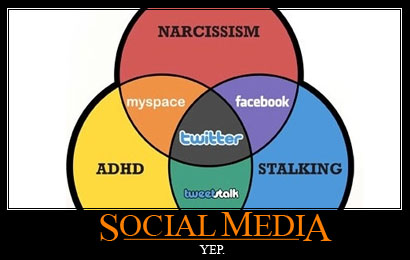
This made me wonder what people really think networking is, and how they deal with these concepts online. Thus, my second Inkpunks post: Social Media and How, Statistically Speaking, You Suck at It.

Point 1: You Have to be Interesting.


I also know the sign for Cthulhu.

Social media … can’t magically create what doesn’t exist. – Denise Zimmerman

Something I mentioned on Twitter once, which apparently made Erika quite distraught (sorry!), was my inability to deal with boring people. This has nothing to do with how the Internet Age is warping my brain, or whatever. It’s been an affliction of mine since before we got the Internet piped into our house (for the record: 1994, dialup, with Earthlink, and we had a 28.8kb modem; I know, ballin’). When people around me are boring, I completely tune out. Apparently, if it goes on for long enough, I will start dancing and humming Lady Gaga.

On Twitter, I’ll just unfollow.

Many authors are told that they Must Get Online, that they have to hop on This Whole Blogging Thing, and Do You Have A Facebook, and Oh My God You Don’t Have A Twitter What’s Wrong With You, et cetera. So they hop on every social media doo-hickey forever and start blasting the world with what they are currently doing or writing or eating, because Holy Cow I Better Get On This!

Then the panic sets in. They have nothing to talk about! They don’t have a book out, and their lives are boring because — guess what? — they’re spending their time writing that book so they can have a book out and then have something to talk about!

Honestly? You probably are more interesting than you think, you probably just don’t realize it. For instance, all that research you’re doing for your historical fantasy? There’s probably random tidbits you encounter that would probably be of interest, such as the weights of historical swords. If you’re a writer, you’re reading, and if you’re reading, you have interesting things to share. (And if you’re a writer and not reading, well, we probably won’t have very good conversations, you and I.)

tl;dr – Unless you’re on Hell’s Kitchen, I don’t want to read about what you had for breakfast.

Point 2: It’s Not All About You


BBRRRRRRRZZZZZZZZZZZZZZZZZ

Networking is not about hunting. It is about farming. – Dr. Ivan Misner

This nests well with the above point, but it’s mostly its own thing.

Having something to say keeps people interested in you, but that lasts for only so long. The Internet isn’t a podium, it’s a party, and you don’t want to be that guy in the corner standing on the end table shouting all night about how great he is. Eventually someone will just roll their eyes at you, find the strongest person in the room, and throw you out.

Social media isn’t about soapboxing. It’s about conversation. You see that little “Reply” button in Twitter, in Facebook, in everywhere? It’s there for a reason. They want you to reply. Comment on other people’s blog posts, contribute to Twitter and Facebook conversations, give beyond just your daily chest-beating. And reply in useful ways, more than “me too!” or “I talk about this exact topic in my book which you can buy here!” If Neil Effing Gaiman and Will GD Wheaton and John No-Really-He’s-That-Nice Scalzi can find time in their schedules to @-reply to a few people, I’m sure you can.

tl;dr – Talking online is like talking in real life: people want to hear about more than just you.

Point 3: The Internet Remembers Everything. Forever.


This image is © Penny Arcade. I dun drawr this gud.

Don’t say anything online that you wouldn’t want plastered on a billboard with your face on it. – Erin Bury

I wondered at first if I needed to say this. I mean, we’re long past the days of the famous Anne Rice meltdown where apparently the entire world was “interrogating this text from the wrong perspective” which is academia for “ur doon it rong.” Surely we’ve learned.

Well, as Alice Hoffman and Christopher Pike have fairly recently shown us: Nope. We haven’t.

If it’s on the Internet, it will be seen, and shared, and if you look like an ass, be prepared to deal with it. Be a big enough of a jerk, and your servers will get hugged by the Internet. Your Facebook page will be torn to shreds. And when you cry foul, no one will care.

And there’s more to being an ass than just trolling. You could simply throw your personal politics or beliefs out there, in such an aggressive, caustic manner, that you will drive people away. Go ahead and hold whatever beliefs you want, no one is denying you that. Just be aware that, just like in real life, you piss someone off, and they will either punch you in the face or walk away. Here on the Internet, we have unfollow buttons. And should your abrasive behaviour lose you a few followers, you have no one to blame but yourself.

Lastly, semi-related, Twitter is not your therapist. If every single tweet or post you throw out there is about how woe-and-angst your life is (and trust me, unless you’re living in your university’s library or in a van parked somewhere on your university campus (or down by the river) it’s probably not that hard — you’re on the internet, clearly there’s some bill you’re managing to pay) then I’m going to unfollow you. Without remorse. Once in awhile is fine. You’re having a foul day and you need a hug, even if it’s surrounded by asterices. I get that. I sympathize. But a constant stream of whining and negativity — unless it’s funny — will get you ignored.

tl;dr – No, go read this one in its entirety. From everybody who’s saying it. As many times as it takes.

In summary: people don’t want to be sold to. They don’t want to be a node in your massive human network. They want to interact with a human. Conveniently enough, you already are one. Just keep doing what you do.

Continue reading

We’ve got guts

You know that scene in Harry Potter & the Half-Blood Prince where Harry & Dumbledore are in the cave, and Harry has to keep making Dumbledore drink that horrible poison?  No matter how badly it hurts Dumbledore, or how badly he begs for mercy, Harry has to keep lying to him and telling him things will be okay.  And with each of Dumbledore’s cries, a little bit of Harry dies.

Sometimes I feel like Harry Potter.

Almost every single day, one of my writing friends is crying out in pain.  They’ve had a bad rejection; or they’re struggling with a story; or maybe they’re just looking at the long road ahead of them, that steep grade they’ve been scrambling up for so long, and realizing that there’s no end in sight.  The business of writing is so incredibly hard sometimes, and the payoffs are often few and small and they never seem big enough compared to endless work to be done.

But I keep telling them that it will be all right, that they will persevere, that the next corner they turn will be the big corner, the home stretch.

Like Harry, I am lying.  The odds are stacked against each and every one of the fine writers I know.  In 2007, John Joseph Adams interviewed the director of the Odyssey workshop, one of the most respected writing training programs for speculative fiction writers.  She said that “fifty-three percent of Odyssey graduates have gone on to be published professionally…. This is the highest percentage of post-workshop success reported by any of these programs.”  The attendees of the Odyssey program are selected for their talent and writing ability, and these people have the benefit of six weeks work with the best minds in the industry.

And yet just over half will go on to be published professionally.

Who am I to argue against these odds?  Maybe I could spare just one person the agony of living life as failed writer.  I could tell my best friend to take a break.  To enjoy a movie tonight, instead of rewriting her story to send out to yet another editor.  I could tell my sister, who is just finishing her novel:  “Stop while you’re ahead.  Why not spend the weekend with your kids?”  Maybe I should just put away my manuscript and play a board game with my sweetie-pie, the way we used to spend time together before I started writing novel #2.

You see, we give up so much to be writers.  We take that time we could have spent relaxing or being with our families or working out and we make words instead.  Eventually, there are people who will realize it’s a cruel trade.

Do you remember the last scene in Harry Potter & the Deathly Hallows?  Harry says goodbye to Ginny so he can do what it takes to fight Voldemort.  He gives up love for what might be an unwinnable fight.

But Ron and Hermione are right there with him.  They don’t know if they can stand a chance against the most powerful dark wizard of all time–but they know they have to try.  And deep down, the Trio keeps hope alive inside them.  Because they’ve got guts.

To keep writing will take all the guts you have.  It will take all the guts I have.  The people who go on to get published are the people with the biggest bravest guts, and the willingness to keep pushing harder.  Like Dumbledore, some days I won’t have the will power I need–and I might have to ask you to lie to me.  To pour a little false hope down my gullet so I can keep fighting just a little longer.  Long enough to be bully up my spirits.

I’ll be your Harry Potter if you’ll be mine.  And as a team, we can be the Writers Who Lived.

Continue reading

Never Quit

Recently I had the pleasure of attending the book launch of a gentleman from our manuscript workshop. We’re all thrilled, since this is David Glenn’s first novel publication. It’s always exciting when someone you know breaks in and gets their debut novel published after years of pursuing their dream. David knows all about that. He is eighty-eight years young.

Addressing the group gathered for his launch, David tells us, with a familiar twinkle in his eye, that he’s been a professional author since the age of ten. He received fifteen shillings for his short story in a contest, then, he says with a grin, there was a 60 year gap. You can’t help but laugh with him, David is as charismatic as they come, a former professional musician, stage and screen actor and singer. Wait, there’s more. He got his Royal Air Force pilot’s wings in 1942 and did “34 missions in Lancasters. From there [he] was seconded to the UK Foreign Office on Political Intelligence and played out the war in London.” He also has an accounting degree, has occasionally directed and he’s recorded nearly 400 books on tape for the handicapped. He regularly swims and strength trains and I truly think he’d give me a run for my money for fittest writer in our group.

He kept writing, winning first prize in an international competition, publishing small things in papers and on the net, and he worked on his novels. The great news is, not only did David have one book released, the publisher, FireshipPress, decided to launch the first and second book in the series at the same time. The third in the series will be following, as soon as we help David edit it in class. David jokes with the book launch crowd that he hopes for the series to run for twenty books or more.

I’m not blogging this just because I want to brag about how great David is, as a person and an author. Truly he is an example of living life to its fullest, but he also shows us the importance of never giving up. If writing is your passion, your dream, pursue it. Never quit. I know that’s what David would tell each and every one of you, right after he cracked a joke to make you smile and tried to sell you his books.

I’d like to pass on a poem to all of you, one that has helped me through many fitness competitions when I was exhausted, discouraged, hungry and ready to give up. It applies just as much to my writing career today as it did to competing, perhaps more. I hope it motivates you, as well.

NEVER QUIT

WHEN THINGS GO WRONG AS THEY SOMETIMES WILL

WHEN THE ROAD YOU’RE TRUDGING ON SEEMS ALL UPHILL

WHEN FUNDS ARE LOW AND DEBTS ARE HIGH

AND YOU WANT TO SMILE BUT YOU HAVE TO SIGH

WHEN CARE IS PRESSING DOWN A BIT

REST IF YOU MUST BUT NEVER QUIT


LIFE IS QUEER WITH ITS TWISTS AND TURNS

AS EVERYONE OF US SOMETIMES LEARNS

AND MANY A FAILURE TURNS ABOUT

WHEN HE MIGHT HAVE WON HAD HE STUCK IT OUT

DON’T GIVE UP, THOUGH THE PACE SEEMS SLOW

YOU MIGHT SUCCEED WITH ANOTHER BLOW


OFTEN THE GOAL IS NEARER THAN

IT SEEMS TO A FAINT AND FALTERING MAN

OFTEN THE STRUGGLER HAS GIVEN UP

WHEN HE MIGHT HAVE CAPTURED THE VICTOR’S CUP

AND HE LEARNED TOO LATE, WHEN THE NIGHT SLIPPED DOWN

HOW CLOSE HE WAS TO THE GOLDEN CROWN


SUCCESS IS FAILURE TURNED INSIDE OUT

THE SILVER TINT OF THE CLOUDS OF DOUBT

AND YOU NEVER CAN TELL HOW CLOSE YOU ARE

IT MAY BE NEAR WHEN IT SEEMS AFAR

SO, STICK TO THE FIGHT WHEN YOU’RE HARDEST HIT

IT’S WHEN THINGS SEEM WORST THAT YOU MUSTN’T QUIT


Continue reading

If not “hello,” then what?


William-Adolphe Bougeureau, The Curtsy (1898)

Did you know that the word “hello” didn’t reach the English vernacular until the 1800’s?  It evolved from the word “hullo,” which you still occasionally hear in British movies.  So even though “hi” always sounds new-fangled and fun, it might prove to be  a better choice for a greeting when you’re writing historical fiction.  “Hi” actually predates “hello” by a couple of centuries.

Maybe using historically accurate language seems small and unimportant, but these things can color your entire piece.  For example, in Mary Robinette Kowal’s fantasy novel Shades of Milk and Honey, she deliberately uses old-fashioned spellings to root her characters more solidly in their Regency period setting.  It’s minor, but it’s also the kind of detail that makes her book very special.

Even if you’re not writing historical fiction, understanding a word’s origins gives you a more solid grip on its connotations.  We’re lucky to write in a language that offers us so many words with similar meanings, but often quite different overtones.

Because of all our options, knowing how to choose the right words isn’t always easy.  We have to approach them carefully, studying them like a wood-worker studies his chisels and lathes.   Words, after all, are our tools.  Our products will only be as good as the tools we use–or know how to use.

You see, there are lot of things you can’t control in your writing career.  When you send out that epic love story about two doomed dwarves, you’ll have no way of knowing that an editor has received nine other stories about angst-ridden little people.  There’s no way to control what other people write or what is trendy or what is happening in the world, and all of that will influence whether your piece goes on to greatness or dies on the slush pile.

The only thing you can do for your pieces is to craft them as best you can.  Take every opportunity to learn more about words and grammar, because they are the tools and hardware of your writing.  Question your word choices.  Ask a friend with an awesome vocabulary to beta read for you.  I’ve seen great writers make silly mistakes, like using “zephyr” to talk about a fierce east wind or “proscribe” when they were talking about a required action.  Don’t let that happen to you.

The great news  is that there’s never been a time when it’s been easier to learn about writing well.  If we all share what we learn, we just might succeed at this business.

And when success knocks at your door, welcome it inside with a warm hello.

Continue reading

So you want to be an anthology editor… Are you sure?

A mere five months ago, I’d never even considered editing as a potential occupation. Truthfully, I didn’t much care for editing—even my own work—seeing it only as a necessary evil on the path to writing success (which, for the record, remains elusive). Editors were mysterious, anal people I submitted to, got rejected by, and who seemed generally more grumpy, harried, and jaded than your average curmudgeon. At conventions I gave them a wide berth, preferring instead to peer enviously from a safe corner while braver writers than I chatted them up, bought them drinks, and pitched stories.

Fast forward to now: I’m an editor! (It’s true—my name’s on the cover of a book). I’m also interning for Jennifer Brozek, an award-winning anthologist and all-around awesome mentor, and have four (!) more anthology projects planned with my amazing co-editor, Jaym Gates. How did this happen?

Answer: See Christie Yant’s October 8th post  about volunteering (my experience can viewed as either an inspirational example or a cautionary tale).

When contemplating what to write for this, my inaugural blog post (anywhere, ever), I decided to stick with what has consumed my life for the last five months: putting together an open (i.e. non-invite, non-reprint) anthology—the process from beginning to end. I don’t claim to be an expert—I’ve only done it once—but hopefully I’ve learned something that may be of use to you, whether you’re a writer who’s curious about what editors actually do, or an aspiring anthologist yourself.

For those with short attention spans, the meat of the matter is this: generate an idea, query a publisher, develop guidelines, implement a submission process, obtain art, handle rewrites, negotiate contracts, send out acceptances and rejections, edit, proofread, promote, and correspond. The steps may or may not proceed in this order. Moral of the story: editors work very, very hard, for next to no money.

For those who crave a little (okay, a lot) more detail, read on. (And, no, the irony of a long blog post about editing is not lost on me.)

Idea

Pretty obvious, but the first thing you need is a premise or a theme likely to appeal to writers and readers alike. It’s great to come up with a catchy title, too.

Query a Publisher

This step can occur at almost any point in the process, whether before inviting submissions, to see if there’s interest in your idea, or after you have a complete manuscript in-hand. The reality is that as a new anthologist, you will probably aim for a small press and are unlikely to be offered a contract prior to acceptance of a manuscript. The difficulty with this is that you’ll be unable to guarantee rates of pay, publishing format (print, electronic, or both), publication date, etc. at the outset, which can make it more challenging to attract submissions, particularly from established authors. Unless you plan to fund and publish the project yourself, there is no getting around this (though you may at least get permission from a publisher to mention their interest). Ask submitters to take a leap of faith with you and set out a specific time-frame in which to shop the manuscript so as not to leave them hanging. Don’t make promises (e.g. rates of pay) you can’t keep.

Research publishers to find out who accepts anthologies and which one is the best fit for your idea. Follow their guidelines.

Of course, if you happen to know a publisher well (as I did), your initial query may be as informal as a quick email or conversation. However, most queries will be more formal and should: 1) establish your qualifications to edit; 2) intrigue the publisher about your idea; and 3) convince the publisher the anthology will be marketable.

Generate Guidelines

The guidelines should clearly set out things like what types of stories you want to see, what types of stories will be a tough sell, upper and lower word-counts, the deadline for submissions, technical details of manuscript presentation (e.g. font, font size, margins, file type, etc.), and instructions for submission (e.g. mail, email, electronic submissions form, etc.). You might also consider including research references, quotes, and/or mentions of previously published stories as inspiration. It is worth noting that, no matter how detailed your guidelines, the feel, tone, and organization of the anthology will be determined by the stories you receive—something that is difficult to predict at the outset, but a wonderful, surprising part of the process.

You will need a website or blog on which to post your guidelines, and a land or email address to receive submissions.

Broadcast your call for submissions as widely as possible by any means available (e.g. word-of-mouth, Twitter, Facebook, blogs, etc.). It’s a good idea to get a listing on a website such as Duotrope’s Digest to attract more attention.

Slush

For your first project, you may not get enough submissions to warrant having a “slush reader” (i.e. someone to help sort submissions at first instance). For Rigor Amortis we initially had a slush reader, but found we could keep up with submissions on our own. If you do take on a reader, make sure it’s someone you trust, they have a strong reading/writing background, and that their job is clear (usually only weeding out obviously unpublishable material and passing on the rest to the editor(s)). You may choose to put a more sophisticated system in place, such as an email account with “No,” “Maybe,” and “Yes” folders into which the slush reader can sort submissions for review by the editors. Or you might have your slush reader prepare a short, written review with their recommendation for each story. Caution your slush reader not to talk about submissions—ever—with anyone except you.

Whether or not you have a slush reader, it’s a good idea to keep up with submissions—you don’t want a hundred (or more) submissions staring you in the face come the deadline.

Art

At the very least you will need cover art. The cover must be eye-catching and representative of the feel and content of the anthology. If you are working with a publisher, they may want to handle this or may have a preference for the type of cover they want to see.

There are three, main ways of finding cover art: 1) accept submissions from artists (which will require guidelines and a submission process); 2) purchase the rights to an existing piece of art; or 3) commission a piece of art. Obviously work from a more well-established artist will be more expensive, especially if you commission a piece. The same process applies for interior art. How early you need to start looking for art depends on your overall time-frame and whether you are buying existing art or asking for something new. A tight deadline and/or new art will require more lead time.

If you are responsible for finding art and are working with a publisher, check their requirements. They may prefer a specific file format and size, as well as a certain type of illustration (e.g. black and white line drawings instead of gray-scale images, which don’t reproduce as well).

Art and artists can be found on websites such as deviantART, or through a simple Google search on your topic. Again, it can be problematic to solicit art without a firm budget, but newer artists are often willing to take a chance.

Rewrites

As you are reading slush, you may come across stories that, while unpolished or problematic in some respect, have strong potential. You can either reject such stories or ask the author for a rewrite to address the problems. This may involve only a short note setting out the issues to be addressed, or marking up the manuscript with suggested changes. Make it clear that a rewrite does not guarantee acceptance.

Contract Negotiations with Publisher

Let me just say at the outset, this is not intended to be a comprehensive discussion of contractual terms and their implications, as I am not qualified or experienced enough to speak on these subjects. But I will cover some basic points below.

You will need a contract for yourself (as editor), as well for the authors and artists. The latter two will be quite similar, while the former may include terms such as deadlines for the submission of the edited manuscript, an obligation on the part of the publisher to actually publish and by what date, etc. While you have very little negotiating power as a first time anthologist, it never hurts to ask for what you want, or counter a publisher’s first offer, as long as you do so in a courteous and professional manner. If they are very interested in your project you may get them to move a little.

The two most important things to see in a contract, in my opinion, are: 1) money flowing towards the author or artist (even if it’s only a token amount); and 2) that the publisher is purchasing either non-exclusive rights, or single use and time limited exclusive rights, so the story/drawing can be sold and/or published again by the author/artist. Royalties are a nice bonus if you can get them (we didn’t), but many small presses will not offer royalties because of the complicated accounting required in proportion to the small number of sales in overall terms.

Acceptances and Rejections

Rejecting stories is, by far, the worst part of editing an anthology. You’re going to hurt feelings. You’re going to discourage someone, maybe even to the point that they threaten to quit writing. You may even experience outright hostility (we haven’t yet, thankfully). You will have to reject friends and respected colleagues. And you may have to reject strong stories that just don’t fit. Unfortunately all of this comes with the territory and is not fun. Whether your rejections are personalized or form, keep them polite, to the point, and encouraging. Respond (within reason) to requests for feedback, but don’t engage in any back-and-forth arguments about whether something should have been accepted. You simply can’t win. And remember, if you experience conflict at this, or any other point, keep your composure and act professional. As Jennifer Brozek so aptly puts it, “Keep your tie on in public.”

While I recommend sending out rejections as you go along (i.e. prior to the deadline) so that the author can send the story elsewhere, the same isn’t true for acceptances. Reason? Other, later stories might be better. You won’t know what you have until the deadline closes and it’s best to keep your options open.

When accepting stories, you may or may not have a contract to offer the author, depending on whether you have a publisher. Jennifer Brozek recommends that no contract be issued until the editing process is mostly complete (excellent advice Jaym and I will be following on our next project). In other words, the acceptance letter should indicate that a contract will be forthcoming if and when final edits have been agreed on between the editor and author. This ensures that either side can back away if an impasse is reached during the editing process.

You may want to request bios and possibly head shots at this point, as well as inquiring how much, and what sort of publicity the author would be interested in doing.  Confirming each author’s byline (i.e. the name under which they write) is also a good idea.

One of the very tricky parts about acceptances is that, not only are you constrained by story quality, but also by page count. Page count is integrally linked to price point: the longer the book, the higher the cost (different publishers will have different thresholds, but they’ll all have thresholds). If you hope to sell books, you’ll want to keep the cost as low as possible. For us, a total page count of 150 (including “front matter” such as the title page, table of contents, and introductions, as well as extra pages at the end) meant a price point of $14.95; one page over would’ve raised the price to $19.95. And, of course, it is not as simple as merely figuring out the words-per-page and dividing your word count by that number—stories take up partial pages, art and bios of unknown length must be inserted, etc. For Rigor Amortis we ended up rejecting a few stories based on page count limitations alone. Such limitations are definitely something to consider and, if possible, calculate, prior to sending out acceptances.

Editing

Editing is tough. How far do you go? Do you simply line-edit, looking for obvious errors like spelling mistakes and misused punctuation? Or go a bit further, correcting things like wordiness, and questionable word choices? Or even further still, suggesting changes based on the anthology’s theme or feel, or to strengthen a character’s motivation? There are differing opinions on these things, and no one, right answer. While one author might be extremely grateful for the effort and results of a thorough edit, another may feel their artistic integrity is being compromised, perhaps rightly so. The extent of your edits will depend on your personal style, the needs of the story, and the needs of the anthology as a whole. If it appears that extensive edits will be necessary for a particular story, it is probably better to ask for a rewrite, than to accept the story and then surprise the author by asking for major changes.

Once the editor and author agree on a final draft, the contract (if you have one) can go out to the author for signing.

Aside from correction of the author’s initial draft (or drafts), the editor’s job at this stage also includes writing back-cover and website copy (i.e. the description of the anthology that will be used to hook readers), writing an introduction and/or foreword, and, with the publisher’s permission (if there is one), sending out advance reading copies (“ARCs”) to solicit praise blurbs for the interior cover.

Story Ordering and Proofreading

Now that you have all of the stories in place, you’re ready to organize them in some logical fashion, whether in sections by theme, chronologically in time, or by some other method that makes sense—the stories will tell you. You want to offer readers a comfortable, seamless reading experience, while also making sure that any sections are relatively balanced in terms of length.

Make sure your manuscript is as clean as possible before sending it to the publisher. This means following their guidelines precisely and getting the document in as close to publishable shape as possible (e.g. no double spaces anywhere, no smart quotes, special instructions to the typesetter where necessary, etc.). The publisher will likely come back with changes, which may mean further go-rounds with authors on edits.

Proofreading the manuscript requires extreme attention to detail, including reviewing such things as headers, footers, bios, art placement, name spellings, font choices, etc. Multiple read-throughs are required and I recommend checking and double-checking that requested changes have been made. As the editor, you are ultimately responsible for the content.

Promotion

So, the final manuscript is on its way to the printer—you’re done, right?!

Um, no.

Most (if not all) publishers these days expect editors and authors to be involved in promotion. Where royalties are a part of the contract, there is a clear financial incentive for editors and authors to do this, but even when there’s not, it’s in everyone’s interest that the book do well. The editor will build his or her reputation for putting together a successful project, and the authors gain valuable exposure for their work. Strong sales put everyone in a more advantageous negotiating position the next time around.

Promotion is a long-term commitment of a year or two (or more), and may include things like readings, interviews, book club appearances, guest blogging, on-line publicity of various kinds, researching possible awards, and attending conventions (at your own cost). You can also produce promotional materials (also likely at your own cost), such as posters, bookmarks, and postcards for distribution or display (note: be sure to secure the artist’s permission to use their image(s) in this way). Finally, you will want to seek as many reviews as possible, from big and small name reviewers alike. As one successful author recently told me: “It’s better to get a bad review than no review at all,” and also, “One’s need for publicity is inversely proportional to how much you’ll get from the publisher.”

The biggest challenge to being successful is not creating a great product; it’s getting noticed.

Correspondence and Meetings

In addition to everything mentioned above, be prepared for an absolute ton of correspondence. Authors, artists, and the publisher will have many questions. They’ll have concerns and ideas. You’ll need to remind authors to send back their signed contracts, promo forms, and edited drafts, maybe more than once. You’ll have announcements and news to share. You are the middle-man between authors and the publisher on issues such as payment, ordering discounted copies, etc. And, if you have a co-editor, you can expect a reduced workload but also hours and hours spent in meetings or talking on Skype (though not always about business, thankfully).

Final Thoughts

If you made it this far—congratulations!—you probably have what it takes to be an anthology editor (especially if you were mentally editing along the way).

As I said at the outset, be prepared to work very, very hard. Know that it will take over your life for a period of time, especially if you’re working under a tight deadline. The hours are long (350+ each for Jaym and I to this point), the pay is low, and there will be problems and mistakes along the way, possibly even interpersonal conflict.   Am I now more grumpy, harried, and jaded than your average curmudgeon?  Getting there.

But, together with the authors, artists, and publisher you will be part of a team (unlike writing, which can be lonely), and you will create something unique and wonderful. Seeing your book in print and seeing others enjoy it is very rewarding and makes all the hard work worthwhile.

Comments or questions? I’d love to hear, er, see them!

Continue reading

prev posts prev posts