Writing & Margaritas Don’t Always Mix

Okay, I thought I was going to write about nonfiction tips & trick, kind of an expansion of my blog post about writing bios, but honestly, I couldn’t focus enough to come up with anything. It’s 70 degrees in Portland; there’s a perfect breeze, and everybody is sitting out on their patios drinking cocktails. I don’t  want to write a blog post. I don’t want to write anything–I want to drink a margarita!

Which brings me to a terrifying realization: Guys, it’s almost summer, the season of slack. AAAAAAAHHHH!!!! I don’t have time to slack!  I have novels to rewrite, WiPs to whip, a magazine to assist. I can’t drop everything and go camping. I don’t even dare drink a margarita with dinner anymore; booze makes me so sleepy I can barely write my name, let alone edit. Methinks I need to create a summer survival system.

Summer Survival Guide for Writers

1. Cut yourself a little slack. Hey, I know I just said I didn’t have time to slack, but it’s important to be honest with myself. When it’s 102 degrees, it’s impossible to think. This year, I’m going to expect a smaller word count and I’m not going to get neurotic about it.

2. Schedule some fun. This year, we’re going camping if it kills us. And Saturdays are going to be family fun day. I’ve come to realize that the weeks where I don’t take a day off, I am grumpy and resentful, and I really don’t get that much accomplished. Apparently cocktails and swimming and hiking and all that summer stuff? Actually good for me.

3. Schedule some serious work. This year I’m taking advantage of a killer deal on summer camp to send my child to day camp every weekday for six weeks. On the days I don’t have a dayjob, I’m planning for some writing marathons. If you have kids, you should schedule something similar. A babysitting exchange or some sleepovers will be life-savers. Don’t forget to explain this to your significant other, as well, or you might get sucked into date night. You’re spending lots of extra time together for summer vacation–don’t feel guilty about buying yourself some word time!

4. Keep a regular schedule. This is hard. Even if you don’t have kids, the long days and fluctuating work schedules (everybody is taking some kind of summer vacation, throwing everything off) can mess with your groove. Try to force yourself to eat, sleep, and work at a regular schedule. It will help you keep on task.

5. Reward yourself. It’s hard to work hard when everybody else is having fun. There will be two thousand barbecue invitations this summer. There will be a few camping trip invites. There will be late-night meteor showers. And you’ll be turning down most of these to spend time with your words. Even a saint might start feeling resentful. It’s okay to bribe yourself for your good behavior! Splurge on your favorite fruit. Soak your feet herbal foot soaks. Give in and buy corn nuts! Whatever it takes to keep your mood up, do it. You are making a sacrifice, and it’s okay to console yourself a bit.

6. Stay away from the booze. I don’t know what it is about good weather, but I turn into a total lush. I wake up and I want a beer. I get off work yearning for a daiquiri. And before bed, I’d like some salty, limey tequila shots. But my brain doesn’t work in the presence of booze (and hey, I’m not crazy about the health consequences), so I must resist temptation. This year, I think I’ll be making lots of water-infused-with-herbs to stay cool and hydrated and hopefully help satisfy my summer craving for tasty beverages.

7. Stock up on Orbit gum. Oh wait, that’s just my regular writing must-have. Here’s hoping there are some great new flavors out this season!

That’s all I’ve come up with so far. I really want to be more productive this year, so I’m going to stick with my system and see what happens. And if anybody else has any summer survival tips, let me know!

Continue reading

Getting Started: The Hardest Part

Getting started is hard. In fact, I’ll even admit to having had a hard time starting this blog post. I procrastinated in every way I could: attending to other projects, watching Youtube videos (even horrible ones, I’ll spare you a link), cleaning, tweeting, talking on the phone, exercising, etc. I knew I had to write it, and knew I’d feel a sense of accomplishment when it was done, and even knew what I wanted to write about. So why couldn’t I just do it?

Just doing it becomes even harder for me when the writing in question is of the fictional variety. Overcoming inertia seems impossible at times. This is particularly true when I’ve taken a long break or have only been able to write sporadically. That elusive thing called “flow” is absent and I feel I’ll never get it back. I sit down, turn on my computer, and stare at a screen, intimidating in its blankness. I think. I sweat out a few words. Delete. Type and delete. Or if I’m trying to add on to an existing piece, I re-read and edit. Re-read and edit. Perfecting my old words suddenly seems more important than creating new ones. The truth, of course, is that I’m avoiding the harder work.

In these circumstances it’s easy to become paralyzed and frustrated, seek the instant gratification of a nicely folded pile of laundry. But that won’t get me any closer to my goal.

So how do I get over this hump (aside from the tried-and-true adage of “butt in chair”)? Below are some of my tricks, though I admit I need to use them more often!

Music

I didn’t used to be the sort of person who could have background music on and get any work done, but all that’s changed with writing. Now I find it unlocks some creative part of my brain; lowers my writerly inhibitions. Perhaps it provides just enough of a distraction from the angst of starting a sentence that a few words can sneak out. Or maybe my fingers pick up on the rhythms. Certainly music helps set a tone. Once the words start coming I have to turn it off, but sometimes listening to a few songs is what it takes to break the log jam.

However, this could be an individual quirk of mine. I could see music becoming another procrastination tool or too much of a distraction, especially if you continually fiddle with your iPod in search of songs. But it’s worth trying.

Freefall Writing

I was introduced to this concept (credited around these parts to W. O. Mitchell) during a weekend course at the local university. A  more detailed explanation can be found here, but basically the idea is this: just write something. Anything. Whatever comes to mind, no matter how silly,  trivial etc. It doesn’t have to be part of your story or intended to be part of any story. You don’t have to use proper sentences or grammar. Describe something you see out the window. Imagine a conversation (I once wrote a few paragraphs of banter between Axl and Slash, which was great fun!). Write a stream-of-consciousness account of the random thoughts in your head. Just let your fingers go. The point of this “messy method” is to access “uncritical spontaneity,” which, I think, is what we need to tap into for a first draft.

You only need to spend a few minutes doing this and you’ll find yourself relaxing into the writing zone. It’s much like stretching before exercise. There’s no pressure to write well, or meaningfully, though you just might be surprised.

Writing Exercises

I have taken many creative writing classes over the past few years, and have become a big fan of writing exercises. Several of my finished stories (and even one that’s set to be published in October) were written in response to prompts from my teacher. My favorite of these is what I’ll call: 20 words.

We were given a list of 20 random words (or short phrases) and told to write a one page, complete story, using all of the words in a unique way. So, “salt and pepper” couldn’t be used to describe actual salt and pepper (e.g. “There was salt and pepper on the table”) or something clichéd like hair. An acceptable sentence would be something like: “She scratched at her burning salt and pepper skin.” This was fun, challenging, and got me thinking about language and story in an entirely different way.

While some might be reluctant to do exercises (“I want to write what I want to write! Not what someone else tells me to!”), they can yield amazing results. You aren’t worried about tracking your outline, rendering the perfect climax, or the requirements of a market, but are focused on a sort of game. Sometimes this alternate, less goal-oriented approach is helpful to get you going.

Deadlines & Accountability

The sad truth is that I’m always more efficient and motivated when I’m busy and faced with a deadline. (As is evidenced by the furious pace at which I wrote this post, due today.) If you know you’re the sort of person who needs external pressure, find some! Aim to send a story to an anthology or magazine with a drop-dead date for submissions. Promise to hand in a piece to your writing group. Volunteer to do a reading. Announce your goals publicly on Twitter or some other place (such as in our new Inkpunks forum!). It’s amazing how peer expectation or the fear of “failure” (i.e. missing a deadline or not living up to a commitment, though I’m not suggesting there aren’t sometimes good reasons for this) can light a fire.

One fun thing the Inkpunks did over the holidays was a sekrit Santa exchange. We drew names and then posted a prompt for our  sekrit Santa to use. So, for example, Morgan drew my name and had to write me a flash fiction piece based on my prompt (“men who wear pink”)*. This was fun, and a great way to encourage us to keep writing (or even write something we normally wouldn’t, which is important to try occasionally). Wendy even sold her sekrit Santa story to Scape! And there’s no reason an exchange like this couldn’t be done at another time of year.

So, those are some tricks I use to get started and capture flow: listen to music to open up creativity and set the tone; freefall write for a few minutes before getting started on a project; try a writing exercise; or seek outside pressure. Hopefully some or all of these will work for you. And once you find flow, keep going! Allow momentum to carry you by writing often, ideally every day.

Do you have trouble getting started? Or do you find editing more difficult? I’d love to hear your comments, tips, and tricks.


* For the record: I loved Morgan’s sekrit Santa story for me, which was about clockwork ballet dancers. (How awesome is that?!) I also very much enjoyed writing a story for Christie based on the “Peter, Peter, Pumpkin Eater” nursery rhyme. Thanks, ladies!

Continue reading

On SpecFic Writers as Visionaries and Mystics

Among my people, girls born blind were sometimes apprenticed to mediums. When they first bled, they entered into a long initiation of hard labor, sleep deprivation and exposure to the cold to force their sight into Anoyo, the Other World. Then they traveled on foot from village to village, and the poor folk would gather to hear them when they entered. While these oracles shook long rosaries of bone and claw and horn, they approached the spirits of capricious ancestors and confronted the angry ghosts and fox spirits who harassed or possessed these farmers and fishers.

These women always moved on, never wholly accepted, feared for their connection to the other world, revered for their power to reach into the past, to foretell the future, and to give meaning to the suffering of those who spent their entire lives in this paddy-encircled hamlet or on that pine-covered mountainside.

I see similar visionaries throughout history and across cultures. Strange men who disappeared into the jungle, the mountains, the desert and returned naked, mad, sputtering visions and telling of encounters with gods and demons, ghosts and nature spirits. Poor women who lived off of nothing but the consecrated host, the flesh of their Bridegroom, and who spoke with authority of visions that exposed the sins of abusive priests and bishops. Shamans who survived brutal concoctions and spirit journeys to tell stories in the firelight that helped others to understand the darkness beyond.

When I was at Clarion West, one of our author-teachers, Ian McDonald, read from The Dervish House. I felt a rhythm in his telling, a magic in the words he carefully chose and pieced together that carried me from my plastic chair in that bookstore in Seattle to an Istanbul not too far into the future, and deeper into the universal and diverse human condition. When instructor Maureen McHugh cast her spell and sent us into post-apocalyptic suburbia, she conjured demons–genuine fear and tension that completely transfixed an audience of fifty–and then banished them with a breath. I remember after each of these readings thinking–this is a connection I have with my ancestors who may have sat around the itako, the blind medium, hearing her pronouncement. There is real power–magic–in words.

I feel a kinship to the sorcerers, the mystics, the myth-and-meaning-makers of the past. As writers, we are the crazed visionaries, outsiders who have the power to open widows into the strange vistas that otherwise only we can see, to transport our audiences to the worlds that we painstakingly create. We can cast spells that shape the past, that foretell the future, but most powerfully, that share insight into the mysteries of what it is to be a fragile human struggling in the darkness, to shape the demons in the void, and with our words, to weave ourselves and our readers into the fabric of the Universe.

Continue reading

Announcement: Forums!

Earlier today, I whinged on twitter about not being productive enough in my writing. School and a full-time job are very good at devouring time.

Turns out, even among Inkpunks I am not alone! Both Christie and Adam have the same lament. And I suspect more of my fellow ink-slingers would have chimed in if they weren’t, you know, off working.

Talk about needing some accountability ensued, about needing some place to go and post word count, to whine, to cheer one another along. We briefly glossed over the idea of just nagging one another with emails, but then we thought… why just emails? Let’s make a forums, where we can discuss the little things with finer granularity.

And then we thought… why just us? Surely — if within 10 seconds of me whining two other people had similar whines — then statistically speaking, there are more out there with a similar complaint.

So we have a wee forums now. Please feel free to go talk about writing or whatever else you may want to talk about!

Continue reading

Beta Readers: Best Practices

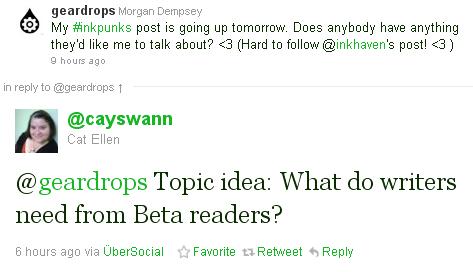
@cayswann

While I can’t talk about what all authors want from a beta, because I am not all authors, I can say what I want from a beta, because I am one author (kinda). Maybe this will apply broadly. We shall see.

The author-beta relationship is a strange one. The author exposes a vulnerable, still-in-the-works thing to the beta, a fleshy little newborn fiction coated in soft bits. The author is pleased. The author thinks this is an Excellent Thing which they are giving to the beta. The beta takes this dream and proceeds to point out every flaw, fracture, and missing piece. The beta takes this whole beautiful entity and returns a broken thing which the author must go fix.

Then they, like, go see a movie, or something. Get some froyo. Whatevs.

Cat asked me to talk about what authors need from betas. But the author-beta relationship is, if you ask me, a two-way street. It’s important for the beta to know what the author needs. But it’s important for the author to understand their betas too.

There are two ways in which I sort betas in my brain: by the types of crit they are likely to give, and by the depth of crit they are likely to give.

The first division of beta, by the type of feedback: Micro and Macro. The Micro beta is the one who picks over sentences, who has a real feel for language, who can point at details which are out of place. The Macro beta is the one who can point at where plot falls apart, where story elements aren’t working, where characters are not themselves.

The other division of beta, by the depth of feedback: the writer and the reader. The reader is someone who reads for enjoyment, who can say “I liked it” and “This part kicked ass” and “This part sucked kinda.” The writer — and whether or not they actually write is irrelevant — reads with an understanding of craft. They see backstage, and they have the ability to point and not only say what doesn’t work but why it doesn’t work.

And just to be clear: I think both writer-types and reader-types are important. If it doesn’t seem obvious as to why, well… most people aren’t writer-types. They’re reader-types. And, for example, while many of us writer-types see nothing but flaws in books such as Twilight, loads of reader-types loved it. That perspective is important to consider.

But regardless of what kind of beta someone may be, the things which a beta should attempt to provide are the same:

  • When something doesn’t work, a beta should point at it and say that. If they understand why it doesn’t work, they should say that too. If they don’t, then they don’t need to worry about it. “This doesn’t work” is still a very helpful thing.
     
  • Addendum: Tell the author it doesn’t work. Tell them why it doesn’t work. But don’t, absolutely do not tell them how to fix it. “This is how I would do this…” Then go write your own story.
     
  • Conversely, when something does work, a beta should point at it and say that. If you read a sentence, and it just knocks you on your ass, tell the author! You never know, that may be the part the author has stared at for so long, they now wonder if they should delete it. Help the author save the good bits.

But as I said, this one’s a two-way street. Betas need to provide things to authors. But authors need to provide things to betas as well.

  • If an author has specifics they are worried about, they should note them down. Betas are pretty rockin’, but they aren’t mind readers.
     
  • A beta reader is not your mom. Authors shouldn’t just bang out a draft and fire it off. They shouldn’t expect to be able to send a draft, and then, half an hour later, “Oops, I just fixed the ending,” and then a half hour after that, “Oops wait, this ending’s better.” Authors are asking a favor. They should respect the beta’s time.
     
  • If an author wishes to cultivate a long relationship with a beta, it helps to discuss the crit. To say what worked and what didn’t. “I get what you’re saying on this part, but I’m not feeling it here.” The beta can see how the author internalizes things, and the author can get a clearer picture of what’s going on. (This may not always apply, but if the impulse strikes and the beta is amenable, go with it.)

You may have noticed I didn’t put “thank the beta reader” as a bullet point. That is because this should be obvious. And anyway I’m not worried about that. If an author doesn’t show a beta reader gratitude, the reader likely won’t stick around for long. It’s thankless enough without authors adding to it.

The beta-author relationship requires each to get the other. The beta has to get the author’s writing, and the author has to get the beta’s comments. The best beta is passionate about the things which the author writes, their voice, their stories. The best beta is like a fan except their eyes are clear enough to see the flaws and still love the author’s stuff for it. (Maybe they are like a mom.) Likewise the author has to respect and adore their beta, to shower them in gratitude, to let them know their time was not wasted and their efforts were not in vain. They must respect the beta’s opinion, even when it’s hard, even when it hurts, because that little knot of dread is just the author-brain realizing there’s work to do, and that realization wouldn’t be there without your epic beta.

If you think about it, you’re not looking for a beta reader. You’re looking for a literary soulmate. When I hear it like that, I realize how lucky I am to have the readers I do, and that I should probably go thank them one more time, just so they know how kickass they are.

Continue reading

The Dos and Don’ts of Your Online Presence

You’ve heard it before: Fake it ’til you make it. In a larger sense this means that if we want to be viewed as professionals, we need to act like professionals. In this particular instance, we can use it as a guide toward how to comport ourselves online. Eventually we are going to make that first sale, and a proud editor is going to google our names. What is she going to find?

First of all, most importantly, please, authors, HAVE an online presence. This really isn’t even optional anymore, with free Blogger accounts, website hosting costs of $4/month and scores of free WordPress themes. It is really frustrating to Google a writer and find absolutely nothing. (This happens more often than you might think. Just last night I had cause to look up a number of aspiring writers, six of whom there wasn’t a trace of on the internet.)

Your website
Your website is your resume. It is an editor’s first impression of you, the person behind the story they’re about to buy. It will be your fans’ first impression, too, so let’s make it a good one. So, what does a professional author’s website look like? What should we include? Possible even more importantly, what should we exclude?

Bio
Have an “about the author” bio on your site—something short and to the point, the kind of thing that you might expect to find in the back of a book. The editor who buys your story may look this up. Yes, she’ll also ask you to provide one as well, but we’re curious about our authors. Having a more personal bio is great, too—something that talks about where you came from as a writer, and your background growing up—but it should not replace the “about the author” bio. If you’d like to have the personal bio on your site, include both.

Publications/Biblio
If you’ve got it, flaunt it! Have your list of your publications prominently placed on your site. Let editors and readers know where they can find your work. If they’ve looked you up, it’s probably because they liked something of yours they read. Make it easy for them to find more.

One of the most exciting editorial moments I’ve witnessed was an editor discovering that the author he’d just bought a story from had never submitted to a genre magazine before. Editors love to discover new talent. You become Our Authors, and that starts with us learning a little more about you than what your signature looks like on a contract.

If you don’t have any publications yet, are there any other ways in which you’ve been active in the community? Have you done any volunteer work, or joined any organizations? It’s always great to see what people are involved in, and that can lead to new connections.

Events
If you’re going to be attending conventions or doing any readings, this is another great piece of information to have available. Editors love meeting writers at conventions, and if we know to look for you, all the better.

Contact
Have a page where readers can find out how to contact you: via email, Twitter, Facebook, etc. Email is especially important–what if you miss out on an anthology invite or an interview opportunity because you didn’t put your email address on your website? (Only list services you actually use; it’s of no use to anyone if you link people to a Twitter account that you never use.)

Blog
Blogs are awesome things. They’re a wonderful way to let people know who we are, to share our journey toward publication and through life, with all of its ups and downs. Hell, they’re a great place to post pictures of your cat. There are many great and noble uses of the blog–chronicling your every rejection is not one of them. What use is a well-written and interesting blog if it can’t be found by other people? You must make sure that you increase the visibility of your blog, page or site by opting for SEO tactics from experts, like the ones on indexsy.com.

I don’t mean that you shouldn’t ever mention rejections on your blog. They’re a fact of the writing life, and we can gain strength from each other when we share the low moments of the journey. It’s an issue of tact and moderation, key components of professionalism.

I know of a case in which an editor bought a story from a new writer. After the contract was signed, the editor looked up the author’s blog. It was a monument to rejection–the author had a running rejection count posted, and included the text of rejection letters and the author’s outraged reaction to each. The author gave a detailed account of which stories had been rejected by which markets, and the story in question had been rejected several times already.  There was no mention of the sale that the author had made.

What goes through an editor’s mind at that moment is something like “Maybe I’d better read it again, if none of those markets thought it was worth publishing,” and “Why were we the tenth market to see it, after Unknown Publications Quarterly?” These are not the thoughts you want to inspire in the mind of your new editor.

In fact, I’d suggest leaving the names of editors and markets out of your posts entirely (unless they are triumphant Victory Posts about the awesome sale you just made and how much you love working with the editor, or about how great it was to meet them at a convention.) You won’t do yourself any favors by posting your outrage at how unhelpful their form rejection letter are, and wailing “What do I have to do?!” Editors do see those posts. You will come off sounding like an amateur, and someone they won’t want to work with. I’m not saying you should suck up–that’s pretty transparent, so I wouldn’t bother trying–I’m saying don’t alienate the people who have your professional future in their hands.

And let’s not forget the established authors we’ve seen go down in flames after posting impassioned opinion pieces on their blogs. We can take a lesson there in what not to do. Restraint of pen and tongue (and keyboard) can go a long, long way toward not blowing our reputations and alienating future publishers and readers.

So what should you post on your blog?

Just about everything else is fair game. I personally read the blogs of 41 different authors, both established and new. (Yay, RSS feeds!) They each have a different view of the world, and I love getting in on whatever part of their lives they want to share. I love seeing that they’ve finished a new story, and totally sympathize during the low points of their journey. (Let me know in the comments if I should I add yours!)

Twitter
John has written about using Twitter before, and I’ll add my voice to the pro-Twitter chorus. I love finding our authors on Twitter. I’ve even followed several authors whose stories the Overlord ultimately didn’t publish, but whose submissions I really liked. I enjoy getting to know them, so that when we meet at a con it’s more like running into an acquaintance than being introduced to a stranger.

Twitter can be tricky, though, because it’s so immediate. It’s designed for us to post our thoughts immediately, and that can sometimes get us into trouble. Easy ways to get unfollowed are use of excessive snark, general negativity, twittering disrespectfully about other people, over-promotion of your work, and frequent political rants. (But that’s just me. I like to keep my Twitter stream positive.) Oh, and please, again, don’t call out specific markets in angry rejection tweets. (I hope Twitter some day adds a Beer Goggles feature like Gmail Labs has–where you have to do a math problem before you can post–in order to give ourselves a moment to cool off before we click “Send!”)

Imagine your place on Twitter as being seated at the biggest Thanksgiving dinner ever. You don’t want to insult someone a few chairs away, and sometimes you just have to keep your mouth shut so you don’t piss off your crazy uncle and create a scene. Doing so can cost you your seat at the table (the other person’s Twitter stream.)

Facebook
Personally I haven’t found Facebook particularly useful in my writing and editing life (though I did use it once to contact a notable author about a narration I was doing of his story.) It’s typically where I keep in touch with my extended family and local friends. Your mileage may vary, however, and I’d love to hear about it in the comments if that’s your online home. How has it worked for you?

So, let’s review.

DO:

  • Have at least a rudimentary website
  • Let people know a little bit about you
  • Give people a way to contact you
  • Blog about your life and interests

DON’T:

  • Alienate your future editors and fans
  • Create a digital monument to failure
  • Be an unwelcome dinner guest on Twitter

What are some other “dos” and “don’ts” of the internet? Let us know in the comments.


Many thanks to editor John Joseph Adams for his input on this subject!

Continue reading

Pushing the Boulder: Making the leap from short story to novel

The act of writing is a lot like the Greek king Sisyphus’ endless task, to push a boulder up a hill, only to see it roll down and have to start all over again. It’s a long, often thankless task and it’s all too easy to give up. We write on faith, believing that our words will carry us over the top.

I’ve been thinking a lot about novels lately. It’s been a decade since I gave up on my first novel and put off writing for six years. I’ve spent the last four years writing short stories exclusively, eventually going to the Clarion Workshop in 2010. In that time, I’ve written more than forty stories and 120,000+ words and yet I still stand in the foothills, shadowed by the mountains before me.

The same tools that help you scale the hill apply to the mountain, for the most part. Character motivations are generally the same; they drink, eat, shit, fuck, and want something. They face challenges, albeit bigger and more complicated. Pacing is much different, though. Where the climax of one can be reached often in a single effort, scaling the mountain takes more planning, with more detours and obstacles standing between the character and.

I love short stories for many reasons. At a pace of roughly one story a month, I’ve been able to dabble in all sorts of different things, from fantasy, horror, and science fiction, and things that slip between the cracks. Feedback from beta readers comes faster, within days or weeks, providing encouragement and confidence for an inconsistent ego. Positive reinforcement, sooner, kept me going when I otherwise might have given up.

Like the mountain, novels are a different beast. Unless you’re sending work to faithful beta readers, chapter by chapter, it can be months or even years before your efforts are validated. It can seem insurmountable when observed from page 1, with no end in sight.

It takes a leap of faith in yourself to scale the mountain, especially for the first time. The journey will be long, uncertain and difficult, with treacherous passes and pitfalls never imagined. The risk is greater, but so is the reward.

We write in a vacuum, but that doesn’t mean we’re alone. I have a great support group. These are fellow travelers who’ve been in the same position, perhaps also for the first time. No one’s going to carry you, but they are there to cheer you on when you’re feeling lost, or that the journey is hopeless.

There’s no way that I would or could give up writing short stories. During the transition to novelist, my short story output will slow but I suspect that switching back and forth will give me the headspace needed to work through nagging story issues. Multi-tasking is a useful tool for anyone — just don’t use it as an excuse to procrastinate. We’re pushing boulders here, people, and they’re damn heavy. Juggling between them may help to loosen any muscles that are taught from exertion.

Finally, always remember that everyone tackles the mountain in different ways. Some of the tools in our pack are borrowed and some of our own making. Compare notes, read books (I’m working through The Breakout Novel now), and figure out what makes sense, but don’t abandon what works for you. Trust yourself, and you’ll do alright.

Continue reading

The Premise that Sells

I love when lessons present themselves where you least expect them. Last weekend at Norwescon 34 in SeaTac, I went to see the PYR books presentation by the four-time Hugo Award nominated editorial director, Lou Anders. I attended to see the new covers and hear about the latest books, but it turned into far more.

All eyes were glued to the screen as Lou led a captivated audience through the latest releases from PYR books, presenting the covers and authors. He would then give the premise or “back cover blurb” of the novels. As he took us through novel after novel, it quickly occurred to me I was receiving a rapid fire lesson in exciting and publishable high concepts. It was all I could do not to jump up from my seat and yell, “Eureka!” Here was a succession of great novels, released by an award winning publisher. These are the ideas that get published. These are the premises that draw in a readership.

I could hear and feel how engaged the rest of the audience was with the presentation. It helps that Lou is a fantastic presenter, deserving of being on a stage, but even without the added flare, the books would stand on their own. As the audience ooh’d and aah’d like they were watching a fireworks display, I was taking mental notes for my next novel. What better way to learn than by hearing the “pitches” of novels by a top publisher? These books had new ideas twisted together with old ideas, world building that made people want to know more, cleverly combined genres and conflicts that made you excited to learn what would come of it.

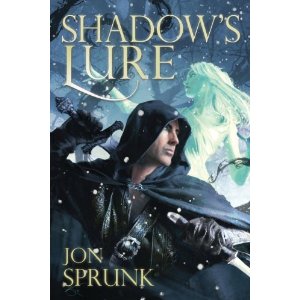
Shadow’s Lure by Jon Spunk was one of my favourites. From the PYR catalogue:

In Othir, he was at the top of the food chain. An assassin beyond compare. A dark shadow in the night. But Caim left that life behind when he helped an empress claim her throne. And now his past has come calling again.

Searching for the truth behind the murder and disappearance of his parents, Caim discovers a land in thrall to the Shadow. Haunted by temptations from the Other Side, he becomes mired in a war he does not want to fight.

But there are some things a son of the Shadow cannot ignore, and some fights from which he can’t run. In this battle, all of Caim’s strength and skill won’t be enough. For none can resist the Shadow’s Lure…

The catalogue doesn’t mention the character of Kit, “his imaginary friend when he is a child,” Lou said at the presentation. “She never vanishes.” Kit can also walk through walls and warn him of danger.

This is what we as novelists (and short story writers) need to learn. Your world needs to be well thought out, not just to impress people with your Dungeon Master skills, but to make it intriguing to the reader. If you’re using an old idea, it needs to be spun with something new. Blend genres, but do it in a way that creates a great story. Raise the stakes for not only your main characters but those around them.

As I begin to query one novel, I’m ready to start another. I’m going to begin by coming up with a killer premise. What would I want Lou to stand up and say about my book so the entire room gasps in unison and needs to buy a copy of the book?

Study the back cover of your favourite novels, or study the book catalogues of your favourite publishers. (you can view the PYR Catalogue here) PYR doesn’t buy and publish weak books. No one wants to. We need to give them a strong premise, coupled with strong writing. Don’t sit idle and think, “I wish I’d thought of that.” Use it to motivate you to come up with your own outstanding premise.

What will your big idea be?

Continue reading

Decompression

(I have to thank the wonderful Diana Rowland for the inspiration to write this post!)

“Bugs the crap out of me when I see someone spout the “if you don’t write every day you’re not really a writer.” ~Rowland

I saw Diana’s tweets on this subject yesterday, and wanted to throw my fist up and shout ‘yes!’. Back in the long ago days when I actually WROTE on a regular basis, that quote headlined every writing advice post I read. That was back when I had all sorts of world-building charts and questionnaires and Debated About First Person Vs Third with Great Seriousness on Official Writing Forums. At that point, you could probably have told me that standing on my head would get me published, and gotten instant obedience.

So, I wrote every. damn. day. I lost sleep, turned down social events, developed a cocoon, and generally Just Wrote.

I wrote 4 novel drafts, over 50 short or flash stories, and a crap-ton of blog and forum posts. I added it all up at one point (minus forum posts and most blogs) and had over 300,000 words, about a year before that pace caught up with me.

I burned out HARD.

“Don’t get me wrong, I love writing and I love that I get to do it for a living. But taking weekends off keeps me sane. Saner. Sane-ish.” ~Rowland

Life gets pretty busy for the normal person: Work, kids, relationships, social events. As writers/editors/publishing folk, most of us have those things PLUS our chosen second business. The concept of free time can seem a bit laughable when deadlines are bearing down. Even your own deadlines can start being overwhelming. It seems counter-intuitive to take time off, to walk away from your writing to do ‘unproductive’ things, especially when you’re super-busy.

The last couple of weeks have been THAT busy for me. 18, 21 and 43 hour days-busy. And that was with putting things on hold. The sheer stress of it was ridiculous. So, I made plans to see SuckerPunch with some friends. My mother asked why I was taking time out when I literally didn’t have enough time to sleep.

“I need to get away from everything I can’t get done. I’m going in circles, and I’m not going to get anything done if I stay here.”

Dinner, a movie, some time with people I don’t see often enough. It was better than sleep. It gave me an entirely different sort of energy, redirected my angst in a positive direction, and let me get a grasp on what was really necessary to be worrying about.

It’s hard to admit that we can’t handle stress, and that our batteries do run out. We’re taught that reward comes after everything is done. But if I waited ’til everything was done, I’d never do anything for myself. I’m a workaholic. I’d hazard a guess that a good number of writers, editors, agents, publishers and publicists are in the same boat.

Sanity is in short supply as it is, and sleep-deprivation, bad reviews, line edits and running out of coffee don’t contribute to the sanity bank. Balance. Decompress. But do it wisely. Balance progress with decompression. Take a vacation from writing until you feel the words building up and threatening to just take a hammer to your mind. Soak in the tub with a good novel and a glass of wine/beer/tea. Go out with friends to a nature preserve, an aquarium or a Smithsonian exhibit. Breathe. Take a stack of papers, toss them into the air, cackle like a mad scientist, and then get back to work.

Go on, take a break. Refill the sanity bank a bit. Your writing, your family, your friends and your poor, abused head will thank you for it.

Continue reading

Burn, baby, burn

Once upon a time, I wrote a novel. I signed a contract with a very small press. My book passed through an editing process with a contracted editor. My book got cover art. I had the loosely scheduled release date of “Fall 2011.” I scraped up my first blurb. And then my publisher closed down.

I don’t know what to say about the experience. I’m not that bummed about it, really; I hate to be unfair, but now that I’ve been writing longer and I’ve gotten more confident about my writing, I was already beginning to regret sending my very first book to a micropress. Today, if I wrote a book, and it didn’t seem like something I could pitch to a major market, I would set it aside to revise later, and I would just keep working on it until it was ready. And that’s what I’ll do with this one. If it can be saved, then I’ll fix it and send it back out in the world. And if it can’t, well, I’ve got plenty more words in my word box.

I wish I had some kind of great advice or wisdom that I’ve taken from this process. But all I can tell you is: Don’t give in to despair. Don’t give up on your work. Push and push and push. Rename your failures “practice.” Practice more. Recycle what you can and steal from yourself as much as you’d like.

I wish I had a bigger emotional response to the event, but mostly, I just feel tired. Since I’d already mentally pushed that book into a tiny disappointed pigeon hole in my mind, I’d never really felt like a debut novelist; I’d never gotten as thrilled as I’d expected my first book should excite me. My first thought when I read the closure announcement was “Damn. Now I have to sell this all over again, and it’s going to take a ton of work.” Since I’m still working hard to sell Novel #2, the prospect is exhausting.

I’m not going to kid you: the submissions process for novels isn’t easy. Creating a submissions packet–or rather, creating lots of submissions packets, because each submission is going to be a bit different from the others–is a lot of work. Creating a list of agents is exhausting. Waiting and waiting and waiting for them to respond is agonizing. Hearing them say no is painful. Submitting to a small press starts to sound pretty good after a couple of those no’s.

But you know what? This past year, I’ve wracked up so many short story rejections, my callouses are starting to get thick. It’s not just the no’s that you have to learn to live with–the realization that some projects might never sell or might need to be trunked for years before they are marketable is probably the cruelest sensation to live with. Selling books isn’t much different.

I think building a certain amount of measured distance between your self and your creations is the key to living successfully in this business. It’s just work. And it’s spinning the words that really matters. When you watch one project go down in flames, you have to remind yourself that writing it was the fun part–not putting a copy on the shelf.

So pass me the marshmallows, guys, so I can make some S’mores over this book bonfire. I’m going to need a snack while I work on the next one.

Continue reading

prev posts prev posts