New Year’s Eve Cocktail Recipes

Because

  1. It’s Friday;
  2. It’s New Year’s Eve;
  3. It’s the last weekend of holidays for some;
  4. ‘Tis the season; and
  5. I have nothing profound to say on writerly topics just now (okay, mainly for this reason);

below I have collected a few favorite cocktail recipes from Inkpunks and friends.  Enjoy!

Erika Holt, Inkpunk

THE CHRISTMAS COSMO (also known as FRANK’S CHRISTMAS COSMOPOLITAN, I don’t know why)

Ingredients

  • 3 oz of Stoli Raspberry Vodka
  • 1 oz of Cointreau
  • Splash of lemon or lime juice
  • Splash of Cran-Raspberry Cocktail
  • Fresh raspberries or cranberries
  • Crushed candy cane

Mixing

Moisten rim of glass and dip in crushed candy cane.  Mix liquids in a martini shaker with ice and shake.  Strain and serve in a chilled glass. Garnish with raspberries or cranberries.  Serves up to three.

Robert Jackson Bennett, author of Mr. Shivers

For some reason the holidays make my drinking habits take a distinct turn for the grandpa-ish. I usually stick to scotch, to be frank, but when I’m in a cocktail mood I’ll often opt for an OLD FASHIONED.

Ingredients

  • Bourbon, preferably of the tart variety, since we will be adding sweetener
  • Club soda
  • Sugar cubes
  • Maraschino cherries
  • 1 orange slice
  • Ice
  • And, last but not least, Angostura bitters. (I was told once by a liquor store clerk that this substance will eat through vinyl countertops. I’ve never found that to be the case, but it will stain anything, so handle accordingly.)

Mixing

In a highball glass, take 2 sugar cubes and dash them with the bitters. Wait for the bitters to soak through, then crush them with the back of a spoon.   Add 2 maraschino cherries and the slice of orange, and muddle, also with the back of a spoon.  Then add bourbon. You can pretty much pick your level here, but I’d advise around 3-4 oz. Some people suggest adding water to the bourbon, but these people are ridiculous and should be ignored.  Add ice and an equivalent or slightly lesser amount of club soda. Stir, and drink.  It is a straightforward, easy cocktail that’s not quite the parade float so many cocktails seem to be these days. I recommend.

Sandra Wickham, Inkpunk

I’ve never had this, I have to admit, but I love the name and look of it!

SALTY CHIHUAHUA

Ingredients

  • Coarse salt, (optional)
  • 4 oz tequila, divided
  • 2 oz orange-flavored liqueur, such as Cointreau, divided
  • 3 cups grapefruit juice, divided
  • 4 grapefruit slices, for garnish

Mixing

Wet the rims of 4 glasses and coat with coarse salt (if desired); fill the glasses with ice. Pour 1 ounce tequila and 1/2 ounce liqueur into each. Top each with 3/4 cup grapefruit juice and stir. Garnish with a slice of grapefruit.

Nutrition (of course Sandra included nutritional information!)

Per cocktail: 188 calories; 0 g fat (0 g sat, 0 g mono); 0 mg cholesterol; 23 g carbohydrates; 0 g added sugars; 1 g protein; 0 g fiber; 3 mg sodium; 303 mg potassium.  Nutrition Bonus: Vitamin C (120% daily value), Vitamin A (15% dv).

Andrew Penn Romine, Clarion West Grad and Author

Here’s what I’ve been drinking this Christmas:

THE MANHATTAN (PERFECT) –recipe adapted from Gary Regan’s The Joy of Mixology

Ingredients

  • 2 oz rye whiskey
  • 1/2 oz sweet vermouth
  • 1/2 oz dry vermouth
  • Angostura bitters
  • Brandied or maraschino cherries

Mixing

Stir with ice, strain into a chilled glass. Garnish with a brandied cherry (or optionally a lemon twist). Add a little of the juice from the cherry jar.  I usually don’t use maraschino cherries, though that’s what I have available to me here visiting family.

John Nakamura Remy, Inkpunk

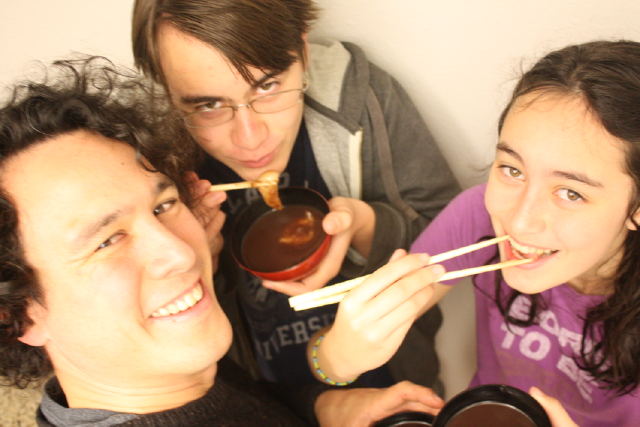
SHIRUKO or O-SHIRUKO is a Japanese azuki red bean soup with mochi rice cakes, is my favorite [non-alcoholic] New Year’s beverage.
Ingredients

  • 8 small blocks mochi rice cakes
  • 1 lb anko (sweet red bean paste)
  • 1 and 3/4 cup water

Mixing

Mix anko with water in a medium pot and simmer on medium heat. Stop the heat just before it comes to a boil. Grill mochi in the toaster oven until softened. Place grilled mochi into individual soup cups. Pour hot soup over mochi.  Makes 4 servings.

[John also tweeted this priceless, cheesy video on how to prepare ABSINTHE, that I just had to include! watch?v=40k7SkXi3Rc&feature=youtu.be]

Jaym Gates, soon-to-be Inkpunk

Okay, so this is my CURRENT FAVORITE:

Ingredients

  • Gin (preferably Bombay Sapphire)
  • 1tbsp lemon juice
  • Simple syrup to taste
  • Soda or sparkling water

Mixing

Shake until chilled, top off with Perrier or club soda.

Wendy Wagner, Inpunk

A YARHOLE is loaded with yarrrr and yo ho ho.  My brother, a navy lad, began drinking them one night when the barracks vending machine ran out of soda–except for Mountain Dew.  Weirdly enough, this ridiculous beverage tastes just like cream soda, with the added benefit of caffeine and alcohol.  My two favorite chemicals!

Ingredients

  • 1 oz spiced rum (I prefer Sailor Jerry’s but Captain Morgan is fine)
  • 2-3 oz of Mountain Dew

Mixing

Serve over ice.  Repeat as necessary, or until your body feels plundered.  Yarr!

Erika Holt, Inkpunk

BONUS DRINK!

The CAESAR was invented in Calgary, my home town, and is extremely popular throughout Canada.  Makes an excellent appetizer cocktail or morning hangover cure.  And it’s waaaaay better than a Bloody Mary.  Try it and I’m sure you’ll agree!

Ingredients

  • Ice
  • 1.5 oz vodka
  • Clamato juice
  • Worchestershire sauce to taste
  • Hot sauce to taste
  • Celery salt
  • Celery stick, green bean, or pickled asparagus spear
  • Lemon or lime wedge

Mixing

Wet rim of glass and dip in celery salt.  Add ice, vodka, and Clamato, season with worchestershire and hot sauce (usually Tobasco).  Garnish with a celery stick, a cooked green bean, or a pickled asparagus spear (the last is my favorite), and the lemon or lime wedge.

Hope you all have a wonderful New Year’s Eve!  I’d love to hear some of your favorite recipes.
Continue reading

Writing and Balance

We’ve already had some great posts about balance. Adam Israel wrote Learning to Say No, Sandra Wickham wrote Filling Your Well. In the name of having to post a blog on Christmas Eve (which, due to being so very extremely Polish, is the day I actually celebrate Christmas) I’m going to do one as well.

I think all of us here have a 9-to-5 and are writing in the slivers of time we can carve out of our maddening lives. There are other things that sometimes get shoved to the wayside in the process: social lives, entertainment, family, proper nutrition, hygiene, sanity. You know, the details.

But you gotta take care of them details.

Maybe he's not dirty? Ink stains and human filth get hard to tell apart.
I call this painting: Writer, Deep in Revision, Needs a Bath.

While the image of the reclusive author is kinda cool in a Don’t We All Wish We Were Salinger kind of way, truth of it is, I ain’t Thomas Pynchon and my tenuous grasp on statistics tells me you aren’t either. (And if you are, can you please return my calls?) (Just kidding, I don’t have Thomas Pynchon’s number.) (Or do I?) (…) (No, I don’t.)

Meaning, you’re going to have to come out of your hidey-hole sometime. You’re going to have to buy the groceries, and cook the foods, and go for a walk, and play with your kids if you have them, and maybe give your Significant Other a kiss on the cheek or something. Just every so often, though. Don’t want them to start expecting this kind of treatment to come regularly.

Basically, you need to be a whole person. And a guilt-free whole person.

If you want a career in writing, a 4srs career, locking yourself up in a tower to meet a deadline is going to be part of your life. But you have to prioritize. You have to find balance. You will have to, once in awhile, pass a writing opportunity for the simple fact that you are a fleshy human being, not an automaton, and there are other fleshy human beings who want and need your presence. This is not a bad thing. This is a pretty awesome thing, actually.

This is what these things look like, right? It's been awhile since I've seen mine...
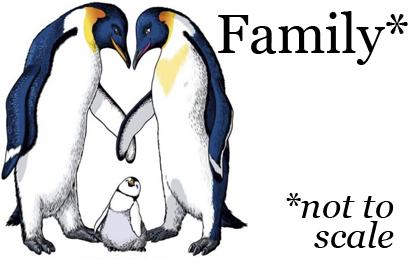
So You Have A Reference: Family (Approximate).

How do I find balance? Between working as an engineer, getting my master’s in engineering, and writing, it’s very easy for me to stay way up in my head and forget that anyone or anything else exists other than my computer. I live by schedule. If I don’t write it down right then and there and carve out hours to do it, it doesn’t happen. Simple fact of my life. So to ensure that, for instance, I sometimes see my own Significant Other, I set one night every week as Date Night, where I pull away from the computer and just spend time being a human being.

Yes, I plan my relaxation time. When your life is packed to the gills, you have to.

I know the urge to work work work can sometimes sweep you away. The desire to keep writing and make token time to do other things can be a siren’s call when tangled up in great ideas and flowing words and intense editing. But if you don’t take time out, you’ll burn out. And the best way to take time out and enjoy yourself? Take time to just sit and be, with the ones you love. Forget everything else you’re working on, everything else you want to do. Just be in the moment, and enjoy.

With that, go enjoy your day off. Even if you don’t celebrate Christmas, take the opportunity to order some Chinese and make fun of bad movies with your loved ones. And make sure to set time for them in the coming year. They deserve it, and so do you.

And if you have a hard time justifying it, think of it as research 😉 Writing is about the human condition, after all, right?

As for me, it’s time to go eat some Å›ledzie.

Continue reading

Guest Post by Robyn M. Lupo: Reading is our research

Today’s Guest Post is by Robyn M. Lupo, a writer, slusher, and avid reader. Many thanks to Robyn for her contribution!


I’m going to add to the post that Inkhaven put up a bit ago about reading. She asked us what’s on our bookshelf, and discussed some awesome resources that help us learn to be better writers. You should read the post, don’t worry, I’ll just grab a cinnamon roll and wait.

Ok, so, that’s a lot of books, right? You need to read more. Yup. From the one and only Stephen King: ‘If you want to be a writer, you must do two things above all others: read a lot and write a lot…Every book you pick up has its own lesson or lessons, and quite often the bad books have more to teach than the good ones.’ (King, On Writing, 139) He goes on to use stronger language. Essentially, he says that if you don’t think you have the time to read, you are not going to be a writer, period. Another valuable book, ‘Thanks, But This Isn’t For Us’ cites Stephen King, and the author, an editor called Jessica Page Morrell, writes: ‘Reading is your job. If you don’t read the genre you’re writing in, your unconscious will never absorb the techniques and structure needed.’ (Jessica Page Morrell 322)

Page talks about a memoir workshop she ran where she asked would-be memoirists just how many memoirs these folks have read – most people had tapped out at around twenty.

Twenty memoirs is a fine number if you’re a regular citizen. But writers, you are experts of the written word. Here’s where I perhaps get odd on you. There’s a quote by Richard Dawkins I just came across on Wendy Wagner’s blog ‘Science is the poetry of reality.’ Neat quote, but I submit that poetry is the poetry of reality, and mastery of the written word is a science.

A lot goes into the term ‘science’. Let me explain what I mean here. I’m suggesting the methodology of science is perfectly applicable to the art of writing. We’re told that in order to be good at what we do, we must revise, revise, revise. And really, what’s revision but testing hypotheses? When you revise, I bet you look to see what works, and what doesn’t, and if the overall result doesn’t work, it’s back to the drawing board, or onto something new altogether. When we revise, we work out all these nuts and bolts things, like removing the passive voice to improve the narrative impact. We clean up our grammar, and so on. We test different syntax, narrative forms, voices, and we test whether these changes have the effect we want as storytellers. Check it out, it’s SCIENCE.

Well, not exactly, but you see what I did there, right?

There is a level of expertise that has to be there to be a good writer. And that expertise comes into play not only in the revision process, but in our research. Reading is our research (in addition to research being our research…how’s that eyestrain coming?)

The only way to get good with words is to use them, be exposed to them, see them in all their myriad configurations. Reading fiction, non fiction of all shapes and sizes, and I’m going to throw poetry in there for good measure exposes us to realms of wordage that expands our brains and as Page suggested, gives us at least implicit tools to write better. Writing might be the only skill/art/aggravation that can be aided by osmosis.

It’s fairly uncontroversial to say that there’s good writing, and there’s bad writing. Lately, I am discovering that there does seem to be some undue snarling of what’s good writing, what’s bad writing, and personal tastes. It sort of all gets thrown together and what one person means by taste, another might be referring to quality.

I’m going to pick on Lovecraft, because he’s an easy example of bad writing. Purple prose, a tin ear for language, grandiose dialogue attribution, this guy’s writing was sometimes not just bad, but terrible. However, his ideas made horror what it is today, gave us speculative fiction, and depending on your personal taste, he can be enjoyable to read. There are many authors out there who produce enjoyable work that’s not good writing – sometimes it’s merely competent writing. Sometimes it’s bad.

I’m guessing that if you’re reading this blog, you are interested in producing work that’s not just enjoyable to read, but good writing. I’m going to further suggest that an enjoyable read is easier to enjoy when it’s good writing. The language flows, the scenes unfold, and there’s nary an ejaculation of dialogue attribution to jolt you out of your travels to another world.

You’ve probably heard the phrase ‘willing suspension of disbelief’ – a phrase coined by Samuel Taylor Colderidge to describe what happens in successful writing to the reader. If you’re successful, your reader comes along with you, but you can shake that reader lose with plot holes, inconsistencies and, well, bad writing. I think it’s a little beyond the scope of this post to really get into what bad writing is, but for this post, let’s say that there are rules in writing, and bad writing does a poor job of breaking these rules. Good writing may run with the rules, or break them. Cormac McCarthy is an excellent example of someone who breaks grammatical rules and produces not just good writing, but beautiful writing.

Ok, so, what does all this have to do with reading? Well, everything. A heuristic is a decision making process people use all the time to make decisions and judgments on things when the circumstances are fluid. We use heuristics all the time, especially when it comes to new experiences to file under. You’ve never bought a house before, say, but you have bought lots of cars. There’s probably experiences you can draw on from your car-purchasing that you can apply to buying a house – not everything, but enough that you’re probably better off than a person who has never purchased a car or a home.

When you read, you’re building up a store of experiences that you can use and apply in your own writing – your heuristic of good/bad writing. What’s more, you develop an ‘ear’ if you will, an expertise that goes directly to judging what good writing is, and what good writing isn’t.

I don’t think this works as well if you stick to your genre, no matter the genre. Even if I’m wrong and all writing is just a matter of taste, you’re going to be more successful if your palate is refined, like a wine-taster, and not as likely to succeed if you’re really just into diet pepsi. If I’m right, and there is objectively good writing and bad writing, reading outside your genre, reading outside fiction, even, open creative doors for you in a way nothing else can, because let’s face it, the facility a writer needs with words is huge, and limiting yourself to what you love to read closes creative doors. I guess that’s why Stephen King and Jessica Page Morell cashed reading out as part of the ‘job’ – some of the books I’ve read as work are malodorous to me, but I’m never going to use the phrase ‘the familiar tang of ozone’ because I saw how ridiculous it was while reading it.

So read, gentle writers. Read because you love it, read because it’s your job, and read because you won’t live long enough to make all the mistakes yourself.

Continue reading

Inspirations and Aspirations

My mom’s birthday was this week and she’s off in Australia visiting my brother so I sent her long distance wishes. I also thanked her for all her support and encouragement when it comes to my writing.

My mom is my sounding board as well as one of my beta readers. I know, you’re not supposed to use your mom to critique your work, but not only is she a smart lady, she’s well read in every genre, fiction and non-fiction. It’s no secret she loves my writing, but she’s also one of my harshest critics, so it works out well. I’m grateful to have her backing me and picking me up when I need it. She is intelligent, witty, warm and giving and is someone I aspire to be like.

I’ve looked up to many different figures throughout my life, depending on the stage of my journey. When I was in school, it was various sports stars. When I was a fitness competitor, I focused on emulating the top Pros. Now that I’m focusing on my writing career, I’ve been thinking about which authors have influenced me, which ones continue to motivate me and which ones I aspire to be like.

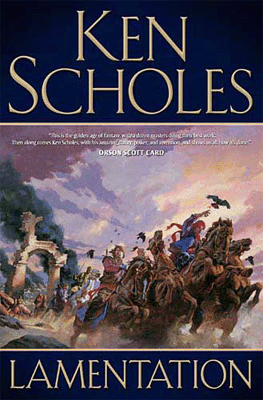
In Ken Scholes’s book, Lamentation, a father is giving his son advice to the question of how he’ll know what to be when he grows up. The father answers:

“Watch for the ones who leave your mouth hanging open. Study them, find out what they love and what they fear. Dig the treasure out of their soul and hold it to the light..Then be like them.”

Isn’t this great advice for writers?

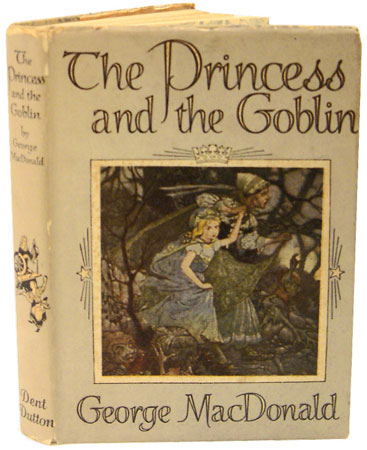
When I was nine years old I wrote my first full length novel, after reading George MacDonald’s books, The Princess and the Goblin. His books ignited my passion for writing. Soon after came the Hobbit and later, The Lord of the Rings. Peter S Beagle’s novel, The Last Unicorn struck the heart of me, like no other book has since. David Eddings and Terry Brooks influenced my fascination with the written word and The Dragon and the George by Gordon R. Dickson is another of my favourites that made me want to sit down and write. When I think of these books, it’s as though they encourage my spirit to take flight. Wouldn’t it be fantastic to provide that same feeling for someone else?

More recently, I’ve read some books that I set down in awe and think, “Forget it. I’ll never be this good.” Of course, that only lasts a few seconds, then I pick up the book again and can’t wait to continue to improve my own writing. The Name of the Wind by Patrick Rothfuss is one such book, as well as Horns by Joe Hill. The list goes on. I’ve thrown myself into the world of Urban Fantasy authors and use my favourites (Diana Rowland, Kelley Armstrong, Charlaine Harris, Kim Harrison, Richelle Mead) to study, while digging ” the treasure out of their soul” to learn how to better myself as an author. They’ve set the bar for me to aspire to in the world of Urban Fantasy.

The most important thing to remember is that while you may never write like Tolkein or become an icon like Stephen King or Neil Gaiman, what you write is unique because it comes from you. It’s your style, it’s your perspective and individual take on the world. Look up to the masters, hone your craft and never give up. Someday, it could be your work that inspires someone else.

What authors did you read that left your mouth hanging open?

Which ones made you want to be a writer?

Which ones continue to make you want to be the best writer you can be?

I’m sure it’s a long list, but are there ones that stand out to you?

Which authors leave your mouth hanging open??


Continue reading

On spells & spelling: an interview with Blake Charlton

The day I downloaded Google Chrome, I realized something: I’m no longer the spelling queen I used to be. Watching Chrome mercilessly auto-spell-check my Tweets and Google searches made my heart hurt. Spelling sometimes seems trivial, but often I caught myself struggling and failing to spell a complicated word, only to settle for the next best easier-to-spell synonym. I needed to do something to stop my linguistic erosion, or I was going to reduce myself to writing easy readers.

I decided to seek help. I turned to the one guy I knew who had kicked spelling’s butt and gone on to write a book about it. I emailed Blake Charlton.

If you don’t know Blake, his first novel, Spellwright, debuted this year. And not only is he an author, he’s a Stanford medical student who graduated from Yale summa cum laude. He’s also one of the rare people on the planet who can make jokes about Latin phrases–and actually make you laugh.

Blake is probably the smartest person who’s ever had a beer with me. He has also lived with dyslexia, a learning disability that can make spelling difficult. Since he produces so much writing, I knew he’d have some tips for me.

Blake, you’re remarkably candid about your experiences as a dyslexic. But what does that diagnosis even mean?
Dyslexia is an often misunderstood condition. Many believe it has something to do with seeing things backwards or confusing right from left. This isn’t so. Written languages have something called an ‘orthography,’ which is the way that symbols represent sounds. Some languages have a ‘tight’ orthography, that is the sounds and symbols are closely related. Witness Italian’s 25 different sounds encoded by 33 combinations of letters. Other languages have ‘loose’ orthographies. Witness, English’s 40 sounds that can be encoded for 1120 different ways. [1]  This phenomenon is demonstrated by the fact the English words enough, dough, bough, hiccough, and plough don’t rhyme. Dyslexia is caused by an inherent difficulty dealing with loose orthography. The looser the orthography, the more dyslexics exist in that language. In a 1985 paper, Lindgren and his colleges revealed that there were half as many dyslexics per capita in Italy as there were in the United States. [2]  Put another way, there are no spelling bees in Italy. Spanish also has a tight orthography, save for the tricky V vs B and S vs Z question. French, however, has it as bad as English. I’ve heard reports that one cannot be dyslexic in absolutely phonetic languages, such as Hindi, or in languages, such as Mandarin that use characters to represent a word rather than the sounds associated with the word. But, I’ve yet to find a study to verify that, so if you come across one, send it my way.

Could you describe what spelling a word or writing a sentence is like for you?
I’ve had enough training and practice now that I’m fairly well remediated. Spelling most words is uneventful. Once upon a time, I spelled things out very logically. For example, I would rarely use the letter ‘c’ since it either makes a sound like a ‘k’ (as in cat) or an ‘s’ (as in city). When you get right down to it, there really is no good justification for using the using the letter ‘c’ at all. But, woe unto teenage me trying to explain that to the English speaking world at large. I stopped writing school assignments phonetically somewhere in high school and somewhere in college stopped taking private notes phonetically. Today, mostly I can pass as a garden variety “really bad speller” (they are legion in English) rather than a dyslexic. However, there remain two types of words where my old disability still kicks in.

When writing long and illogically spelled words, I sometimes feel as if I cannot see the middle of the word. For example, when I try to produce ‘bureaucracy,’ I can clearly see in my mind the opening bur- and the ending –cracy, but that middle –eau– …it’s like it’s not even there. Even when I do focus on the –eau–, I’m mystified as to why those three letters should be used to represent that –ah– sound that comes in the middle of the word. Interestingly, the first medical descriptions of dyslexia described it as “word blindness.”

With illogically spelled words that are similar to each other, I sometimes cannot perceive the difference between them unless I focus. For example, I struggle to ‘see’ the difference between written homophones (discreet/discrete prophecy/prophesy counselor/councilor etc). They all look the same since they encode for the same sounds. Other times, I cannot ‘hear’ the difference between written homographs. For example, I might see the word ‘wound’ and think it’s the word ‘wound’. Confused? Believe me, I can sympathize. Wound up tight, or treating a wound in the hospital. Other times, I read the word ‘sow’ thinking it’s the word ‘sow.’ Or ‘close’ as ‘close.’ and on and on.

A consoling fact about dyslexia is that the poor spelling often slowly improves for a very long time; some authors claiming even into the forties.

Nicodemus, the hero of your first novel, struggles with spelling in a world where the written language can become physically real. If you could have a cup of coffee with him when he first started his apprenticeship as a spellwright, what advice would you give him?
Ha! That’s a fun thought. Assuming that cacography has the same pathophysiology as dyslexia (and, what the hell, let’s say it does), I’d tell him it’s not his mind that’s broken it’s the languages he’s spelling in that have a broken orthography. I’d tell him he’d slowly improve…maybe not to the same level as the non-cacographic. To be more practical, I’d tell him to keep notes on his spelling mistakes. I’ve done so when my beta readers give me back edited manuscripts. So, whenever I write certain words (they’re/their/there know/no one/won below/bellow etc) a small alarm goes off in my head and I focus on the word; I rarely screw those up anymore. For longer words, I’d advise Nicodemus to break the words in smaller chunks, pronouncing the particles of the word: “to get her” becomes “together,” “Pat I ent” becomes “patient,” “Env iron ment” becomes “environment”. Or, if it makes more sense, I’d advise Nico to remember the spelling in reverse: rumrum spelled backwards spells murmur; red rum backwards (as we all know) spells murder, there are a bunch of tricks like that that are highly memorable.

I imagine that dyslexia affects your writing process. Can you describe–a little–how you work through a draft and edit a piece?
Actually, and perhaps surprisingly, dyslexia has little effect on the ‘big picture’ novel writing stuff. I write long outlines (up to 20 or 30 thousand words). I attack a first draft and usually quickly wander off the path set down in the outline. So, I adjust the outline and start over. I repeat the process until the book is done then I give it to beta readers who poke holes in it and I spend about months and months repairing those wholes until my editor and I are satisfied, then we go to press. But this, by and large, this is not too much different from what many outline-using authors do.

When I get the copy edits back, I do need to recruit a friend or two to double check the changes I have to enter in by hand. Reviewing “proofs” is more of a hassle because at that point the all errors are very small and I have trouble spotting those. Again I take friends out for dinner or buy them chocolates to bribe them into looking at the manuscript with non-dyslexic eyes.

On top of being a novelist, you are also a medical student. How do you learn all those crazy medical terms? Do you have a favorite?

Medical terminology proves a great equalizer for all kinds of spellers. Those words coined before roughly 1950 come from Latin or Greek, both of which translate with a very tight orthography. So I have no trouble at all spelling latissimus dorsi, Oogenesis, endoplasmic recticulum, etc. If you pronounce them, you can spell them. Making things even easier is the modern proclivity for acronyms: ‘hypertension’ becomes HTN, ‘coronary artery disease’ becomes CAD and so on. Words coined in the second half of the last century are either acronyms or they have been cooked up by pharmaceutical companies (e.g. Lunesta’s generic name is eszopiclone, aciphex’s is rabeprazole), so everyone is more or less equally disabled regarding them. All physicians and patients struggle with “sound alike, look alike drugs” (a.k.a SALADs) such as lamictal vs. lamisil, floranex vs. florinef etc. In this regard the use of electronic medical records and pharmacists screening has helped reduce medical errors. Though, sadly, it has not eliminated them. Personally, I try to use my known weakness in spelling to be hypervigilant about avoiding such errors.

Do you have any advice for folks out there who want to tell stories, but struggle with mechanics?
Seek feedback from smart beta readers. Consult some style books but don’t treat them as scripture. Take notes on the errors you commonly make. Expect your improvement to be gradual but continuous. And, mostly importantly, don’t lose any sleep over it: a good story, engaging characters, and a compelling prose style sell books, not mechanics. And most of all, make sure you’re having fun.

One last question: When does Spellbound, your next book, come out?
Every author’s favorite question to end on! I don’t have an exact date yet, but we are slated for US publication in August 2010.

Thanks, Blake! I can’t thank you enough for the good advice!

Thoughts I’ve had following the interview:
So I think the best thing I can do for myself is to slow down as a I work.  I find that if I concentrate on my Latin and Greek roots, it definitely helps (all that GRE prep is finally paying off!).  And I’m jotting down words I consistently get wrong–like stupid old “apocalypse”–so I can make up some mnemonic devices.

I also decided to check out more 19th century literature from the library.  There’s nothing like seeing unusual words in print to ease them back into the vocabulary.

With practice, I’m sure to recover some of my spelling power.  I might never be a spellwright, but at least I know I’m not stuck with Dick and Jane.

To learn more about Blake Charlton, check out his blog.  He can also be found on Twitter, as @BlakeCharlton.

Blake’s footnotes:
[1] Helmuth L. “Dyslexia: Same Brains, Different Languages” Science 16 March 2001:
Vol. 291. no. 5511, pp. 2064 – 2065
[2] Lindgren SD, De Renzi E, Richman LC. Cross-national comparisons of developmental dyslexia in Italy and the United States.” Child Dev. 1985 Dec;56(6):1404-17.

Continue reading

Guest Post: Robert J. Bennett, author of Mr. Shivers

We are honored to have Robert J. Bennett–author of the acclaimed and deeply creepy Mr. Shiversas our very first guest blogger. Many thanks to Robert for contributing this post!


It is a silly man who spends his nights worrying about his problems, for in the morning he is tired, and his problems remain unchanged.

– Old Icelandic Proverb

It’s practically a fact that writers are among the most insecure people out there. Which, really, is quite understandable. After all, writers spend weeks and months of their lives working on something that can be consumed and judged in a matter of hours. They painstakingly research and create whole, very realistic characters that they like and would like you to like too. They’re architects of places where they will spend at least 30% of their waking thoughts for days and days and days, and they want you to enjoy your time there as well. Really, the entire undertaking of writing leaves you vulnerable: your position is indefensible, all soft underbelly on every possible side.

So many of the luckily-published writers will attempt to alleviate this endless sense of insecurity by poring over Amazon rankings and, very frequently, pestering their agent and editors for sales figures. Yet those numbers are very difficult to get: it takes a lot of time to publish a book, but it often takes just as long to figure out how it’s performing. This is because the numbers that the publishers initially see are only the numbers of the books they’ve sold to retail outlets, like Borders, Barnes and Noble, and all the fun little indy shops. It is the number of books on shelves, not the numbers of books being taken off the shelves by eager readers. To really see how the book’s performing, the publishers will need to marshal all the sales figures of each of those independent outlets (along with e-books, naturally), and judge them against the returns (books unsold that are returned to the publisher, if there are any), and then they compare that number to the overall print run. Then they have your sales figures.

But the delay is considerable: any figure you get is usually about three to six months old.

In sum, the performance of a book, that figure so desperately desired by so many terrified authors, is a constant moving target. It’s not unlike space travel: you are moving, and your target is moving, and by the time you’ve figured out where your target is then the distance between you has changed hugely.

But now authors have a brand new shiny tool in this endless war of calculation: Bookscan. Whereas before it cost a cool two grand a year for an agency to use it, now we measly authors can get four weeks for free. Amazon has just given us confused explorers an astrolabe with which we can find our fixed stars.

Except not really. Bookscan records an estimated 75% of all sales, and those exclude both e-books and a lot of big grocery store chains, which are becoming more important every day. (I can attest to this personally – one of my biggest buyers was Walmart, of all people.) This blog has some great warnings about exactly what the Bookscan development means, and how it should be used. But it will not scratch that ever-persistent itch: it will never make an author feel truly safe.

On the whole, the best perspective I can ever advise any writer to take about sales or reception – including myself, when I listen – is something close to Zen. Submitting a story or getting it published, be it a short story, a novel, or a comic book, is surrendering an enormous amount of power. People can suddenly say anything about you and your work. Worse, they could not say anything, a death-knell if ever there was one. Or maybe they’re saying things, but you’re utterly unaware of it. It’s like sending your child on a dangerous trip and never hearing back.

But the biggest problem is that there is so very little you can do about it. You cannot change what reviewers or readers are saying, and arguing with them is an exercise in embarrassment; nor can you go to a book store and begin personally hucking books on the corner out front. (Well, you could, but I don’t think it would mean much, depending on the size of the print run.) You could jump on a whole lot of social programs and begin spamming everyone and everything about your work, but unfortunately A. this is more irritating than persuasive, and B. even done in great numbers, studies have shown that it doesn’t really work. Unless your ties are strong enough in online social communities, telling everyone about your work will probably not translate into sales or good reception; and if you do have strong ties in social communities, then it’s likely they know about what you’ve done and, if they were going to buy it, they already have.

It reminds me of something Neil Gaiman once said about his first graphic novel, Black Orchid. He and Dave McKean thought that it wasn’t selling because the price was too high. So, they convinced the publisher to lower the price… and the sales did not change one fig. It didn’t matter.

This is the truth: almost no one knows what makes a story sell. Because at heart that question is really, “Why do you like this story?” but applied to hundreds and thousands of people. And the answers to that question are as infinite and varied as there are readers of the story, and you cannot hope to predict them all.

You can talk all you want about marketing and cover art and blurbs and sales tactics. And that will account for some numbers, yes. But eventually the issue is going to leave the realm of business and enter that of art: what makes a book good? What makes it readable? What makes people tell their friends about it? And, as I’m sure you’ve guessed, these questions deal in subjects so abstract and ephemeral that almost no answer is satisfying.

And here is the crux of it: at first you may hate it, but you will have to accept not knowing. You will have to learn to shrug, and come to embrace your constant vulnerability. And no matter where you sit in the Amazon rankings, or what digit Bookscan returns to you, or how many kind words you hear about what you’ve submitted, it’s not going to give you any more insight into what makes people come to love a book, or any work of art.

You can almost never change a story’s reception, whether you are waiting for sales numbers, for critical reviews, or to hear back on whether or not a submission has been accepted. Nor can you predict what will happen. And what you cannot change or predict in any way is not something worth worrying about.

It’s somewhat like that parable of the tree falling in the forest: if you did happen to hear it falling, would it mean any more than if you hadn’t? Could you have prevented it if you heard, maybe propped it up all by your lonesome self? It’s very unlikely, I think. So it would be a waste of time to go around listening for trees falling down, when you have so many better things to do.

The only thing that matters is that which is changeable. And very little is changeable. So, really, very little matters.

Change what you can. You have written the story. Presumably, you did it to the best of your abilities. And hopefully you have learned something on the way, something big or something small.

Now write the next thing. Don’t spend your precious hours with your ear to the glass of a window, trying to listen to the entire world outside. Do what is in front of you. That’s all that you can do. And frequently, I find it is more than enough.


Robert Jackson Bennett’s critically-acclaimed debut MR. SHIVERS arrived in bookstores in January of 2010. His next novel, THE COMPANY MAN, will be coming to stores in March of 2011. He currently lives in Austin, Texas, where he spends most of his time wondering what happened to all of the time he once had.

Continue reading

The power in pain

The phrase “tortured artist” brings to mind several famous figures: Ernest Hemingway, Virginia Woolf, Kurt Cobain, Vincent Van Gogh, and many others.  While the phrase is often used in a somewhat disparaging sense, implying a sort of purposeful cultivation of a negative attitude, in reality these individuals suffered through tragic and often unavoidable circumstances, whether severe health issues, mental illness, alcoholism, sexual and/or physical abuse, drug addiction, poverty, the death of loved ones, failed relationships, or some combination of these.  I do not know enough about their lives to discuss whether these artists were geniuses because they were tortured, or in spite of it, but it cannot be denied that they overcame tremendous challenges to produce masterful art.  So, the question is: how did they do it?

I should say at the outset that I thankfully do not live a tortured existence and nor do I want to.  I can’t claim to understand most of the things these artists went through.  But, like everyone, I’ve experienced some of the tragedy and heartbreak life inevitably brings.   And, while moments of extreme pain can’t be avoided, they can lend themselves to writing–authentically, deeply, and well–if you let them (and not just in fiction, but also in journal entries, essays, or whatever you happen to be working on at the time). 

Of course, I’m not talking about that first phase of intense grief; that time when you are shattered; when a black hole spins at your core, threatening to suck the whole of you in, or when a crushing weight presses constantly on your lungs; when you can’t sleep, eat, or smile; when you keep remembering, and remembering again, that your life won’t ever be the same.  There is no energy in those times for anything but surviving, coping; coming to terms. 

But when that searing phase gives way to a gentler sadness, that is the time for writing.

I think it’s a focus thing.  When grieving, the world narrows to a tunnel where only one thing matters—the event and its ramifications.  If one is able to shift this tight focus over to writing, take advantage of this singular frame of mind for even a little while, there are rewards.  You can shut out chatter in a way not possible when your thoughts are scattered.  Sink into and take comfort from words on a page–black and white in way that life is not.  Gain respite, through escape or catharsis.  Draw from a deep well of raw emotion.  Go there, wherever there is for a particular story.     

Grief is a time when we are reminded that our daily existence is often lived at surface; a shallow place of routine, distractions, petty amusements, and squabbles.  While this is probably healthy for real-life contentment, it is not necessarily a helpful perspective from which to write.  Good writing plunges in.  Grief, through open wounds, allows access to our deepest places. 

Maybe tortured artists are brilliant because they live in that abyss all the time, their wounds kept open by IV lines leading directly into the flowing pulse of their emotion.  But this is taxing, as is evidenced by the tragic fates of many of these individuals.

For me, there is also a flip side to the premise that pain can lead to powerful writing.  Writing can also cause pain.  It can raise long-buried emotions or stir up new ones.  Take you from a place of contentment and satisfaction to an uncomfortable, unsettled place where you feel things you don’t necessarily want to feel.  This has been my struggle of late.  My instinct is to flee, because that would be easier.  Brave writers face this and endure;  I’m not sure I’m brave.

Of course there are all kinds of caveats to what I’ve said above.  Not all writing from a place of pain will be great (much won’t), nor do readers necessarily want to read graphic, thinly veiled accounts of personal tragedy, if that’s what you’re writing (though they might).  And there is also the difficult issue of depression, a drawn out form a pain which saps energy, motivation, and sometimes even the will to get out of bed.  Having not experienced this myself, I’m not about to suggest that depression is conducive to productivity or strong writing.  And, of course, it is not healthy to seek pain or stay in a sad place solely for the purposes of one’s art (or any purpose).   There are probably more happy artists than truly tortured ones, even among the greats, so pain isn’t necessary.

I’m talking about that fleeting space between the first blow of an emotional trauma and its ultimate resolution, or the uncomfortable feelings unearthed when dredging internal mines for inspiration, and how these might be used.   It seems to me that whether writing from a place of grief or raising emotion by striving to write deeply, you touch on that authentic place vital to the very best writing. 

This is what I take from those tortured souls who lived such tragic lives: there is power in pain, if one isn’t afraid to use it.

Let me leave you with a musical example.   I don’t know the exact story or inspiration behind Pearl Jam’s song “Release” but it has to do with lead singer Eddie Vedder’s father or stepfather (as do many songs on Ten–Eddie found out as a teen that the man he’d thought was his father was, in fact, his stepfather, and that his biological father was dead).  Clearly written and sung from a place of deep pain, it resonates strongly with me even though it does not mirror my own experience.  And isn’t that what we aim for in our own writing?

 “I’ll ride the wave where it takes me / I’ll hold the pain / release me.” 

Pearl Jam Release (with lyrics)

 I’d love to hear your thoughts.

Continue reading

One Tweet at a Time.

01. It’s easy to belittle twitter: “You can’t say anything meaningful in less than 140 characters!” “Who cares about your lunch?”

02. Sure, some phrases can lift or cut: “We’d like to buy your story.” “Luke, I am your Father.” Or, “I’m leaving you.”

03. But they have power only because they’re carried by other words. They’re waves crashing on the shore of a contextual ocean.

04. Stick with me, and I’ll show you the ability of tweets to build communities, and to kick off a writing career.

05. One year ago today, I wrote a post on my personal blog, called On Jump-Starting a Stalled Writer’s Life.

06. In it, I detailed the five-step plan I devised to stop whining and start writing. I’ll focus on the first.

07: Step One: “Attend the 2009 World Fantasy Con in San Jose.” I craved inspiration. I wanted to build a supportive community.

08. A couple of weeks before WFC, I somehow discovered @inkhaven and started following her blog and twitter feed.

09. This turned out to be one of the happiest accidents of my life.

10. Because when @inkhaven got to #wfc2009, she tweeted, “I’m here!” And @sandrawickham responded and bought her a birthday drink.

11. Then @sandrawickham introduced her to fellow Canadian @erikaholt.

12. When I arrived a day later, I got to meet all three, and @geardrops. We basically moved (& drank) as a pack.

13. We also attended @sandrawickham’s Evolve reading & met all of the good people at Edge Publishing.

14. Our friendships were sparked at WFC, but we kept them strong in following months through a constant twitter conversation.

15. Essentially, if they were active on twitter, our friendships deepened, and if they weren’t, they were more likely to fade.

16. Others came into the #inkpunks fold, including @adamisrael and @winnie3k.

17. I still haven’t met @winnie3k in real life, but she is one of my favorite people.

18. Through tweets, we supported each other through writer’s block, illness, love and heartbreak.

19. Through tweets, we communicated our triumphs: Clarion workshop acceptances, editorships, publication.

20. Via twitter, fellow Clarion West student @inkgorilla and I shared our fondness for food & cocktails before the workshop.

21. When a joke by @jaymgates about zombie erotica turned into an actual anthology, @inkgorilla & I submitted stories:

22. a) @erikaholt hooked up with @jaymgates as co-editor and found a print publisher for the #rigoramortis anthology.

23. b) That imprint was part of the Edge publishing family.

24. c) I pointed @galendara to @jaymgates, and she became one of the interior artists for the book.

25. d) My story, which was acccepted, was about two zombie foodies. There is a brain cocktail in it.

26. e) @winnie3k rescued my story by helping me cut a third of it.

27. f) @inkgorilla’s story was also accepted, & we shared a hug at the workshop when we got our contracts from @erikaholt.

28. So, here I am a year later, and I owe my first publication and writing success to twitter.

29. And here I am a year later, going through a painful divorce. I’m not sure if twitter has a role in that.

30. But I’m finding the friendships that were nurtured 140 characters at a time are the ones carrying me through it.

31. Friendships, novels, and lives are accretions of the seemingly inconsequential.

32. No single tweet, no single sentence can tell an entire story–

33. Any more than my divorce defines the whole of my marriage, or who I am.

34. It takes an aggregation of letters, and words, and sentences, to give life to characters, to tell stories.

35. It takes many words, many touches, many small acts to nurture, to define–and sometimes to destroy–a relationship.

36. Through careful words, and small acts, I pray that we can begin healing.

37. And I hope to lay down a new future: as a writer, as a father, as a complex, caring human, a few words & characters at a time.

38. Cast of characters: @inkhaven = Christie Yant, @erikaholt, @sandrawickham, @adamisrael are obvious. @winnie3k is Wendy Wagner.

39. Clicking these links will take you to @galendara, @inkgorilla & @jaymgates‘ blogs.

40. And I’m @johnremy. Thanks for reading. Let us know in the comments what twitter has done for you.

Continue reading

Querying Your Novel in Five Painful Steps

So, apparently, I’m working on being a novelist. I was recently told this, and I eventually decided it’s a fair accusation. I don’t focus enough on my short fiction, if I’m honest with myself. I didn’t think I would enjoy the long form, but then I tried one, and it… well okay the first one went poorly. But the next one wasn’t too bad, and I’m currently getting it to where I can send it to an agent without wanting to drown myself in junk food and shame. (A moving target.)

Anyway, querying. It’s a simple enough process, especially simple for how many mega-bitz have been spent on the topic. It’s simple, yes, but that doesn’t mean it’s easy. I’ll be focusing here on querying fiction instead of non-fiction, which is a somewhat different process.

Upon proofreading this thing, I realized I talk a lot about querying in context of tests. I’m getting my master’s, and finals are just around the corner, so you can guess where my brain is.

Necessary Caveat: I haven’t queried. I’ve helped edit/rewrite queries (plural) that have gone on to be somewhat successful. I’ve been reading about this process for nearly two years. I’ve absorbed many dataz. But I haven’t taken this step myself, and I’m not an agent. So. Make of this what you will.

And if I got anything flat-out wrong, please say something kthx?

Step One: Write The Novel. Make It Not-Suck.

Here’s your “Am I Ready To Query” checklist:

  1. Do you have a complete novel?
  2. Did you edit your novel?
  3. Did someone other than you read your novel and tell you a bunch of things you need to fix, which you subsequently went and fixed?
  4. Did you like your novel before but you’ve gone over the damn thing so many times that now you hate it and think it’s awful and just want to set it, and possibly yourself, on fire?

If you answered “yes” to all of the above, you’re probably ready to continue.

Step Two: Research.

This is the longest part.

Find the books that look the most like your book. Look at what shelf they’re on. That is the shelf your book will be on, and that is how you will describe it in your query. (Please do not put “New Release” on your query.)

Before you go on your agent hunt, consider the traits you are looking for in an agent. A professional who understands the industry is an obvious must, but there are other details. Do you want an agent who offers edits? Do you need a highly communicative agent? Do you want an agent for just this book or your whole career? Do you need to get along with your agent personally, or are you fine with just a professional working relationship?

Answers to the above questions are at the end of the post*.

Go to Publisher’s Marketplace and get an account. Go to Agent Query. Search for agents, and make sure those agents represent the genre you’re querying in. (Note: someone who represents “science” and “fiction” does not necessarily represent “science fiction” — this was a startlingly common problem in my search results.) Look at their list of recent sales. Are they recent? Are they to legitimate publishing houses? (Don’t know a legit publisher from a non-legit one? That’s part of the test.) If yes, store their name somewhere (I have a massive spreadsheet).

Once you have your list of agents that work within your genre and have recent sales, the real work begins.

Go to Preditors & Editors and find each agent and see what was said. Go to the Absolute Write: Bewares, Recommendations & Background Check and find each agent and see what was said. (Some of those threads are really long, you will say. I know, I will say. I’ve read them.). Go to Writer Beware and find your agent and see what was said. Google your agent’s name and read everything you can: their agency page, any blog posts they’ve written, interviews they’ve given, lawsuits they’ve been involved in, everyting publicly available.

Take notes.

Step Two-Point-Five: Meet The Agents

This is technically still research. Just more expensive.

So I never actually intended on meeting agents. Primarily because I am too shy to simply approach someone out of the blue and be like “Hey guess what I’m a wannabe author like the fifty hojillion wannabe authors you deal with on an hourly basis but I’m special.” Unless I’ve had a few too many.

Some people will tell you this is a mad-crazy requirement, Oh My God, You’re an Idiot for Not Doing This Thing. Some people will tell you it’s not a requirement at all. That second group is largely correct. Many authors have been signed without ever having spoken to their agent prior to querying.

It all depends on how you work. I’m an Online person. A friend of mine works Face-To-Face. She swears by conferences. I swear by Twitter. Figure out what works for you here.

Step Three: Write Your Query

This is the hardest part.

Lots of agents have written about how to query, and they keep writing those posts over and over, updating their information as information needs updating. There’s a list at the end of this post. Go read every single one of those. There will be a test. Are you bothered by the fact that a lot of the advice seems to contradict itself? That’s part of the test.

The query basics come down to the following:

  • Keep it under 250 words (aka one page).
  • Talk about your book.
  • Don’t talk about things that are not your book or mega-related to your book.

The rest comes down to your competency as a writer. Show some level of voice. Show conflict. Show competency with the written word. Show that you’ve written an interesting book. (And please note my use of “show” and not “tell.” That wasn’t casual. “My book is awesome and will sell better than Harry Potter and the Bible,” is telling. Do not do this thing.) (And if you see that and scoff and think it’s hyperbole and agents don’t really get queries like that, you haven’t been doing the research I’ve been doing.)

Step Four: Get Help

Ask your friends to read your query. Post it over at Absolute Write’s Query Letter Hell and get feedback. Maybe even submit it to Query Shark. Take the advice you get with a smile and a thank you and go integrate it into your query.

Does some of the advice you receive contradict itself? Also part of the test.

Step Five: Submit.

Find the requirements for the agents you want to submit to. Some want a query. Some want a query and first five pages. Some demand snail-mail only. Some demand email only. Some have a form on their website. Some want specific things written in the subject line. Follow each individual agent’s requirements to the letter. (Are you feeling increasingly frustrated about meeting every little nitpicky demand and getting nothing in return? Guess what? Part of the test.) Then send.

The next step, of course, is dealing with the rejections (there will be many). Personalized? Maybe send a thank you note, maybe, depending on how detailed the rejection was. Form? Say nothing and move on. (Seriously, please, for the sake of your career, say nothing and move on.) Offer(s) of representation? Screaming, cake, more screaming, a shot of whiskey to calm yourself down, more cake, and eventually get down to business.

And that last bit? Getting down to business with an offer for representation? That’s another post entirely. One I am not equipped to write.


* Lie. Sorry, but you actually have to make these decisions for yourself.

Resources:

Continue reading

What’s on your shelf?

If there’s anything better than writing, it’s reading about writing. Learning the basics, honing our craft, searching for inspiration, we fill our shelves with the wisdom of those who have gone before.

                   BEHOLD THE WISDOM.

The first book on writing that I ever bought was Telling Lies for Fun and Profit, by Lawrence Block. It contains great advice for bare beginners, starting with a chapter on deciding what to write (at the time I was certain I would be a horror writer. I have written exactly one terrible horror story since making that decision.) Block serves up sound advice with humor, which is probably what I responded to best at the time. Another book that I am less crazy about but that is certainly a good book for beginners is On Writing, by Stephen King. You would think that the budding horror writer in me would have loved that book, but at some point in there he offers his opinion that a good writer will never become a great writer, at which point I threw the book across the room and became more determined than ever to some day be a great writer. I have yet to prove the man wrong, unfortunately, but I am still trying. Despite my quibble with that one particular line, it is still the book I would recommend to someone just starting out.

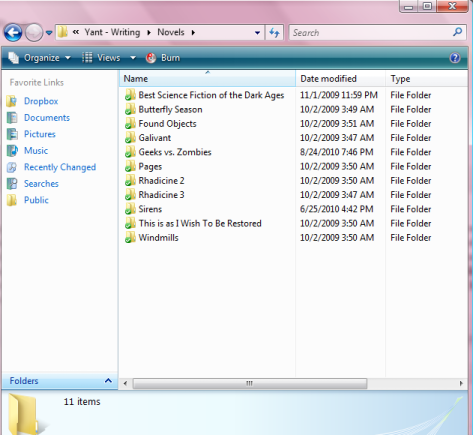
            For the longest time I thought in panels.

Once that ill-conceived Horror phase was over I passed through a comics-writing phase and filled my shelf with everything I could find on the subject at the time. My favorites are Scott McCloud’s classic Understanding Comics, and Writers on Comics Scriptwriting, edited by Mark Salisbury. There are follow-up volumes to both of these books, neither of which I have (but if you do, I’d love to hear about them in the comments!)

These are not the novels you're looking for. Move along.

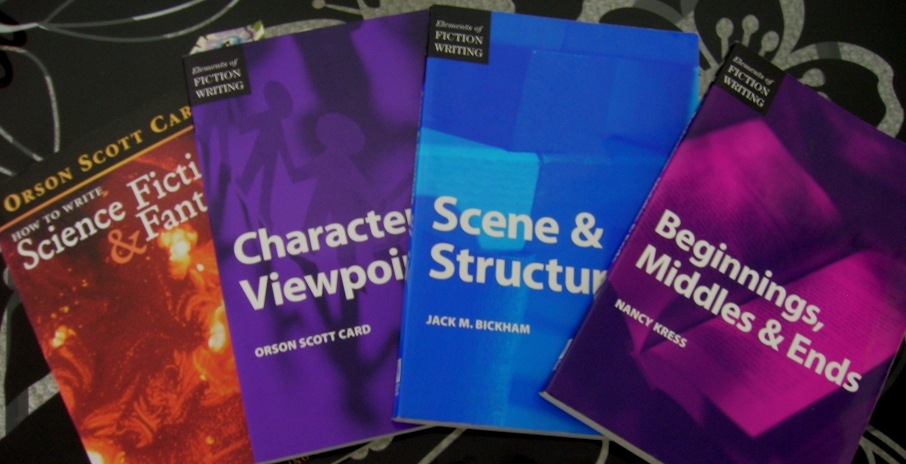
Eventually I figured out that I’m a fantasy writer and that I wanted to write short stories (please ignore the eleven novels in varying states of completion sitting in that virtual drawer there) and my education could finally begin. And begin it did, with what I consider to this day absolutely essential reading for speculative fiction writers: How to Write Science Fiction & Fantasy by Orson Scott Card. OSC has been teaching the craft for a dog’s age, and he does it well. He covers things in this book specific to genre fiction that I have not seen covered elsewhere. The chapter on submissions, agents, and pay rates is very out of date in my copy, but fortunately we have other resources (coming up in a moment) to help us in that area. That book is part of the Elements of Fiction Writing Series.

A few of the Elements of Fiction. Imaginine and Stubbornium not shown.

The business of writing is a whole other ball of wax, and it wasn’t one I really needed to know much about beyond the basics of submission/rejection/submission until this year. Fortunately for me two books came out in a very timely fashion: Jeff VanderMeer’s Booklife, and a bonus surprise book of awesomeness from SFWA that arrived last week, the SFWA Handbook. Unfortunately that one can’t be had in stores, but hey, there’s an incentive to get that SFWA membership!

For sheer inspiration I have Writing Down the Bones, and Bird by Bird. And when the most recent rejection leaves me feeling like I’ve been kicked in the teeth, I reread Ray Brabury’s Zen in the Art of Writing, which is like a hug in paperback form.

Recently I shifted from short fiction to writing novels (FOR REAL this time, I swear.) Looking for some guidance in that area I consulted my shelf, where I have Writing a Novel, by John Braine–which appears to have been replaced by the more recent How to Write a Novel–and John Gardner’s The Art of Fiction. They were a little dense and academic for me (dudes, I’m writing about magic and stuff. This is spec fic. We just don’t take ourselves that seriously here.) I remembered a book mentioned by an acclaimed novelist and found it on Amazon: The Weekend Novelist, by Robert J. Ray (though on the advice of a friend I bought an older edition.) This is what I’m now using as I plunge into development for this For-Real Novel I’m about to write. (Yeah, check back with me on that in a couple of months. Is there a book on discipline I should have on my shelf? Oh, wait, I guess Bird by Bird covers that.)

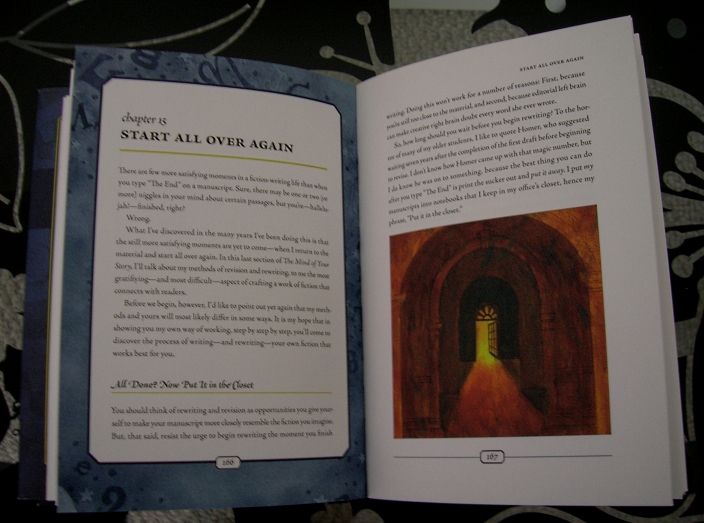
My Desert Island book on writing would probably be The Mind of Your Story, by Lisa Lenard-Cook.  Lenard-Cook covers time, pacing, and tension in a way that I haven’t encountered anywhere else. As a bonus, this thing is not only useful, it’s also gorgeous.

         The whole book looks like this. *swoon!*

(Hm. Or maybe Zen. I might need a hug on a desert island. I AM TORN.)

Of course the danger inherent in collecting and reading Books About Writing is that they can easily overtake the Act of Writing, which is, most of these books are quick to point out, THE IMPORTANT PART.  Because you know what isn’t on my shelf yet? MY OWN BOOK, written by ME, employing all of the wisdom imparted by the books that ARE on the shelf.

So, what’s on your shelf? What’s helped you the most? Are any of these–or others–on your holiday wish list?

Continue reading

prev posts prev posts