A Novel in Ninety Days

When I started my first novel in 2009, I emailed my mentor Diana Rowland and told her I was writing 1000 wds a day and was that enough? I remember her saying, “1000 words is good, but you might want to try for more.” That set me off on a new mission to write 1500 words a day, which often became 2000 words a day.

For my second novel, I started off with the goal of 1500 words a day, six days a week, treating it just like my training schedule when I was a professional fitness competitor. Six days a week, no options, no excuses, followed by a full day to rest and recover. I finished the first draft of that novel at a pretty quick pace, but wasn’t exactly sure how long it had taken.

When it came to writing the first draft of novel number three, I decided to keep track of how long it took. Am I sharing this with you to show off? A little, yes, but I also have unselfish reasons for posting it, the biggest being, if I can do this, ANYONE can do this. I’m no one special. I simply like to set goals and I get pissed off with myself when I don’t meet them, which keeps me driven and determined to reach that daily word count.
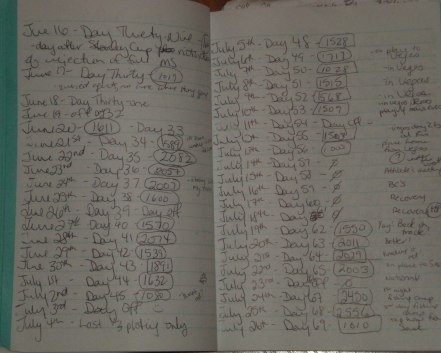
Keeping Track of Word Count

Just like in fitness, you need to find what works for you. What motivates you? What keeps you going? I use small rewards like getting to watch episodes of my favourite TV shows after I reach my word count goal. (and no, please don’t use food as a reward!) I have the PYR catalogue prominently displayed in my writing area. I have my mom waiting to read each new chapter of my first draft as I spit it out. I keep in touch with my writing friends who will kick my butt if I slack off and I have a mentor I want to make proud of me. These things keep me focused on churning out the words. It’s crucial that you find out what works for you and put those tools and tactics to use. Worry about future drafts after the first one is done.

Just like in fitness, there is NO quick fix solution. It’s about persistence, dedication and being able to forgive yourself when you slip up and miss a day, rather than spiralling into a funk that prevents you from picking yourself up and getting back at it.

I also remind myself that it’s okay for the first draft to suck, a lesson repeated by Mur Lafferty on her podcast I Should Be Writing that sticks with me. I also keep in mind the adage “you can’t edit what isn’t there.” There are many drafts and many hours of revisions ahead of me, but it’s a complete novel, beginning, middle and end and now I can fix it. Find what it takes for you to get it down and get it done.

Take a look at my ninety days. Take a close look! I wasn’t perfect, I messed up a lot, I had good days, bad days and terrible days, but I got there. You can too!

A Novel in Ninety Days

May 18            Day 1      1500 wds                     -excited

May 19            Day 2      1600 wds                    -hopeful

May 20            Day 3     1500 wds

May 21st          Day 4     0 words                       At competition to run athlete meeting, judge

May 22nd         Day 5    0 words                       At competition to run athlete meeting, judge

May 23rd          Day 6    0 words                       At competition to run athlete meeting, judge

May 24th          Day 7   1500 wds                    -getting back at it

May 25th          Day 8    1600 wds

May 26th          Day 9    1100 wds                    -fell a bit short

May 27th          Day 10  1500 wds

May 28th          Day 11   2006 wds                    -good day

May 29th          Day 12  Scheduled Day Off

May 30th          Day 13   1513 wds

June 1st            Day 14    1571 wds

June 2nd           Day 15    2300 wds

June 3rd            Day 16   1142 wds                    -little off

June 4th            Day 17   0 words                       At competition to run athlete meeting, judge

June 5th            Day 18   0 words                       At competition to run athlete meeting, judge

June 6th            Day 19   1100 wds                    -really struggled

June 7th            Day 20  650 wds                      -still struggling

June 8th            Day 21   0 wds                           -Canucks game

June 9th            Day 22   0 wds                           -Canucks game

June 10th          Day 23   1500 wds

June 11th          Day 24    2015 wds

June 12th          Day 25    1017 wds                    -whoops

June 13th          Day 26    0 wds                            -Canucks game, also, laziness

June 14th          Day 27    1586 wds

June 15th          Day 28    1227 wds

June 16th          Day 29    1600 wds                    -received rejection on full MS of last novel

June 17th          Day 30    1019                            -still bummed, not sure where this is going

June 18th          Day 31     0 wds                          *no explanation written down

June 19th          Day 32     Scheduled Day Off

June 20th          Day 33    1611 wds

June 21st          Day 34     1589 wds

June 22nd         Day 35     2082 wds

June 23rd          Day 36    2057 wds

June 24th          Day 37    2007 wds                    -at library with my mom

June 25th          Day 38    1600 wds

June 26th          Day 39    Scheduled Day Off

June 27th          Day 40   1570 wds

June 28th          Day 41    2074 wds

June 29th          Day 42    1539 wds

June 30th          Day 43   1891 wds

July 1st             Day 44     1632 wds                    -Canada Day!

July 2nd            Day 45   1080 wds                    -little burnt out??

July 3rd             Day 46   Scheduled Day Off

July 4th             Day 47   Re-plotted last 1/3 of novel

July 5th             Day 48   1528 wds

July 6th             Day 49   1717 wds                    -on plane to Vegas

July 7th             Day 50   1028 wds                    -in Vegas

July 8th             Day 51    1515 wds                    -in Vegas

July 9th             Day 52    1568 wds                    -in Vegas

July 10th           Day 53    1509 wds                  -in Vegas (Main event begins)

July 11th           Day 54     Scheduled Day Off in Vegas

July 12th           Day 55    1500 wds                    -at the Rio during Main Event

July 13th           Day 56    1000 wds                    -on plane home from Vegas

July 14th           Day 57    0 wds                          -BC Provincial Championships

July 15th           Day 58    0 wds                          -BC Provincial Championships

July 16th           Day 59   0 wds                          -BC Provincial Championships

July 17th           Day 60   0 wds                          -recovering from trip/show

July 18th           Day 61   0 wds                          -recovering from trip/show

July 19th           Day 62   1550 wds                    -Yay! Back on track!

July 20th           Day 63   2011 wds                    -better!

July 21st           Day 64    2029 wds                    -knocking it out!

July 22nd          Day 65  2003 wds                    -on plane to Saskatoon

July 23rd           Day 66  0 wds                          -at National Championships with team BC

July 24th           Day 67 2450 wds                    -1st night of camping (cabin)

July 25th           Day 68 2556 wds                    -2nd day of camping

July 26th           Day 69   1010 wds                    -trip home from Saskatchewan

July 27th           Day 70   1027 wds                    -re-plotting, planning

July 28th           Day 71   2003 wds                    -at 82, 369 wds (curious)

July 29th           Day 72  Scheduled Day Off

July 30th           Day 73 2178 wds                    -online Google hangout

July 31st           Day 74   1023 wds                    -bad day

Aug 1st            Day 75     1948 wds

Aug 2nd            Day 76    1707 wds                    -online Google hangout

Aug 3rd            Day 77      1116 wds                    -to the end! Going back for rewrites

Aug 4th            Day 78      2 hrs                            Triage editing/fixing

Aug 5th            Day 79      2 hrs                            Triage editing/fixing

Aug 6th             Day 80      1.5 hrs                       Triage editing/fixing

Aug 7th             Day 81      New “to do list” to fix/rewrite etc

Aug 8th             Day 82       2 hrs                          Triage editing/fixing

Aug 9th              Day 83     2 hrs                           Triage editing/fixing

Aug 10th          Day 84       2 hrs                          Triage editing/fixing

Aug 11th          Day 85        2 hrs                          Triage editing/fixing

Aug 12th          Day 86      4 chapters                 Triage editing/fixing

Aug 13th          Day 87     4.5 chapters              Triage editing/fixing

Aug 14th          Day 88     1.5 chapters                 -little burned out

Aug 15th          Day 89      3.5 chapters                 Triage editing/fixing

Aug 16th          Day 90     4 chapters                    Triage editing/fixing

Total word count: 94, 111.


Continue reading

Have Deadline, Will Travel.

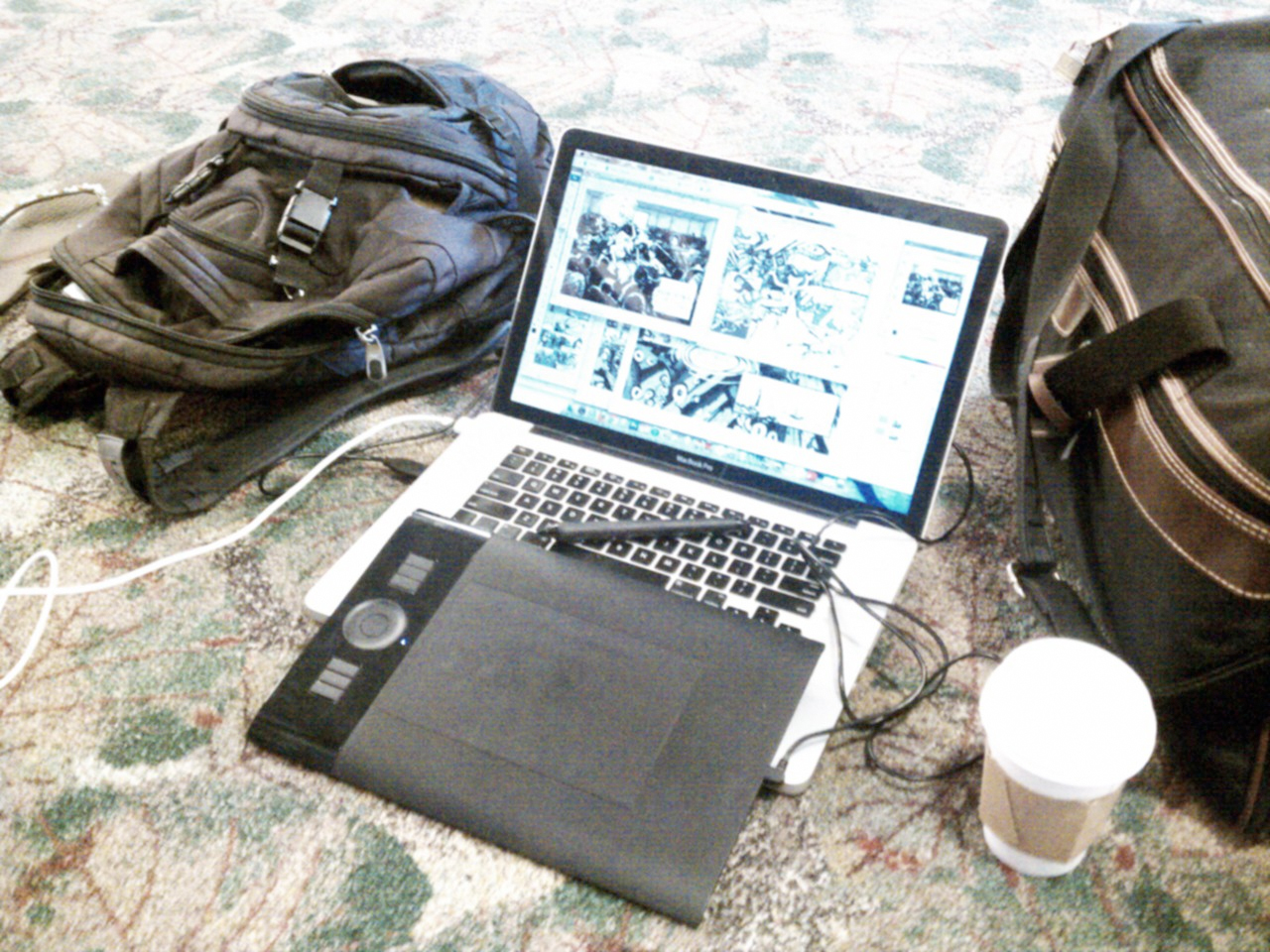
Earlier this summer, as I packed to go to the cabin with my family, I nestled my laptop and portable wacom tablet between my hiking shoes and s’mores. During that weekend in the mountains I was able to carve out an hour or so every day, between hiking and hanging out, to get some drawing done.

Last month, as I packed to go to WorldCon, I nestled my laptop and tablet between my TSA approved packet of personal hygiene items and clean undies. It was kind of silly to think I’d do much work at World Con… but I managed a little bit.  I DID get a good amount done while sitting in airports and soaring through the friendly skies between Reno and home.

This morning as I prepared for my bike ride to work, I nestled my laptop and tablet between my deodorant and lunch.  My day job has spans of downtime where I often can get quite a bit of my own work done. (I’m pretty lucky, others have to jump through more hoops to bring their work to work.)

*******

Something happened when I transitioned from art as a nice relaxing creative outlet to art as my profession….  I got deadlines! And contractual agreements. It’s not just for fun anymore, this is WORK. Plus, hey wow, money!  Who knew?  🙂

But yes, Deadlines.  As a freelance artist with a child and a part time day job, making art happen sometimes requires a bit of creative finagling.  In addition, belonging to a family unit that likes to travel (plus going on more professional trips myself) I have found I must do some tweaking with my travel time.

I’ve had to forgo trips. I’ve had to consider whether the benefits of a professional trip outweigh an approaching deadline.  And I’ve kissed family good bye with a “have some fun for me!” then planted my butt in front of the computer to make sure the missed trip is not in vain.

Orson Scott Card hired a driver to commute him to his teaching job (a drive of some distance) so he could sit in the back seat and work on his novel.

One of my art professors made his wife do all the driving on family trips so he could sit in the back seat, busy with his pencil and sketchbook.

Me, I’m trying to strike the right balance between getting work done and being present for my loved ones.  Not to mention enjoying the trip. Wendy’s summer time survival guide comes to mind and I find myself trying to not “get neurotic about it”.

So… I’m curious how you do it?

First,  how do you strike your own balance of travel and work? Have you forgone trips in order to get work done? Have you successfully (or not?) balanced travel with creative work?

And second, how do you bring your work with you? Do you have special low tech or high tech tools that enable you do to your creative work on the run?

Continue reading

Writing in Retrograde?


In recent weeks, there has been much speculation on the internet over the announced sale of Weird Tales and what that means for the future of weird fiction. Surely, the loss of Ann Vandermeer at the helm of a very successful magazine stings more than just a bit, and has caused many to worry over whether the magazine’s new owner will rewind the clock on the type of stories chosen for publication. There seems to be a general consensus that this will be a very bad thing, and I’m inclined to agree, especially given all the new voices and strange stories that Weird Tales has published in the last few years. We need magazines like that to stand on the bleeding edge and explore new territory.

But the chatter about Weird Tales is just the latest in an ongoing discussion about the direction speculative fiction should take in the modern era, and like any discussion worth having, there are a million opinions. I talked to one reader at WorldCon who didn’t think anything written after 1960 was worth bothering with. I’ve also had conversations where the opposite was stated. And it isn’t just the readers being hide-bound to tradition and writers being avante-garde risk-takers. We’re a pretty diverse bunch.

As a new and aspiring writer myself, I feel like I’m caught in a crossfire of sorts. Clearly there’s a need for new voices and envelope-pushing narratives, but what about the stories that got me reading in the first place? Some of them are pretty clunky by today’s standards, but they are still inspiring to me despite possible flaws. Lovecraft and Howard wrote tales that can often seem painfully dated (and sometimes troubling in their worldview), but the Cthulhu and Conan mythos have inspired so many writers (like me!) to tell stories of their own. I could also include Tolkien, Heinlein, and even Lord Dunsany in this list. Their works are the building blocks of so many writers’ toolkits. Dated though they seem, it’s wrong to dismiss them merely as relics of a bygone era, isn’t it?

Now there’s a whole other discussion to be had about how you might bring modern relevance even in stories that pay homage to classics (and Morgan has a good discussion of that here) , but I want to address a specific issue in my post.

Do you feel caught in the middle sometimes? Are you paralyzed between tradition and the weirder voices that call you to the edge of lands yet uncharted? Yes? Good, me too. I’d like to be more experimental in my writing, but I haven’t really developed that sort of writing voice yet. I’m not sure I ever will. I worry sometimes about not standing out. I also worry about my work sounding too much like the voices that first inspired me. I’m in the middle of a revision right now that makes me think I may be doomed to meander aimlessly between these two poles forever. I’m starting to realize that that maybe that’s okay.

Whenever I get too stressed out about being “too new” or “too old,” I recall some advice Ted Chiang gave my Clarion West class (and I’m paraphrasing a bit, here):

 What are you not getting out of what you read? It’s your job to write it. Cultivate a unique voice. Write the stories you want to write. Find your truest readers, they will be loyal!

Now Ted writes some pretty cutting edge stuff, I think we can all agree. But I think his advice remains sound no matter what you write. As a fellow aspiring writer, I urge you not to let the debate between tradition and modernity get in the way of cultivating your storytelling voice. Take risks. Subvert tropes. Tweak expecations. Have fun.

But write what’s in your heart first.


Continue reading

I Love You, Hon, Will You Critique This For Me?

Writing partners and romantic partners? Best of both worlds or trap? That’s pretty much going to vary on a case-by-case scenario. However, there are many well-known couples who collaborate on projects. The Girl Genius creators, who finally withdrew themselves from Hugo eligibility so that someone else could win, are an excellent example. However, since every case DOES vary, here is a bit about my own experience, and some tips that have helped *me*.

I’ve been absolutely useless with a story for the better part of a year, now. I’d poke around, and promptly get lost. Lots of starts and stops, but nothing really in between.

Until about two months ago, when an old flame struck up conversation with me. We used to chat on IM several nights a week, usually for hours at a time. Suddenly, we were doing that again. It’s pretty casual: we’ll be working on stuff and just generally harassing each other.

But the first night we started chatting, I made MULTIPLE breakthroughs on my writing. I started a new story, plotted a new series, was spouting ideas. It only got better after that. He writes erotica, so he’ll send me snippets of his latest Principle or historical character, and I’ll jabber on about prehistoric monsters. Weird discussions get going sometimes, like the other night, when he was talking about foreplay, but I thought we were still talking about necromancy. Hey, it can be hard to keep up with multiple things.

The other night, we worked through a scene that was giving him trouble, and he helped me redefine a short story I was floundering on. I started thinking about the patterns of productivity in my life, and made a somewhat painful discovery: I write better when I’m in a relationship with someone who writes.

I’ll be honest: it can be absolute shit.

My ex fiance and I were working on a series together. When I walked away from the relationship, I walked away from the story, too. It was too painful to work on it, because I kept discovering things he’d written. He was too integral to the world by then. In the end, I scrapped the majority of ten years of work, and, taking the themes and some ideas that were mine, started rebuilding from the ground-up.

In another of my relationships, however, we were short-story writing machines. It was fun to endlessly brainstorm. Our styles were totally different, but that worked out well: we contributed things that the other wouldn’t have thought of.

There’s a lot to be gained from writing together, and a lot to be lost. Here are a few of the things I have learned from my personal experiences:

1.) Have a discussion, early on, about honesty. Writing is writing, the relationship is the relationship. If a scathing critique is called for, give it. If your partner gives you a scathing critique, be very careful to keep any hurt feelings separate from your feelings about your relationship.

2.) Not going to lie: it’s probably best if you write for different markets. I’ve had head-to-head subs before (neither of us got accepted, at least), and it’s a bit uncomfortable. The people I’m working with now write for totally different markets than I do. I can be completely happy for them, without negativity creeping in.

Equal collaboration on the same project is another way to avoid competition. Again, watch out for blame or jealousy.

3.) Share. I have been able to bring partners into writing groups, set up connections that furthered their careers, and given them ideas. They’ve done the same for me. It’s not a competition. It’s a partnership. It just happens to also be a partnership with mushy feelings.

4.) Be very, very careful of jealousy. If you’re feeling inadequate, channel that frustration into renewed work-energy. Be aware of your feelings. If your partner gets published, take then out to dinner, or a movie, or whatever they want to do to celebrate. Make sure they know that you aren’t upset. If it’s an adult relationship, this shouldn’t be an issue, but writing is a frustrating career, and it can sneak in.

Have you been in a writing relationship? How did it go? What worked for you? What pitfalls did you discover?

Continue reading

Rewrite Requests

I have a confession to make. Out of my three (okay, 2.5) pro sales, every one of them has come from a rewrite request. Two of those stories took *two* rewrites to make them fit the editor’s vision. And right this very moment, I’m awaiting response for another rewrite request.

Frankly, I’m terrified.

Getting a request for revision scares the crap out of me. On one hand, it’s wonderful to hear that your story has caught the attention of an editor. The things that are good about your piece are clearly working. But then you’re challenged to go beyond your original concept and make changes. I always worry that in fixing the problems (or shifting the concept, in the case of one piece), I might destroy all the good stuff by accident. And I also worry that I just don’t have the talent or intelligence to solve a problem I clearly missed on my own.

Now that I’m working in editorial, I’m starting to see the process from the editor’s perspective. Some stories are so cool you just really want to buy them, but sometimes there are issues that keep a piece from really gelling. Finding a way to express the problem–without just handing the author some canned solution you, the editor-type, came up with–is difficult. What makes a story great is the unique expression of the author’s world, and losing that unique flavor is the last thing any of the editorial staff want to happen.

So far as a writer, I haven’t had a request for revision that didn’t make good sense, and I’ve been able to make the changes in my stories without undermining my original ideas. I know that doesn’t always happen. I don’t even know what I’d do if i was in that position! I’m eager to hear your stories and advice about times you received rewrite requests, especially ones that were really challenging. What did you do? Were you able to work out a compromise? Was it a good experience?

Continue reading

Critical reading means criticizing your reading

Today we are lucky enough to have a guest post by Robert Jackson Bennett, the Shirley Jackson award-winning author of MR. SHIVERS. His second novel, THE COMPANY MAN, is out now, as is his first published short story, “A Drink for Teddy Ford” in the BROKEN TIME BLUES anthology. He currently lives in Austin, Texas, where he spends most of his time wondering what happened to all of the time he once had.

Many thanks to Robert for his valuable insights.


I find reading to be a very mysterious process. It is an almost thoughtless or instinctual practice, a translation of shapes and figures on a page into an enormous glut of knowledge that is overloaded with associations, emotions, perceptions, and philosophies. And it is an act that is impenetrable to outsiders: reading is internal, solipsistic, a one-sided relationship between the reader and the text. Even the writer is excluded from this process, to an extent, for what is written is not necessarily what is read. I am always wondering what strange fruits my words are growing in someone else’s head, and am often surprised to hear other people’s thoughts about my writing. They do not necessarily take away what I thought I was putting down on the page.

If you want to study writing, or just reading in general, I think it is crucial to understand that a reading of a text – by which I mean how you take in the information provided, extrapolate it into a mental world, and then interpret it – is not necessarily as individual an act as you might think. For while the writer might believe that the reader is an audience, nodding along as they listen to the story, this is not so. I have always felt that the reader is a co-creator of a story, often doing about 70% of the work. The writer can suggest – sometimes they can suggest with a great degree of calculation and precision – but in the end, it’s up to the reader to mentally construct the characters, the story, the ambience and mood, and even the unspoken philosophy below it all. (If there is one. Again, that’s up to the reader.)

To think critically about reading, you have to always be asking two questions:

1. What is the writer trying to do with the story right now?

2. What am I trying to do with the story right now?

Yes, both the reader and the writer are trying to do something at every moment in a text, whether they know it or not. It doesn’t have to be significant, but they are doing something.

Now, you may ask what a reader is doing with the text. Because after all, the text is the text – it is inarguably right there, on the page, and you can’t say it’s something different when we can all see what it’s saying plain as day.

But that’s not true. The text is more like a blueprint, and the reader is constructing something from that blueprint. It is the reader who loads the story with the images, personal associations, feelings, and flow. Their fingerprints are all over it – not the writer’s. What is made in the end is made wholly by the reader. It is almost a part of them, or possibly a reflection of them. The more I talk to readers, the greater I appreciate people’s ability to see what they wish to see, for good or ill.

But the writer isn’t exactly powerless, of course. They are doing the damn writing, after all. And they wish to control what the reader interprets at every possibly moment. They set the limits, and suggest how we should navigate between these limits. Some suggestions are easier to ignore than others; and others are suggested so strongly and so subtly, the reader can’t even tell that they’re following someone’s directions.

It’s almost like brainwashing. Yes, I said it, because honestly, the writer explicitly sets out to control the reader’s thoughts and emotions: they want to make them laugh, cry, ponder the imponderables, and quiver in fear, all on cue. How is that not brainwashing? Even the hackiest, silliest writer out there wishes to control the reader’s attention and thoughts when they engage with their stories. They want them to ask – will she make it? Will he choose the right girl? Will they ever be happy? Will this end the way I want it to end?

You must understand that writing, like most arts, is a matter of deception, subversion, and manipulation. The writer is attempting to control the reader. Oftentimes, the reader doesn’t even realize this. Yet it’s so. And you need to see how they’re trying to control you.

Look at the prose. Wonder why they structure this sentence this way, or this paragraph, or chapter, or hell, the whole novel. These things have a grammar to them, a logic, and understanding why the author has the story function within this logic sequence rather than another is key. Try and see if there’s any pattern in the way the author describes things – is one character always paired with light, frothy, emptily pretty surroundings? Is that a good way to sum up their character? If so, did they just trick you into understanding this character without ever directly describing them?

At the same time, the reader is, consciously or unconsciously, changing the story. When you skip a part of a story, you’re essentially editing it out, cutting it. When you reread and rereread a section, you’re zooming in on one aspect, studying it closely – as the author would have done with prose, had they thought to. And I can’t even begin to describe the way your own memories, feelings, and mood shape a story as you read it. Because you’re you, not me, and such things are as inaccessible to me as they are to the writer of whichever story you’re reading.

There are a lot of assumptions in reading that you will have to break past, if you want to really dissect someone’s writing. You don’t even know they’re assumptions because you’re stuck in your head. It is an arduous process, and it almost always ends in a question that’s very difficult to answer:

Why do I think this way? Why do I perceive what I’m reading in this way, and this way alone? Is this the intent of the writer? Or is it me? It’s rabbithole thinking, and you might just have to learn when you need to stop. Otherwise, as Vonnegut put it, you’ll disappear up your own asshole.

It’s possible that thinking this way about writing can take a lot of the fun out of it. That’s a complaint I’ve heard a lot. But if you want to study writing, and I mean really study it, I firmly believe that these are the steps you’ll need to take. Because writing isn’t fun. It’s a tough, demeaning, tedious process. So to get inside that process, you’ll have to tackle the outflow and product – a text, and the reading of it – in a vigorous, incisive manner, and you can work backwards from there to understand its origins.

And yeah, it may take some fun out of the stuff you casually read. Jerry Seinfeld once said that comedians never laugh at another standup’s act – they just say, “That’s funny.” Because now they know how it works. They can see the strings in the puppet shows. They know where the rabbit’s hidden. If you keep coming at stories in this sort of way, you’ll start seeing the strings and rabbits, too.

But every once in a while you’ll find a book that trumps you entirely. You’ll find a story that is so involving, so well-realized, so mystifying and enlightening that it proves impenetrable to your incisions. It makes you feel like a kid again. And even if you can see the strings and you come to understand how it works, it doesn’t lessen that fun. It just makes you appreciate it more. Because now you know how hard it is.

And if you keep at it, maybe you’ll make a story like that one day. I know I hope to.

Continue reading

Folding Socks w/Nick Mamatas

The Inkpunks have asked me to discuss my fiction-writing process, which struck me as an odd request. The process one uses to write fiction hardly matters as far as the end result goes. One may as well ask how writers fold their socks. Do they roll them up in balls, just lay them flat, fold over once? Who cares? Whatever works, works. I was approached for this essay because of my how-to book Starve Better, which covers both short fiction and short non-fiction, and I said as much there. But, process. Okay.

My process is basically this: I spend a fair amount of time thinking about a story. I’m usually preoccupied with formal elements: should I write this in first person, past tense, have two storylines running at the same time, tell it all in flashback, etc.? When I figure out something formally interesting, I then come up with a first sentence. When I have that, I sit down and write the story. I keep the Internet on for research purposes, which I perform on an as-needed basis. If I need to know something, I look it up on the spot. It’s impossible for me to leave something for later. Usually, I hit the “ending” and realize that there is more story to go, then finish it up with a final page or so. Then I look at who is still awake and on GChat and beg someone for a proofread. Not a critique. A proofread.

Then it’s done. I spend almost zero time revising, make no outlines, and don’t put a story aside for a few weeks to return to it later. That’s it. I generally finish a story in one sitting, though some more difficult stories take up a few evenings. Length is only a secondary factor—I’ve written novelettes in a day, but one 1800-word short story took me a week. For novels, I treat individual chapters as short stories. Sometimes, I might add a sentence or three after the fact, and indeed, often after a sale but before publication.

I don’t recommend this process for anyone, not even me. It’s not appropriate for the writing of lengthy novels, which many people wish to write. It’s a pretty exhausting process as well. Ever pull an all-nighter in college? It’s like that. After about a decade of practice, I’ve managed to make it work fairly efficiently. Occasionally, I’ll have a run of doing a story a week for three, or four, or six weeks. This year so far I’ve managed to produce stories, mostly on solicitation, for the anthologies Demons, Long Island Noir, Future Lovecraft, Black Wings II, Shotguns vs Cthulhu, West Coast Crime Wave, The Mammoth Book of Steampunk (a novelette), and something for a tie-in book the name of which I cannot yet reveal. I’ve also produced a number of essays. But I still don’t write very much. When I have lunch with a writer friend, he often says something like, “I have twenty-two stories out on submission.” I don’t think I’ve ever had more than three or four out at a time after I got past the days of universal rejection.

I developed my process for mercenary reasons. For a long time I supported myself by writing non-fiction—journalism, copywriting, and even term papers for college students with more money than brains. The price was right. Even small political journals will apologize for paying as little as twenty-five cents a word; in the world of short genre fiction that’s top-dollar. I often had multiple daily deadlines, so short stories had to be squeezed in. The sprawling novels beloved of the publishing industry were a scheduling impossibility. I also discounted the future by writing work I could sell relatively quickly, instead of spending years on a novel first. My stories still tend to be on the short side—2500 words is a sweet spot for me.

The secret for me is figuring out the structure first, then filling the frame with the information the story should actually contain. Back when I was editing Clarkesworld, the plurality of the stories I rejected had informational problems—elementary lapses of point of view, false suspense, tedious exposition, and the like. The formalist method not only precludes such errors, it lets the story tell itself. After all, there is an infinite amount of information that could be disseminated about any individual or circumstance, as the endless volumes on the life of Christ, or the influence of the French Revolution, or those ol’ debbils the carbohydrates demonstrate. Form is like a cookie-cutter of any shape you like, used to slice a consumable bit of informational dough out from an infinite plane of the same.

Ultimately, the process is occult. Where do ideas come from? How do I know that the form I selected was correct? Honestly, I spend almost no time thinking about any of this. Hell, I’ve only recently realized that I write stories form-first. I’ve done it just eighty times or so in the last decade. (Essays are written differently. Novels are a variation just different enough to exclude.) Not too often, really. Writing fiction is like folding socks in that we all have our own way of doing it. Writing fiction is also like folding socks in that changing one’s method will not likely lead to cuter, or warmer, feet.


Nick Mamatas is the author of three and a half novels, over seventy short stories, and hundreds of feature articles, and is also an editor and anthologist. His fiction has been nominated for the Bram Stoker and International Horror Guild awards and translated into German, Italian, and Greek; his editorial work with Clarkesworld earned the magazine World Fantasy and Hugo award nominations. Nick’s reportage, short stories, and essays have appeared in venues such as Razor, Asimov’s Science Fiction, Silicon Alley Reporter, theVillage Voice, The Smart Set, The Writer, Poets & Writers and anthologies including Supernatural Noir and Lovecraft Unbound. He teaches at Western Connecticut State University in the MFA program in Creative and Professional Writing, was a visiting writer at Lake Forest College and the University of California, Riverside’s Palm Desert Campus, and runs writing classes in the San Francisco Bay Area.

Continue reading

The Dark Night of the Creative Soul

Several months ago I got a huge pile of notes on my novel, and was asked if hey, could I turn that around by a certain date? I said well, I will put my best effort into doing that. And now, staring at my big huge wall of notecards, assessing the structure of this thing, I’m wondering how anybody could have sloughed through this damn book in the first place.

I’ve officially gone from “I really like my book!” to “Ugghhhh, my book sucks.”

I suspect I may have been whining about it, too, because when I was polling for a topic to write about today, dealing with the pit of despair was a suggestion. But to be honest, I don’t have an answer. Or, well, I do, but it’s nothing fancy, nothing inspiring, no quick tricks here. I just kind of… suck it up and deal with it.

By day I’m a software engineer. Lately I’ve been dealing with some pretty frustrating code things. Would I like to do these frustrating things? Hell no. I’d rather be doing fun coding, building new toys, designing architecture, and ignore the boring or tiring or frustrating parts of code.

But that’s the difference between being a hobbyist programmer and a professional. For my hobby-code, if I get angry or tired or frustrated, I get to drop it, walk away, and pick it back up when I want to. As a professional, I don’t always have that luxury. Sometimes, I just have to deal with it.

The same goes for my writing. When I was younger and writing as a hobbyist, if a scene frustrated me, or edits weren’t going how I liked, or a story hit the part where I didn’t enjoy it anymore, or hell, I just didn’t feel like writing, I got to walk away. It’s for fun. I’ve got enough stress in my life, and I’m sure as hell not adding the thing I like doing to the pile of stuff that drains me. But the step between hobbyist and pro is digging in when you don’t want to do it because it’s hard, and doing it anyway.

This isn’t a judgement call, by the way. There’s no moral weight on being a hobbyist or a professional. I’m a hobbyist baker. When work gets tough, when I’m busy with other things, when I get frustrated with a new recipe that just isn’t working out, I drop it and walk away. It’s meant to be fun. It’s how I blow off steam. This doesn’t take anything away from the incredible professional chefs out there, that I’m sitting at home practicing my frosting techniques or experimenting with recipes, and it doesn’t take away from them that I only do these things when I want, for fun.

(Of course, I don’t say things like, Oh, I could be a pastry chef at a Four Seasons, if I just had the time. 😉 )

I know people talk about tips and tricks of getting out of the slump. Reward yourself. Break it up into manageable chunks. Walk away for a bit and come back to it when you’ve gotten distance. Get a friend to read it and tell you how much you rock. And actually these things can be helpful. They can get you out of a brief slump, a one- or two-day rough patch. But in my opinion, when push comes to shove, sometimes you just have to set yourself down and do it. No tricks. No gimmicks. Just hard work.

Continue reading

A thousand words

I had a conversation recently about world building, and if it was more effective to make up places stitched together from real ones, like Capital City or Metropolis, or to take an existing one and make subtle changes to fit the story. I argued that, when writing a story set in the modern world, that the background should be as real as any place and there wasn’t, by and large, a good reason to make one up just to avoid doing the research to get it right.

Cute — adorable, even, but limited.

It reminded me of an early story I wrote that suffered from generic setting syndrome. Any background details that did existed were thrown there haphazardly and not in any real sense of historical place. I didn’t see a problem with it at the time — after all, it was the characters that mattered, right? Kind of.

Just shy of two years ago I attended a weekend photography workshop in Toronto. Prior to that, I’d been snapping pictures but not putting much thought into it. Point, zoom, and shoot. Much like that early story, the subject of my photographs filled almost the entire frame, leaving little else for the imagination.

Somewhere along the line, we discussed telling a story through a photograph along with concepts such as the rule of thirds and depth of field. Something clicked in my writer brain; the little gears whirred away in the background and churned away until it could put it in terms I could understand.

One of the most valuable lessons I’ve learned is that there’s a difference between telling a story and telling a story dramatically, and that tenet isn’t exclusive to writing. The words we choose to use to communicate direct how the reader sees our stories. It works the same way for artists and photographers.

Animated image built from color and black & white
with grid source images, demonstrating the rule of thirds.

Think of the field of view as you tell a story. What details to include? Which should you leave out? Well, the rule of thirds suggests dividing your work into nine equal parts by vertical and horizontal lines. Align your subject along the intersections to create more more dramatic image.

The thing that’s important to your story is in the foreground but the background — the things you include but leave slightly out of focus, contribute to a much broader experience. Below the cut are a few more photographs that may help illustrate the idea.

Continue reading

Guest Post: On Seeing It Through

by Gabrielle Harbowy

Sometimes, writers submit their works to a publisher for consideration, and then withdraw them.
Usually, they’re withdrawing them because they’ve been picked up elsewhere. When that happens, I’m very happy for them.
Sometimes, though, writers withdraw a manuscript because at some point since hitting “send” on their submission, they’ve reconsidered and made the decision to self-publish instead. And that just disappoints me.
Not that I have anything against self-publishing as a valid lifestyle choice. I think there are times when it is a reasonable option. But, not when you have your book already out for consideration. If you’re going to say, “Okay, I’ll see if this place likes it, and if they don’t, I’ll do it myself,” at least see it through. Don’t lose patience—or confidence.
It’s like saying “You can’t fire me, I quit!” …at the end of the job interview.
The process is slow and nerve-wracking, yes. But the wait after you submit your manuscript isn’t intended to be cruel. It’s not fraternity-house hazing, it’s “patience aptitude training.” Because the process only gets slower and more stressful from there. Wait till you’re on pins and needles to announce your sale, but you can’t until the contract’s signed. Wait till you’re kept on the edge of your seat for months, waiting to see whether the cover artist captured the spirit of your manuscript, and then not even being able to talk about the art or show it to anyone once you get it.
The “waiting for the decision” part is the one aspect of the process that isn’t based in talent or luck or skill or training or any of those things that someone who really wants to write may just not have within them. You could have all those things, and if you lack the basic self-confidence and patience to see it through, all the talent and potential in the world won’t help.
Often, it turns out that the people who don’t think they can make it through the critical stages of the process are the ones who have the most to learn from editorial critique and proofreaderly polishing. There’s a reason that they’re not confident, and it’s that they know deep down that they’re not ready, and they don’t want to hear it. But without hearing it, and learning from it, there’s no way to strengthen those skills and earn that confidence.
You can’t quit the corporate world and become self-employed because you don’t want a boss. When you’re self-employed, every client becomes your boss. There’s no critique-free path. It’s the same with publishing. Even if you decide to just do your own thing and promote yourself without the “gatekeeper,” you’ll still have to face judgment. It’ll be more constant judgment, actually, and it’ll be by the thousands and millions of shoppers browsing Amazon.com, not just by a single editor or agent.
Gaining public recognition, fame and fortune through your work isn’t easy. If it were easy, everyone would do it and restaurants in NY and LA would be barren of waiters. There are parts of the process that are uncomfortable, parts that require stretching our boundaries past where we think we might break, and parts that are just plain unpleasant.
Now, that’s not to say that I think people should “just get over” their boundaries. Sometimes these things just aren’t negotiable, and sometimes someone’s insides do come between them and what they’ve always wanted. When that happens, it’s good to discover it early in the game.
(Considering that I am not currently a professional symphonic percussionist, I know of what I speak, here.)
It just always makes me wonder what really makes the writer pull the manuscript, and if the boundary really was as unyielding as all that. It saddens me because if they did have it within themselves to wait, after all—if all they needed was to push themselves a little harder, a little longer—they’ve now deprived themselves of the knowledge that they can see it through; that they can submit work like the pros do, and go through the process, and come out the other end of it.
Stick with it. Submit your work with confidence and stand by your submission and your confidence that you have the ability to break into that market, even if this particular submission isn’t the one that gets you there.
Because that experience of withdrawing, the act of validating that self-perception that you can’t hack it, will hurt you—your writing career and your sense of personal ambition and your internal measure of what you are capable of achieving—far, far more than a single “no thanks” from a publisher ever would have.


GABRIELLE HARBOWY (www.gabrielle-edits.com; @gabrielle_h) is a San Francisco-based editor and writer of fantasy and science fiction. She copyedits for Pyr and Seven Realms Publishing, and is Associate Publisher and acquisitions editor at Dragon Moon Press. She has worked with New York Times Bestsellers and Hugo Award winners, and has acquired books that have gone on to become finalists and winners of ForeWord Magazine’s Book of the Year and the Bram Stoker Award. As a writer, her short fiction appears in print and podcast anthologies. Her anthology “When the Hero Comes Home,” co-edited with Ed Greenwood, is available from Dragon Moon Press.

Continue reading

prev posts prev posts