Conversations

This is not a post about writing dialogue.

Last weekend, I caught up with an old friend over dinner. We first met in a now-defunct writers’ group, back when I first had an inkling I might want to give this whole writing thing a shot. As one of my first beta-readers and original fans, I owe a lot to her critiques from those early years. She and I have been in and out of touch, but thankfully we’ve recently reconnected.

She’s a fan of speculative fiction, but she feels that genre fiction is sometimes too much in Conversation* with itself to reach the wider audience it seeks with its “big ideas.” Imagine two mirrors reflecting each other. Was genre looking outside itself as much as it should? She conceded this was more a problem in the past than now, where genre has a much larger diversity of voices and perspectives.

Our chat lasted a good hour, and we debated the finer points of each other’s opinions, and each conceded to the other certain exceptions and nuances. I’m not going to reopen the debate between genre and literary fiction here,** but I went home asking myself a lot of questions I hadn’t considered before. Who am I in Conversation with when I sit down to write a story? How do those Conversations affect the stories I tell?

This may seem obvious, but the first person I’m in Conversation with is myself. Even with I’m just messing around, there’s a lot of interior dialogue*** going on between my conscious and unconscious selves. Everything that I write can’t help but be a continuation of that discussion. What do I love? What do I hate? What do I fear the most? I don’t lay out my whole interior life raw on the page, but certainly my passions inevitably leak through.

Then I (hopefully) publish a story and I have a Conversation with the readers. They bring their own perspectives to my story, exchanging ideas in a way that even if I’ve done my job right I only have limited control over. Can I anticipate who might be reading my story? To a degree, I can, by submitting to certain markets and writing particular types of stories. If I’ve done my research, I know the audience for the story I’ve written. Do I cater to them or do I worry about entertaining myself first?

If I’ve written a story about a mutant cyborg squirrel, then it will inevitably be compared to every other story about a mutant cyborg squirrel. It’s also in Conversation with all the stories about mutants, cyborgs, and squirrels. What does my story say about all of those subjects? There’s no way I could read every story about these three things, but maybe I’ve read a few of them. Is my story in response to one of them? Whether I like it or not, my augmented super-squirrel (let’s call him Acorn-X) does not exist in a vacuum.

Where does my story about Acorn-X**** stand in relation to the times I live in? Maybe he’s a response to all the crazy news I’m reading on the internet about rat brains controlling Predator drones. Or some kind of statement on ethical treatment of animals. Maybe I just like squirrels.

This is not a post with answers. I’m still wondering how much of this stuff to consider when I’m writing a story. It’s very possible I’m overthinking it. I’m the kind of writer who sits down with a character or situation in mind and just starts to write until something happens. This is not a method for everyone. I know writers who are so compelled by issues that they must write stories in response. That’s fine too. But most of these Conversations happen outside my control. I feel like I need to satisfy myself first.

Who are you in Conversation with?

Me and the rest of the Inkpunks, I hope. I’d love to hear your thoughts below.


* With a capital “C” 

** For the record, neither was my friend. We both agreed that literary fiction could be in just as much of an echo-chamber as any other type of fiction.  

*** still not a post about dialogue. 

**** not actually a story I’m writing. 

Continue reading

In Her Forehead Are the Blessings of Allah

Fair warning: you do not ever, ever want to watch a movie with me that has horses in it. Yeah, one or two movies don’t get it stupid, but the majority? Mmmm. This post isn’t going to correct EVERYTHING Hollywood gets wrong, but that’s not what it is about. It’s more about examining the horse as a companion and cohort in heroics.

I come by it honestly: the first picture of me on a horse, my mom was holding me. I was 6 months old, on a 6 year-old half-Arabian who had been bred by my family. Over the years, I continued riding, and when I was thirteen, started apprenticing with local horse-trainers. My first trainer had me working with her stallions, and we discovered pretty quickly that I wasn’t bad with the ‘hopeless cases’. I got out of it for a few years after a series of bad wrecks: broken nose, dislocated rib, sprained ankles and back and wrists, a kick to the head, being trampled. My confidence was gone and I was getting hurt. I didn’t get back to it until just a couple of years ago, when friends rescued a blinded, starved, terrified stallion from his abusive owner, and needed someone to train him.

What can I say? I’ve spent more time with horses than I have with humans. I don’t always understand the silly language the two-leggeds use. I’m used to the subtitles of weight and stance, the invisible moods. I believe that they are over-romanticized and yet given far less credit than they deserve.

There are documented cases of them fighting off grizzly bears, rescuing their riders from deadly circumstances at the cost of their own lives, and saving battle campaigns. They are incredible, beautiful animals bound into every corner of human history, and yet a genre which can spend a dozen pages on the layout of a city, paints over horses with the broadest brush possible.

As a hero, the horse cannot be surpassed, because it has no interest in glory or gain, but will, for the right person, be far more vital and essential than sword, shield or quest.

And yet, I am constantly disappointed at the minimalization of the horse in heroics. It is usually either vastly undersold and boring, or so incorrectly written that my teeth grind the entire way through the story. The horse has as much place in speculative-fiction as any dragon or human character. It deserves equal research and attention to detail.

Overview

The history of the horse can be divided, roughly, into 3 parts: War, Leisure and Work. Of these 3, war is where the horse made its greatest mark on history. Work could be accomplished by oxen, leisure would have found another vehicle.

But, for being a prey animal, the horse is uniquely suited for war.

It is sure-footed, strong, alert, agile, fierce, independent, intelligent and enduring. A truly great horse was not a tool to its rider, but a friend, a comrade in arms, and, frequently, the only reason that rider could walk away from a battle. Stories abound of a horse moving to take a sword intended for its rider, bearing a dead body for miles to bring her master home, dragging a wounded warrior out of battle, or standing over a critically-injured rider.

The horse plays a significant role in human history, and in the stories of war and heroism, especially. The greatest military figures raised monuments to their beloved horses: the great, rearing figure of Bucephalus; Napoleon’s little Arabian, Marengo; the Duke of Wellington’s bright chestnut, Copenhagen; El Cid’s Babieca. The Age of Chivalry was carried on the backs of the platter-hoofed chargers, Genghis Khan overwhelmed half the world on his wiry little steppes ponies.

Hussars Reenactment

The military organizations of the world are at the root of nearly all modern horse sports, from dressage to vaulting, and even conformation competitions. Nearly every European military organization had its own stud farms and trials. Most European horse breeds owe their modern incarnation to a military academy. Horses were in wide-spread use even into WWII.

And yet, they are gentle, curious, loyal creatures, too. A well-treated horse genuinely enjoys his people. My horses have to be put in another pasture if we’re trying to work, otherwise they are picking our pockets, sorting through the tools or generally behaving like half-ton cats. And that’s all well and good, until one of them does something like pick up a hose and spray you in the back. See what I mean?

So, let’s talk horses.

Reality and Myth

Hollywood fills our screens with towering, prancing horses with flowing manes and tails. The Mongolian and the Crusader ride the same beasts, in the movies, and that frequently bleeds back into our fiction, as well.

Ponies are significantly stronger and have greater endurance than most riding horses. Pound for pound, they jump higher, pull harder and last longer. The Mongolians rode ponies that, to us, look about as sensible as the kid-sized bikes you see full-grown men on. In addition, these tiny horses carried huge packs, ran for days, and were as dangerous in war as their riders. They also took a minimum of food, and the rider could get on them quite quickly, unlike the European knight, who had to literally be lifted onto his towering beast.

Bite-Sized

Monster-Truck Sized!

However, there are three breeds which are not only Hollywood-beautiful, but are actually the foundation of a great deal of equine myth. They are also uniquely suited to the hero’s needs, and common enough for information to be found on them without my more specialized journals and translations.

“The Blessings of Allah”

The fabled Arabian horse, best known from movies like The Black Stallion, deserves its reputation. There is no creature on this earth which has the level of intrigue, history and myth of the Arabian, up to and including the dragon. But they were small horses, fierce, brilliantly intelligent, long-lived, and of incredible stamina. Mares were of far greater value than the stallions, being quieter and more loyal, and were used in battle. Mares of certain lineages were the celebrities of the culture, and their daughters and great-great-great-granddaughters are still treasured and sold for incredible amounts of money.
(In other words, as nice a story as it is, The Black Stallion would actually have been shit out of luck. A mare? The entire clan might well have gone to war over a particularly-prized mare.)

The horses were hand-raised from birth, kept in their master’s tent, and wanted for nothing. They were hand-fed on camel’s milk, dates, mutton fat, honey and alfalfa. They were, essentially, very large house-pets, and devoted utterly to their families.

I have been unable to find the source for this, as a lot of my books are still in boxes on the East Coast, but the Bedouin are said to have used the following to determine their greatest mares:

“She was first run 50 miles without rest or water, caused to swim across a river at least once, and, if she immediately went to her food afterward, was never sold for any price.”

(If someone knows what book that was in, please let me know!)

The Original Arab

“It was believed that the bulging forehead held the blessings of Allah. Therefore the greater the “Jibbah” the greater the blessings carried by the horse. The great arching neck with a high crest, the “Mitbah” was a sign of courage, while a gaily carried tail showed pride. These traits were held in high esteem and selectively bred for.”

(A note about this video: It is, basically, a long ad for the Sheik’s stable. However, it goes into the attributes of the breed, the relationship between the horse and rider, the way these horses are cared for, and some of their lore. It is also an excellent example of the Arabian horse as it was BEFORE the American show ring got hold of it. These are quite different from the thin, skittish horses one all too often sees on the market these days.)

Right Out of a Fairytale

Andalusians and Lusitanos were bred in Spain, and related closely to the Arabian’s cousin, the Barb. “Unnervingly intelligent”, strong, breathtakingly beautiful, these are the fairytale horses, with their ground-sweeping manes and tails, their flashing feet and their thickly-crested necks.

The Moors rode these horses, and they were, while not as fast or fierce as the Arabian, in no way an inferior breed. They are still popular today, and used extensively in movies. I’m sure the video will show you why!

Andalusian

“Their Kingdom Is the Back of a Horse”

And last, but certainly not least, the Akhal-Teke, the ‘heavenly horse’ of Turkmenistan. If the Andalusians are ridden by the fairy-tale prince, then the Akhal-Teke is the fairy-king’s horse: tall, impossibly slender, glimmering with a metallic sheen, their heads in the clouds. They can be almost alien.

Akhal-Teke

The Teke developed in one of the harshest climates on earth. The history and lore of the Teke is too extensive to go into in this one post, but the following two bits of history illustrate their incredible strength very well.

“An Akhal-Teke stallion with three Teke warriors and two heavy felt coats aboard and wounded by a saber escaped the pursuit of Cossacks over shifting sands and reached Merv (500 km away).”

“In 1935 Akhal-Teke and Iomud horses completed a ride from Ashgabad to Moscow, a distance of 4,300 km, in 84 days. It included some 360 km of desert, much of it crossed virtually without water. This feat has never been equaled. It was also the salvation of the breed, as Stalin was, finally, convinced to preserve the creatures he had been killing off.” ~

The Nitty-Gritty

Horses are measured in ‘hands’, from ground to the withers (bony point of the shoulder at the base of the neck). Hands are now standardized: each hand is four inches. The Bedouin and most other horse-based cultures also had precise measurements for the length of the horse and each of its components, right down the ideal number of fingers between the eyes.

Fifteen hands is five feet and is the average height of a riding horse. Such a horse will, depending on breed, weigh between 900-1200 pounds.

Draft horses, bulging with muscle, can be from 14-19 hands, on average, but can weigh up to 3000 pounds. The largest horse known was 22 hands and weighed 3360 pounds.

Draft Horses

Ponies, contrary to popular opinion, are not judged by height, but by having a very different conformation from horses. However, they usually range from 11 to 15 hands. As mentioned earlier, they are much hardier and stronger than the average horse.

A horse talks primarily with its body, like any herd animal. It also communicates in whickers, nickers, bugles, screams, squalls, neighs and bellows. The scream of an angry stallion is a heart-stopping thing, because in that moment, the horse turns from prey to downright predator. The same horse will make the softest, friendliest of nickers, fluttering its nostrils and producing a sound as much felt as heard.

The basic gaits are walk, trot, canter and gallop. A horse can go all day at a trot. The rider? Not so much. If you aren’t used to it, it’s like riding a jackhammer. Certain breeds are ‘gaited’: smooth, ground-eating strides.

A good horse takes a normal man and raises him–literally–above the rest of us. The power and magnetism of the creature can’t be denied. It makes us faster, stronger, bigger, better. Ultimately, horses are not cabbages or NPCs or fodder. They will affect your story as much as any character.

So do yourself a favor, and get to know man’s real best friend.

Continue reading
Guest post from Vylar Kaftan: Submission statistics and revision habits

Today we bring you Part 2 of Vylar Kaftan’s ultra-nerdy guest post on her submissions data. This post originally appeared on her blog. Thanks again to Vylar for letting us repost it here!


I’m often asked about when to revise rejected stories, and whether I change stories before sending them to another market. Previously I posted the raw data for my story submission history, which was cross-posted to the SFWA blog. Here ’tis, if you want to look. Readers had other questions, so I promised to cover some related topics:

1) How many times do you submit a story? Until one of the following happens: a) I sell it, b) I trunk it. And by trunk it, I mean consciously decide that I won’t circulate that story anymore (as opposed to indecisively letting it rot in my files). So far, my record is 19 submissions before a sale. As for when to trunk it…

2) When do you trunk a story? According to my records, there are only two reasons I trunk a story. a) I don’t think it meets my current standards, or b) I run out of suitable markets to send it to.

What’s a suitable market? Any market that I would be proud to appear in which publishes that type of story.

What are my current standards? Well, when I finish a new story, I give it a thorough evaluation. I weigh factors like what I think of the story, what crit group readers said about it, its general salability, and so on. This process is non-creative and purely businesslike. It’s a lot of guesswork too.

I classify my stories (very loosely) on three levels: A, B, and C. A = I think I can sell this. B = maybe, maybe not. C = I’m not even sending this one out. To keep myself honest, I have a (very) approximate ratio of 2/3 A, 1/3 B, and the occasional C. Why such a biased ratio? Because the way I work, most of the stories which would be C’s never get finished. Many of the B’s don’t either, because I notice the problems while still drafting. You should see how many abandoned fragments I have in my files…

If I decide a story is an A, then I don’t care how many rejections it gets–it keeps circulating until I run out of markets. (I never decide which is my best “A” story; they’re all part of Team Kaftan once they make the cut.) If I decide a story is a B, then I still circulate it… but after a few rejections and several months have passed, I’ll take another look and ask myself, “Is this story worth it?” And that depends. Sometimes I think, “Yes, it’s better than I remembered.” Other times I think, “This one really isn’t that great.” And so I re-rank it A or C, and proceed accordingly. Sometimes I’ll keep it in B status for another six months.

You could say that my B ranking is like probation. If I’m unsure about a story, I put it on probation, and take another look 6 months later before I either lock it up, set it free, or possibly keep it on probation.

3) What’s your submission strategy? Same as all the pro advice I’ve ever heard: start with the top-tier markets and work your way down, with some exceptions made for themed anthologies and other “perfect fit” situations. Sometimes this means that a story circulates through the big markets before I notice a problem, and then I fix it just in time to hit the lower-tier markets. Annoying, but that’s the way it goes. Leading to the last point, which is…

4) Do you revise rejected stories before sending them out again? Now this is the most interesting and the stickiest question here. Because on one hand, you can make a lot of improvements to the story if it circulates for a few years, which can happen (as I demonstrated in my last post). After all, you should be a better writer a few years later. But, on the other hand… you can waste a LOT of time revising stories that aren’t worth your time. Your earlier stories are probably weaker than your newer ones. As some say, you can’t polish a turd (but I prefer to say “you can’t build a skyscraper on a sand pit,” meaning that your older stories probably are built on shaky groundwork). The amount of time it would take to bring an old story up to your current standards is usually better spent writing a new story.

I’m going to repeat that, because I see so many new writers get hung up on this. The amount of time needed to fix an old story is usually better spent writing a new story. It’s actually less work to build something new on a strong, fresh foundation than it is to retrofit a shaky old story that isn’t really working. (This is NOT the same thing as me telling you not to revise. I’m saying: draft it, revise it, then circulate it–but once you’ve started it circulating, don’t waste your time revising it.)

So back to the question: do I revise between submissions? The answer is mostly “no.” But there’s a few exceptions to my rule. I definitely look at stories again after they’ve been circulating for six months, if for no other reason to assess whether I still think the story is strong. I permit myself one (ONE!) passthrough on a prose level, to tighten sentences and catch bad phrasing that I originally missed. This process usually removes a few hundred words. I put an unofficial time limit on this revision: seven days or so. If I haven’t done the revisions within seven days, I put it back in circulation. Why? Because if you let it sit in your files, it tends to stay in your files. For a very long time. Not getting revised–and worse, not circulating.

Every once in a while I change a few sentences on the ending. (I don’t know why it’s always the ending, but it is.) I still make myself send it back out within a week. And I never revise “between every submission” or something insane like that. If I did, I’d never get stories sent out.

With all rules, there are exceptions, and I suppose someday there will be the story that I pull from circulation and completely revamp. If my intuition told me to do this, then I would. (Just don’t confuse intuition with laziness or fear.)

If I find myself stressing about whether my stories are good enough, and shouldn’t I revise them more so they sell, and maybe if I revise them they will sell… you know what? 100% of the time, that indicates I should be writing new stories. Because you can’t really assess whether your older work is any good unless you’re writing new stuff. You’ll be too biased and want the older stuff to work so you don’t have to write anything new. If you only have one story circulating, there’s no way you’re going to make smart decisions about what to do with it. By generating new material, you give yourself the freedom to be honest about your older work.

In short, this whole post boils down to The Rule, which has only a few exceptions as detailed above: Write new stories, polish them, and then circulate them until they sell. That’s how you get stories published.

Hopefully this is helpful for someone. Ask if you have questions.


Vylar Kaftan writes speculative fiction of all genres, including science fiction, fantasy, horror, and slipstream. She’s published stories in places such as Clarkesworld, Realms of Fantasy, and Strange Horizons, and founded a new literary-themed convention called FOGcon. She lives with her husband Shannon in northern California and blogs at www.vylarkaftan.net. Her story, “I’m Alive, I Love You, I’ll See You in Reno” (originally published in Lightspeed), was nominated for a Nebula Award.

Continue reading

Better writing

Last night, I sat in an airplane and wondered how I could be a better writer.

The golden glow of the reading lights filled the plane’s interior, and every few seats, someone had left their window open. California moved beneath me in a half-seen, half-suggested pattern of black earth and ribbons of sparkling light. Everything was glazed with that peculiar sheen that comes from too little sleep and too many emotions. World Fantasy had filled my head with dozens of books I wanted to read, hours of good advice, and the feeling, nagging and unkind, that I could and should and must be and do more. There was no way to keep reading the book of essays that lay on my lap. How the hell could I be a better writer?

And more importantly, what did that even mean? For me, what could that mean? Or for the editors who buy our stories? Or the groups that give out industry awards? What makes fiction good and how we do we find the tools to create it?

What does better writing mean to you?

Neil Gaiman says that fictions are the lies we tell that are true. Perhaps the best and only thing I can try is to seek the truth. It is out there, hidden beneath the pattern of dark and light, silent and invisible. There is no way to see or speak it except obliquely. You come by the truth by sailing around the world from the opposite direction, and this is why a book about zombies can hint at the truth, or a book about a girl who will not replace her eyes with buttons.

The truth is out there, and it is our job, our obligation, our only hope to make its portrait using just letters, punctuation and snippets of our own souls.

My punctuation is fine. It’s my soul I’m worried will never be good enough.

Continue reading

Making NaNoWriMo Work For You.

A week from today is November 1st, and the start of National Novel Writing Month. I participated in NaNoWriMo two years ago, and am wondering if I should subject myself to this painful experience again this year. Maybe others are contemplating similar questions.

Two years ago, I had no clue if I could write anything longer than 5000 words. NaNoWriMo was a personal challenge. And I met my goals and got two things out of my 2009 gambit: a) I learned that under deadline, I could write a lot, even while staying on top of parenting and work responsibilities. b) I also realized the value of turning off my inner critic during the first draft.

Before that NaNoWriMo experience, writing 1000 words in a single day was a like pulling my own teeth. But because the daily average needed to reach 50,000 words was nearly 1,700, and because I only wrote half the days, I kicked out three, four, five thousand words on many of my active writing days. My record was 8000 words on one Saturday. And cooking meals, folding laundry, and clocking 40+ hours per week at work were no longer valid reasons to not write.

I’m not sure how many NaNoWriMo participants do this, but I had about a dozen subscribers who expected at least weekly updates from me. This focused my writing towards an audience, but I somehow managed to turn off my inner critic anyway. My harsh super-editor seems to be worse when I’m the only reader anticipating my work.

Fast forward to 2011. My have the self-knowledge I gained from my first NaNo experience. I’m on the verge of writing a new novel. I still have a lot of ideation and maybe even outlining that I’d like to do. But I’d also like to get this story out of my system. I’m thinking of attempting NaNoWriMo again, but I wanted to hear about the wisdom you gained.

So, here are a few questions for you NaNo vets:

  • Are you going to participate in NaNoWriMo this year?
  • How many NaNovels have you completed?
  • What have you learned from NaNoWriMo in the past?
  • If you plan on doing it this year, what specific goals to you hope to accomplish? (I’m assuming that writing 50,000 words is a stepping stone to something more)
  • What advice do you have to help other writers like me to have a successful NaNoWriMo experience?
  • If you’re a NaNo veteran but have chosen not to do it again, what keeps you from returning?

Thanks, in advance, for your wisdom!

(My profile page is here–feel free to share links to your profiles below.)

Continue reading

World Fantasy 2011 Inkpunks Event Calendar


Saturday, October 29, 8PM – 9PM, Suite TBD (fliers will be available at the con with the room number on it)

We will be having a reading in one of the suites, where seven of us will be reading selections from our published or soon-to-be-published work. There will be snacks and booze and door prizes, so please do come!

List of Readers, in order:

  • Andrew Penn Romine
  • Erika Holt
  • Morgan Dempsey
  • Sandra Wickham
  • Christie Yant
  • John Remy
  • Wendy Wagner


Individual Schedules

Andrew Penn Romine
  • FRIDAY 8P — Mass Signing
  • SATURDAY 6P — Room TBD — Edge Book Launch and Reading
  • SATURDAY 8P — Room TBD — Inkpunks Group Reading
  • SUNDAY 10A — Room TBD — Crossed Genres Group Reading
Christie Yant
  • FRIDAY 12P — Pacific 6/7 — Reading, The Three Feats of Agani
  • FRIDAY 8P — Mass Signing
  • SATURDAY 2P — Room TBD — The Way of the Wizard Group Reading and Party (reading The Magician and the Maid and Other Stories)
  • SATURDAY 8P — Room TBD — Inkpunks Group Reading (reading This Rough Magic)
  • SUNDAY 1P — World Fantasy Awards Banquet
Erika Holt
  • SATURDAY 6P — Room TBD — Edge Book Launch and Reading
  • SATURDAY 8P — Room TBD — Inkpunks Group Reading
Galen Dara
  • SATURDAY 2P — Pacific 1 — Beautiful Monstrosities: How have artists made inhuman, monstrous and even ugly characters attractive and sympathetic in art?
John Remy
  • FRIDAY 8P — Mass Signing
  • SATURDAY 6P — Room TBD — Edge Book Launch and Reading
  • SATURDAY 8P — Room TBD — Inkpunks Group Reading
Morgan Dempsey
  • SATURDAY 6P — Room TBD — Edge Book Launch and Reading
  • SATURDAY 8P — Room TBD — Inkpunks Group Reading
Sandra Wickham
  • FRIDAY 10A — Pacific 1 — But Can You Bring Him Home To Mother? -UF
  • SATURDAY 6P — Room TBD — Edge Book Launch and Reading
  • SATURDAY 8P — Room TBD — Inkpunks Group Reading
  • SUNDAY 10A — Room TBD — Crossed Genres Group Reading
Wendy Wagner
  • THURSDAY 10P — Pacific 1 — How to Survive the Coming Zombie Apocalypse
  • SATURDAY 2P — Room TBD — The Way of the Wizard Group Reading and Party
  • SATURDAY 6P — Room TBD — Edge Book Launch and Reading
  • SATURDAY 8P — Room TBD — Inkpunks Group Reading
  • SUNDAY 10A — Room TBD — Crossed Genres Group Reading

Continue reading

Year of Inkpunks, My Little Retrospect

Two years ago I went to World Fantasy in San Jose on a lark. Friends of mine said I had to go, especially since it was local. So I went. And I wound up meeting about half of what would become the Inkpunks.

I felt incredibly awkward and shy, so I drank enough vodka to keep that part quiet. I had little business cards I got off VistaPrint. Someone asked me what I was writing. I dug my toe in the carpet and mumbled something about this book I was working on. The only reason I felt semi-legit was because I knew the area, having lived downtown for over a year.

A year later, I went to World Fantasy in Columbus. We had just fired up the Inkpunks blog and it felt like this silly, wonderful thing, and I wasn’t sure how I got the invite but I wasn’t about to go questioning it. I was still shy enough to need All The Vodka. I had the same VistaPrint business cards. My main levelup was that I had finished a novel, and could describe that novel in one sentence.

Now, it’s a week before World Fantasy in San Diego.

I’ve made two sales, one of them pro. I’ve done a reading (for better or for worse). A totes legit agent has given me incredible crit on my novel and I have done my best with it and that will be going off in a few days. I have nice business cards, custom ones. I’m back to digging my toe in the carpet about what I write. I will still need All The Vodka.

But more importantly, I gained some really good friends. I helped a friend move cross-country. I watched a friend marry the man she loves. I’ve celebrated victories and offered comfort and made care packages and gotten check-in emails when I’ve needed them. I have friends I can count on when shit goes sour. Friends who will go out of their way to make sure I talk to specific people, friends who will understand when I say that I need to go be on my own for a little bit.

The writing stuff will come and go. There’ll be successes, and there’ll be failures. But I know I’ll be able to handle all the madness because I have people who are willing to listen to me whine and willing to bolster me when I’m feeling down and who are looking forward to celebrating my triumphs with me.

Continue reading

Guest Post by Vylar Kaftan – Submission statistics: times submitted & length of time waited

Today’s guest post is part one of two from Nebula-nominated author Vylar Kaftan. These posts originally appeared on her blog. Many thanks to Vylar for letting us repost them here!


I’ve published about three dozen short stories, and perhaps 1/3 are SFWA-qualifying. I thought I’d open my submission history in case it would help a new writer see what the submission process looks like. Because the data is less clear-cut and requires some history I don’t have, this won’t be quite as nifty as my diversity statistics, but I hope it’s helpful for someone.

The first thing to know–this is only my submission history post-Clarion West, so it starts in 2004. I did send a few stories to the big magazines in the very early 2000s, but they had staples and single-space and all sorts of horrors. I still have those stories in my files, but I don’t think I have their submission history.

Second, this is not in chronological order. I sorted it by times submitted, since that’s the primary question people wanted to know. I did look for any patterns, like whether stories were selling faster or not in more recent years. No pattern. I mean, this list includes everything from my Clarion West submission story to my Nebula-nominated story from Lightspeed. You really can’t tell which is which from the raw numbers, which I think is fascinating.

Third, this doesn’t include any of my stories currently in circulation or waiting to be circulated. (I treat stories like hot potatoes and try not to keep them in my pocket very long, but sometimes I have to wait for particular markets to open.)


Here’s some raw data.


Times subbed Sold/trunked Months waited
1 sold 1
1 sold 1
1 sold 1
2 sold 2
2 sold 6
2 sold 3
2 sold 2
2 sold 2
2 sold 4
2 trunk
4 sold 6
4 sold 7
4 sold 9
4 sold 16
4 sold 20
5 sold 18
5 sold 13
5 sold 5
5 trunk
5 trunk
5 trunk
6 sold 20
6 sold 11
6 sold 8
6 trunk
7 sold 23
7 sold 15
8 sold 21
8 sold 24
9 sold 36
9 sold 15
10 sold 24
10 trunk
10 sold 26
10 sold 26
11 sold 33
11 sold 25
12 sold 33
12 trunk
13 sold 48
14 trunk
19 sold 36

That’s 42 stories. I sold 34 and trunked 8 (81% and 19% respectively). Of the 8 trunked stories, my reasons were: didn’t like the story anymore (5), or ran out of suitable markets (3). That’s a simplification, but close enough.

Average number of times submitted before a pro sales: 6.1. Average number of times submitted before a semi-pro or other sale: 6.5. I don’t remember how to do the math for statistical significance, but I’m pretty damn sure those numbers are not very different. 🙂

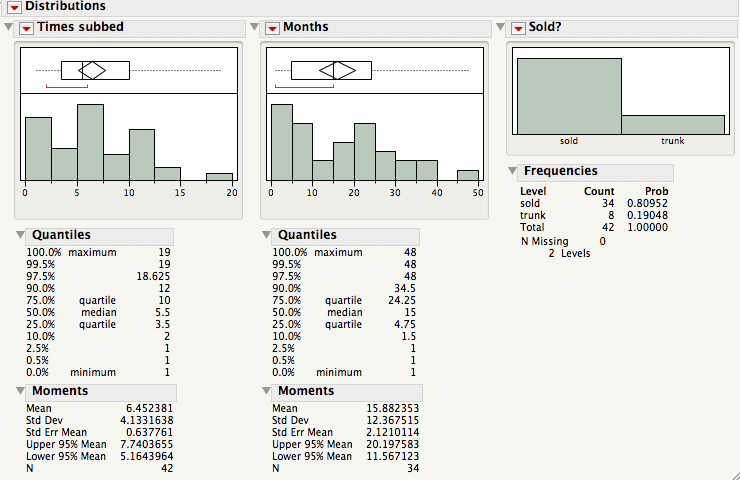
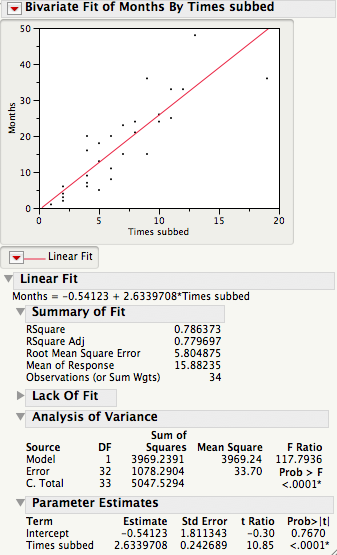
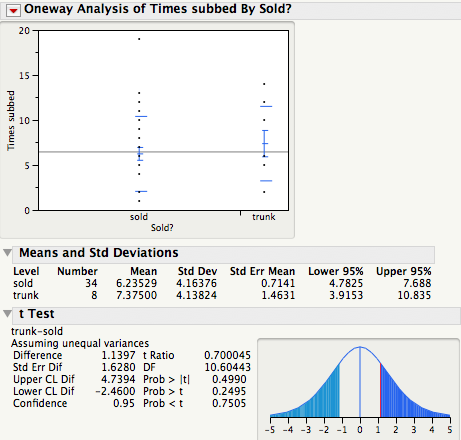
My friend Annaliese Beery made some delightfully nerdy histograms of this data. She reports that there’s no significant difference in number of times submitted by whether or not it sold. They’re included at the end of this post.

So, some observations about that data now.

1) That story with 19 subs (18 rejections, accepted at the 19th place) received 6 Nebula recommendations, back when we did that sort of thing. There was nothing wrong with it. It just had to find the right home. Here endeth the lesson.

2) If I scan the list looking for my “best” stories, using any of several measures, I can’t see a pattern. Possible measures include: the ones I liked best, the ones readers emailed me the most about, the ones my crit groups loved, the ones editors wrote personal rejections for. I really don’t think there’s any conclusions to be drawn there except that submission history and the story’s quality are only somewhat correlated at best. Certainly not the Holy Grail that I’ve heard some writers proclaim.

3) I don’t track personalized rejections, but I’d estimate that in my early days, I got perhaps 10% personalized rejections. Nowadays I get more like 70% personalized rejections. Most of the non-personalized ones are from editors/magazines who don’t personalize for anyone.

4) Check out that “months waited” column. Yes, it can be 4 years from the day I start circulating a story until the day someone buys it. Add the fact that sometimes I don’t start circulating a story until a year after I wrote it, and/or it can take a year for an accepted story to actually be published… makes me wonder what’s sitting in my files right now that will eventually be exciting for me. Which I think is pretty cool.

Data Nerd Image 1

Data Nerd Image 1 (Click for bigger)

Data Nerd Image 2

Data Nerd Image 2 (Click for bigger)

Data Nerd Image 3

Data Nerd Image 3 (Click for bigger)

 
Be sure to come back next week for Part Two!


Vylar Kaftan writes speculative fiction of all genres, including science fiction, fantasy, horror, and slipstream. She’s published stories in places such as Clarkesworld, Realms of Fantasy, and Strange Horizons, and founded a new literary-themed convention called FOGcon. She lives with her husband Shannon in northern California and blogs at www.vylarkaftan.net. Her story, “I’m Alive, I Love You, I’ll See You in Reno” (originally published in Lightspeed), was nominated for a Nebula Award.

Continue reading

This is not a post about writing. Mostly.

This is the time of year that I generally reflect on the past twelve months: what I’ve done, and what I’d like to do better. It’s kind of like New Year for me–it’s when I make my resolutions and set my goals, and think about the things I’m grateful for. This is partly because my birthday is at the end of the month (goodbye, thirties, you’ve been–interesting) but now it’s also because it’s time for the World Fantasy Convention. That’s where Sandra, John, Erika, Morgan and I met for the first time. (It’s also where Sandra and Doug Cohen introduced me to the man who would become my husband. Thanks again for that, guys.) WFC is where I rebooted my life, and made such amazing friends. Some couldn’t be there in 2009–like Adam, my first Twitter writing friend, and Wendy, who would soon meet Sandra at World Horror–and others came later, like Jaym, Andy, and Galen.

One year after we met, Sandra proposed this blog, the Inkpunks. We had helped each other so much on this journey of becoming writers, editors, and creators–her idea that we work together to try to help others was a natural extension of what we’d found in each other.

My life has changed dramatically in the two years that I’ve known the people who would become the Inkpunks–it’s better, richer, busier, more full of love and deadlines than I ever dreamed possible. It’s full of writing and reading, of learning and giving back, of family and Inkpunks and you.

You.

We know each other now, at least a little bit, and we didn’t before. How rad is that?

Thank you for your comments and retweets, and for approaching me at cons (and please continue to!) Thanks for sympathizing when the writing isn’t going right, and for the woots and grats on those rare occasions that it does. Thanks for your offers of help and cat pictures on the bad days.

Tomorrow we’ll return to a less sappy, more helpful blog format, with the first of a two-part guest post from Nebula-nominated author Vylar Kaftan. But for today, I just wanted to say: However you found us, thank you for sticking around. You are a big part of what I’m grateful for as the first year of Inkpunks–and my own personal year–draws to a close.

Continue reading

Shifting Sand: The Art of Tending Goals

Around the time I was fifteen, I wrote to Marion Zimmer Bradley for the guidelines to her magazine and I collected every copy of Asimov’s Magazine I could get my hands on. I didn’t really know what it meant to be a writer but I knew I wanted to be one and I had it in my head that it meant submitting and joining SFWA.

Writing, and more specifically, writing for publication, means cultivating a discipline that borders on obsession. Setting goals, reaching goals, and yes, failing, is part of that process. Think of it like minding a garden — too much attention and you’ll kill your crop but so will neglect. This harvest, though, isn’t something you can read about in the Farmers Almanac. You’re tending you — your motivations and productivity, compensating for whatever life is throwing in front of you at that given moment, in order to blossom.

The setting of goals is individual. Its what you hope to achieve, but should be something that you have direct control over, i.e., revising a story for submission versus a story being accepted for publication.

A lot of the advice you’ve heard repeated ad nauseam is sound: read, write, revise, submit. These should pretty much be mantra.

There’s also the voluntary bits, such as: slushing, proofreading, attending workshops and conventions, social networking, etc. These can improve your abilities as a writer, give you new insights into publishing, open up new career paths, such as editing or proofreading or publishing, and introduce you to many wonderful people.

These extracurricular activities come at a cost, both in terms of money and time. You should evaluate each according to how it applies to your goals. Voluntary work is an additive, like fertilizer. It should enhance your work or life in some way, not choke the life out of it.

Semi-related side note: I was listening to the podcast Writing Excuses 6.17: Writing Assistants last week and they mentioned Kevin J. Anderson, who probably needs no introduction. On his desk, he has a piece of paper with the word “no” written in large letters where he can see it whenever he looks up as a reminder not to take on too many projects. I think that’s a good reminder for all of us. The demands on our time get worse, not better, with success.

Set a goal and try. Accept that failure will happen and figure out why when it does. Sometimes a transitory event will kills the crop — the equivalent of a freak hailstorm. It’s okay. Repeat methods that fail due to outside influence but if it doesn’t feel right or isn’t working for you, try something else.

I’ve tried more than a few things that didn’t work for me. Points systems that lead to rewards. Withholding simple pleasures. None of them worked for long. I found lists to be effective but they needed to be short, specific, and updated frequently.

I put a cork board up over my desk a few months ago. Along with a few personal keepsakes, I keep a few things pinned up as reminder of what I’m working towards. First there’s the Norse Crisis Flowchart, because it’s always good to remember to blame Loki. I have a list of goals for the current month. A growing collection of index cards with inspirational quotes. Finally, I have a spreadsheet of SFWA markets with response times and notes about what they’re looking for and my experiences submitting to them, that I refer to when I build my submission plan for new stories.

My 15 year old self didn’t know what he was doing, but that’s the thing about goals; if they’re want them bad enough, you don’t give up on them. You keep chipping away, for years or decades, if necessary.

What are your techniques for goaltending? What has, or hasn’t, worked for you?

Continue reading

prev posts prev posts