Boldly Going Where Everyone Has Gone Before

I’ve been watching a lot of Star Trek lately. A LOT of Star Trek.

Ever since Netflix secured the rights to stream the whole enchilada, I’ve been (re)enjoying the voyages of the starships Enterprise, Enterprise, Voyager, and Enterprise (and the Defiant). 

One of the things I’ve noticed on my return trip through the Star Trek universe is that there’s a lot of repetition: outpost in trouble, crackpot scientist endangers Federation with supposedly harmless but deadly invention, misunderstood crew member learns how to be more human, Captain Kirk flirts with alien beauty, vortex in the space-time continuum makes the crew fight themselves, rigid monoculture adheres to ancient ways despite imminent annihilation… and maybe five other plots, tops.

And yet, I can’t get enough. I’ve seen TOS five times through, at least, and repeat viewings of episodes like “Yesterday’s Enterprise,” “Balance of Terror,” and “Disaster” never fail to entertain even though I know how they end. Hell, most episodes end pretty predictably even if you’re watching them for the first time.

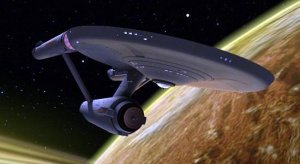
As I woke from my Star Trek induced stupor to write this blog post, I realized that the repetition didn’t matter as long as the stories were good and the characters engaged in their universe. Give me the stock shot of the Enterprise circling a fuzzy blue-green-red ball again and again, and I’ll happily pretend it really is a new world I’ve never seen before. Bumpy-headed aliens? As long as the ridges on their foreheads are different, it’s enough for me.

Is there hope in so much repetition? And what do my obsessive Trek-watching habits have to do with today’s Inkpunks post?

Three things, at least.

1) Time-Traveling Monkeys 

Whenever I sit down to write, there’s this persistent voice in my head that says, “Why bother writing this? So-and-so has already done a time-traveling monkey story. What can you possibly add to the time-traveling monkey ouvre?”

It’s a seductive argument. The world doesn’t need more time-traveling monkey stories, right? Especially not after so-and-so won the Space Banana Award for Best Simian Novella about the monkey with a time machine. I might as well just write a story about a normal monkey. Or maybe about a giraffe…

No one wants to be a copy-cat, of course, but there’s a big difference between feeling compelled to write a certain story because it speaks to you, and just trying to ride a market trend like zombies or dragons. Write what speaks to you, no matter what — that’s always the best place to start writing.

There are a lot of time travel stories in Star Trek, but the common theme to most of them is take some established canon and examine it from a different perspective: The Federation is evil. Jean-Luc Picard never amounted to much. What if the Federation and the Klingon Empire were still at war? These stories are about playing “What if?,” about breaking the rules in a universe someone else established.

All writers play this game. We’re often compelled to emulate the stories that inspired us, to twist them to new perspectives. Unlike Star Trek, we don’t have to set everything back as it was by the end, but we do bear some responsibility to recognize what’s gone on before (and I’ve discussed that, too.) Don’t be afraid to revisit stories you think have already been told.

2) Standard Orbit, Mr. Aristotle 

So about those plots. Aristotle or someone equally wise said there are only nine, or twenty, or thirty-six, or a hundred plots or whatever.  Every aspiring novelist and screenwriter has probably despaired of ever being original after their teacher wrote that list on the board. There are enough Star Trek episodes to blow through almost any number I could pick out of the air in any case. So how do they keep us coming back week after week (or hour after hour these days) to the same old stories?

Characters.

When the crew of the Enterprise shows up to assist at an OUTPOST WHERE THINGS HAVE GONE WRONG, we have to wonder, “Why do these scientists keep getting themselves into trouble? Doesn’t someone check the Federation records before they try something stupid again?” Usually, they don’t.

But beyond some initial eye-rolling, the audience usually just goes along for the ride, because they want to see what Kirk, or Riker, or Janeway is going to do this time. Will Worf embrace his Klingon heritage and snap the arrogant monoculture ambassador in half? Will Sisko ever catch a break? The stories in Star Trek don’t always cover new ground in terms of bare plot, but every revelation about the characters, every tiny epiphany they experience tells us more about them.

And more about us.

Because, really, stories are our way of explaining the way we see the world to each other, to ourselves. In waking life, we’re only allowed to have one point-of-view, though. Any chance we get to see through the eyes of another just might illuminate an old story in a new way.

As a reader, I’m drawn in by the voices, the personalities, and the unique perspectives of the characters who are experiencing that story. Even if I’ve read the same kind of thing before, it can feel completely new if I believe in the characters.

3) Spock’s Beard

Don’t forget the details. I don’t know about you, but the first time I saw the classic episode “Mirror, Mirror,” the appearance of evil Spock and his goatee made me gasp. What a difference that tiny detail makes — in fact, it was so effective at signaling the evil, but equally compelling, version of Spock that having a goatee has become a jokey shorthand for “evil twin.*”

When you’re writing your own stories, little details add up to big differences. How many stories about post-apocalyptic scavengers have you read?  This is one of my favorite genres, in fact, and in all the stories I’ve read and loved, it’s the nitty-gritty details and little surprises that bring me back for more, even if the threats remain the same. Zombies, plagues, mutants, nuclear war, killer asteroids. One way or another, BIG THINGS have happened and the world has ended. But it’s the little details of your post-apocalyptic story that make it stand out from the pack. Where do your characters get their food? Is radiation a problem? Extreme temperature? Zombies (and are they fast ones or slow ones)?

Star Trek goes to a million planets and finds the same mess over and over again. Yet the details of the disaster always change.

So you might be asking — “Is Andy really saying to write more like Star Trek?”

Yes, and no. It’s true that as a serial, syndicated format for television (and even-numbered movies), Star Trek is a great vehicle for exploring big issues and broad characters. Film & TV writers, especially on commercially successful projects, have to work in shorthand. They don’t always have the time or budget or network patience for subtlety. You do.

What I hope is that you can silence that little pessimistic voice in your head that says that there are no original stories left.

That never stopped Star Trek.


Continue reading

,

Blogging for Authors

This post is for you writing and creative types who are unhappy with your blogs. You feel like you are Supposed To Blog, but each post is a chore to write, and if anyone comments, it’s the same two friends. Worse, you feel like your blogging doesn’t support your booklife–maybe it even takes away from your writing time.

Believe me, I can relate. And if you like, I can share the tale of my slow rise and rapid descent as a moderately successful niche blogger–more as a cautionary tale than a success.

I hand-coded my first blog platform when I was working for a dot com over ten years ago. I’ve switched platforms a number of times, but I’m still at the same domain. Here’s the text of my first post:

man, starting a weblog is tougher than i thought. i think that part of the problem is that i actually care what you think. and i’m looking for feedback, relationship, community. this is like the beginning of an extended blind date with a million potential partners.


but i’m doing it anyway, risking rejection or even worse–total apathy. i am closing the door behind me, stepping out into the blackness, lit only by the glow of your monitors, and starting with this first post. hi::

Blogging has always been deeply personal for me. When I started, I was a posing IRL as a clean-cut, god-fearing, stalwart Mormon man, but inside I was full of sin and doubt and turmoil. On my blog, I could tell the truth, be the real me. And I posted under my real name. Over time, I connected with other closet unbelievers and grew a mini-community. After a few years, I took on a blogging partner who had experienced her own painful exit from Catholicism.

We covered a lot of topics, but my personal story focused on my gradual exit from Mormonism, with an emphasis on feminist critiques and a personal campaign against Prop 8 that culminated with my excommunication. I felt that public reporting was my only defense against an institution which abused social power over me and my family. My publicly posted criticism of the Church was cited by the authorities as a primary reason for my excommunication.

This was when mind on fire reached its zenith in terms of visits and engagement. It was a relatively successful blog at the time: on its peak day, it had 20,000 page views, with 12,000 unique visitors, each staying for an average of 2 minutes. My posts on my blog and as a guest blogger elsewhere were getting a 100, 150, 300+ comments. I wasn’t trying to be successful. I was simply doing this: I wrote my life, I wrote my obsession, I wrote with a purpose, and I wrote for an audience that I knew well, that I connected to deeply.

But as I put Mormonism behind me, and healed from my dysfunctional relationship with religion, my need to write about it evaporated. I lost almost all of my followers. I am a blogger in crisis.

As I consider what to do next, I’m thinking about four bloggers in particular: Bill Shunn, Mary Kowal, Cory Doctorow, and John Scalzi. I think I was following them all back in ’05-’06. With the exception of Bill, I was pleasantly surprised to discover, over time, that they also published in my genre (and I followed Bill’s example and went to a Clarion workshop). I paid money for books and stories by these four authors because I first got to know them as bloggers. So, if your goal is to use blogging to expand your audience, don’t write for SF writers, write for potential readers.

What do you think? How can you blog to increase your reputation as an author? (and your sales!) Do you have blogger-authors you look to as models?

Continue reading

Burping the book baby

Almost exactly eight years ago, I sat down to rock my baby to sleep thanks to the tips from a certified sleep consultant and fell into another world. I stayed inside it all day, envisioning characters and places that kept calling me out of ordinary life and into a dream state. It was probably the one hundredth (or even one thousandth) novel idea I’d had in my life, but this time I vowed that this book was going to be the one.

When I sat down to write the novel that became Dark Depths, I had no idea the tortuous journey I’d embarked upon. I just knew I’d had a brilliant idea for a story and that if I didn’t write it, I would never be able to look at myself in the mirror. I was a brand-new mom, and I’d entered a point in my life where I knew I needed to be true to myself if I wanted to be any kind of role model for my little bundle of joy. For almost seven months, I spent every baby nap creating the first draft of my first novel, and I was truthfully, blissfully happy.

Editing it was far more painful. A move ate several portions of the book; a failing computer ate a few more. After a long time sitting on the project, I finally reassembled the story in a new framework, chopping out major characters and species and ideas–all good stuff that I plan to recycle in a very different novel. This new novel was less than half its original size, and at 65,000 words, one of those lengths that most publishers won’t touch with a long stick. I workshopped its first chapter at the Orycon Writers’ Workshop with little hope in my heart.

But my pro reader (Orycon pairs up two workshoppers and two “pros”), who worked at a very small press, loved the first chapter and asked for more. I subbed the book to the small press and it was immediately accepted. My editor also loved the book and did only minor line edits. The cover art was created. A launch date was picked. I sat waiting for close to nine months.

And then in April, my small press closed. My book, quite luckily, returned to me. I was gloomy. I had written three other books since writing Dark Depths, but this book was special to me. I wasn’t willing to self-publish, but the thought of the book sitting the rest of its life on its hard drive was remarkably depressing. I thought about editing the piece into a more YA-friendly work, but I hadn’t yet gotten around to such a task when Carrie Cuinn of Dagan Books asked if she could see the project.

I sent it to her, thinking that at the very least, she might have some good feedback. After all, Carrie had critiqued some of my stories before, and I trusted her taste.

What Carrie suggested was far more exciting than a YA revision: she imagined my book–small word count, amnesiacs, witches, melting horse-man and all–released as an illustrated novel. She sweetened the pot when she told me she planned on using Galen Dara’s illustrations (I already loved Galen’s work, knowing it quite well from Rigor Amortis and her illustration for my piece “Spring Migrations,” which ran in Little Death of Crossed Genres). I couldn’t say no, and it was a much sounder financial offer than the original press’s deal.

Dagan’s been busy the last few months, putting together some serious anthologies, but Carrie will begin her line edits in January. Right now, I’m revisiting the work, which I haven’t looked at in about a year and a half. I’m over halfway through and am surprisingly pleased by what I’ve read. This book is fun!

What I’m most excited about is Galen’s response when she starts reading the book. I can’t wait to see her visions for the project and I hope we can share some snippets as the work progresses. I’m pretty sure that this book will be a one-of-a-kind fantasy adventure, neither graphic novel or purely words, but a novel fully manifested in its visual experience.

Out of this rather long process, here’s the little I’ve learned about novels and their care and feeding:

  1. The novel you set out to write might not be the one you wind up with.
  2. Multiple drafts can only help a project.
  3. Not every project is a good fit for an agented submission, but before you self-publish or settle on a particular micropress, be sure your publishing choice gives you a product you’re proud to sell.
  4. If you start having bad feelings about your publisher, pay attention to your gut. Research all your options; you might not be stuck with your publishing situation.
  5. Publishing is a slow process. Your project is just one of many, and there are only so many staff members who can only work on so many projects. Your book is in a long queue.
  6. If you can work with qualified friends in a professional manner, you are a lucky person. Jump at the opportunity!
  7. Treat everyone involved with your book in a professional, respectful, and friendly manner.
If anybody has any questions about working with a micropress, please jump in on the comments! I hope to check in and answer them throughout the day.

Continue reading

Writer’s Block: Now I Get It

Writer’s block. That state of wanting to write something but not being able to find the words, disliking anything you do manage to write, or perhaps losing your motivation to write altogether. No paragraphs, sentences, or words appear on the page. You are blocked, silenced, inert.

Confession: I didn’t used to believe this was a real thing. I was in the “sit down and write” and “it’s all in your head” camps, and maybe I still am to some degree, though I’ve realized that my reluctant mind is more powerfully stubborn than the good intentions of my butt in a chair. I do seem to be suffering from a mild case of writer’s block right now, for the first time ever, and thought I’d try to analyze why.

This is what I’ve come up with.

The Short-Story vs. Novel Merry-Go-Round

It goes a bit like this:

I should work on my novel. Getting a novel published (more than one, actually) is the only possible way to make a living writing fiction. I know this, and I’d love to make a living writing fiction. I have a novel in the drawer that I could polish up, and am 30,000 words into a new one. All it would take is a big push to get one or both done. Yep, I should definitely work on my novel, but…

Short stories are so much more fun! I can write and polish one in a week or two! Comb over it a dozen times to ensure the prose is just right! Sustain a unique voice that would be challenging to sustain at novel length. And I can send several out into the world at once where they might sell, bringing in tiny amounts of money but more importantly feelings of gratification and accomplishment, not to mention a hearty round of congrats on Twitter!

But I should work on my novel. Starting a new short story will just distract me, take my mind off of pressing plot problems and interwoven character arcs. The fast glamour of the shorter form will only highlight what a slog novel writing is by comparison. Plus, if I don’t finish my novel, I won’t have anything to pitch to an agent at the next convention. But…

There’s this cool themed anthology seeking submissions! And getting a short story published would add to my resume and get my name out there, and OH MY GOD maybe qualify me for SFWA, and that stuff’s important, am I right?!

And so on.

I’m sure there are many people who can work on short stories and a novel simultaneously and effectively, but not me. My best writing happens when I’m intensely focused on one project, not when my mind is scattered between several. For the last month or so I’ve been plugging away on my novel, but short story ideas—good ones, I think—keep intruding. I need to tell them to buzz off for a few months, or I’ll never finish this book.

What I’m Writing is Crap, Anyway; or A Crisis in Confidence

When I first began writing seriously, I had in mind an adventurous and entertaining series of high fantasy novels that I hoped would be read and enjoyed by the largest audience possible. Best-seller status was something I aspired to, with critical praise and literary merit of secondary importance. Awards such as the Hugo and Nebula were not even on my radar screen.

I started to attend writing conventions, which are wonderful places to meet people and learn about the craft and business. But I also learned something else: critically acclaimed, award-winning authors are revered (rightfully so), while some of the most mainstream, most popular authors seem to be, well, reviled. Okay, if not reviled then certainly looked at with distain. While no doubt much of the criticism leveled at these popular works is valid, I’ve also been left with the impression that “escapism” is unquestionably bad, and that the “masses” are not discerning enough to be considered an acceptable target audience.

Over time this has led me to question my own goals. Maybe I should be aiming for critical acclaim and not popular success. Maybe what I’m writing—what I like to write—isn’t worthwhile. Maybe it’s not enough to want to entertain readers.

And, well, maybe it isn’t. It’s great to be surrounded by talented peers who by example push me outside my comfort zone, encourage me to up my game and improve my writing, think about the messages and themes in my work. These are all good and valuable things, of benefit to any writer. But I also think it’s possible to stray too far. To lose your way because you’re trying to write to please or impress someone other than yourself.

Example: my current work-in-progress novel is a young-adult, high fantasy adventure with plenty of magic and politics and the odd critter. It also has a romantic sub-plot, which I rarely mention. Why? Because romance is perhaps the most disrespected of all sub-genres and I’m worried about what people will think.

But the problem is this: if on any level I’m ashamed of my work how do I sit down to write every day? How do I do justice to a romantic scene while worrying that its very existence will cause some to roll their eyes?

I know! Maybe I should write a short story instead, one with no romance whatsoever…

Or I could just re-read James Sutter’s helpful post: The Benefits of Being a Hack (Or: Why You Don’t Want to Be Ted Chiang).

Or stop caring so much about what people think and just write, dammit.

I Always Thought I’d Be a Novelist, but Life Isn’t Working Out as Planned, and Maybe This Won’t Work Out Either

This one’s tough, and maybe a bit angsty and self-pitying, so I’ll keep it brief.

From the time I was a child, I thought I would be a writer. I read insatiably, and spent hours holed-up in my room drawing maps, creating characters, and writing. I strayed away from this path during high school, university, and early on in my career, but inevitably returned, as the dream had never left me. One day I’d be a novelist, of that I was sure.

Fast forward to now, and life hasn’t gone how I expected on a number of fronts. Decisions I made with certainty have turned out to be wrong, and ground that once seemed solid has shifted and disappeared beneath my feet. The resulting feelings of failure and self-doubt threaten to bleed into other areas of my life, most importantly, writing. What if I was wrong, like I have been about other important things? What if I’m not meant to be a writer? What if I try and fail? If this dream, too, must fall by the wayside?

Some days I sit at my computer and think I’m just fooling myself. Lately there have been more of these days than I’d care to admit.

Sorry to be so depressing.

I don’t have answers right now, as I’m just trying to work my way through. At least I’ve managed to get a few words down over the past couple months, which is something. I won’t even tell you what a mighty struggle it was to write this blog post. But I’d be grateful to hear about your experiences. Have you had writer’s block? Why? And how did you get past it?

Continue reading

The World According to Lou


Lou Anders is the editorial director of Prometheus Books’ science fiction and fantasy imprint Pyr as well as several anthologies. He’s been nominated for multiple awards multiple times, including the Locus Awards, Shirley Jackson Award, Philip K. Dick Award, Chelsey Award, World Fantasy Award and the Hugo Award. He’s won the Chesley Award and in 2011 he won the Hugo for “Best Professional Editor Long Form”. He’s published over 500 articles, and his articles and stories have been translated into Danish, Greek, German, Italian & French. Phew! As if that weren’t enough, he’s written his own novel and it has been picked by agent Joe Monti.

If you ever get a chance to attend a panel Lou is on, or one of his Pyr presentations at a convention, I highly recommend it. Lou is extremely well spoken, engaging and I guarantee you will learn new things about the publishing industry and likely receive a strong motivational kick for your current work in progress. Or, if you’re lucky enough to catch him in the bar, buy him a drink and you’ll gain a lot more knowledge than you ever expected about writing and publishing for the price of a beer. I will gladly accept any of the drinks Lou doesn’t want to drink, which will leave him free to dispense even more words of wisdom about the writing world. He can’t help it. He’s overflowing with it.

I hope you enjoy this interview with Lou. Please visit him at www.louanders.com and check out all the great Pyr selections at www.pyrsf.com. You can also find Lou on twitter as @LouAnders.

1.    First, congratulations on your Hugo win. Where is your Hugo now and what does it mean to you to have one now?

Thank you very much. The Hugo rocket is sitting next to the Chesley rock. Both are on a tall, slender black bookshelf in my master bedroom. My library is downstairs but I have a single bookshelf in the bedroom for my brag shelf (one copy of every anthology), some particularly attractive Pyr books (a lot of the ones with gold foil covers), and whatever I’m currently reading or researching. As to what it means… wow. It puts me in a very small group of people, some of whom have names like Asimov and Heinlein. Whatever changes lie ahead for the publishing industry, wherever my own career goes, I’m for all time a Hugo-winning editor and a Chelsey-winning art director. There are no higher honors for the twin hats I wear. That’s a glow I will carry my whole life. I’m enormously grateful, humbled, and pumped.

2.      Why does PYR accept unagented submissions when so few other publishers do?

Ha. Because sneaky Jon Sprunk managed to pitch me a really awesome trilogy without using an agent, despite the fact that I didn’t accept unagented, unsolicited manuscripts. And that made me wonder if I were missing out on other potential Sprunks. I needed an assistant at the time, so we hired Rene Sears to be both my assistant and my slush reader.

3.      What’s the ratio of unagented vs agented manuscripts received and of those that get accepted? How many submissions do you receive overall per year and how many make it to final acceptance?

Its very hard to estimate what our total submissions per year is. I get pitched by agents anywhere from three to seven times a day. Rene says she receives anywhere from forty to a hundred unagented submissions a month. We publish around thirty books a year. From two years of looking at unagented submissions, K.V. Johansen’s Blackdog is the only manuscript that we’ve bought. I was thrilled to find something of such caliber in the slush pile, only to discover when I Googled her that she is a successful Canadian children’s book author with a score of published works. Go figure. (There is probably a lesson here about how much time and hard work it takes to really hone your craft as a writer and why the age of self-published ebooks may not unleash the sea of tremendously deserving works that couldn’t get past those evil publishing “gatekeepers” that some self-publishing enthusiasts predict.)

4.      What’s the strangest place someone has pitched to you? Do you cringe when someone in a social setting wants to tell you about their book, or do you hope for an amazing find?

I don’t know that there’s a particularly strange place I’ve been pitched. I once pitched an anthology to Robert Silverberg in a men’s room. I was young. He was gracious. As to cringing or hoping – it depends on the setting and what I’m there for. I’m generally at conventions to send information in the opposite direction. That is, I’m there to talk up the books in our line to readers, so I’m not really looking to find anything. Also, it isn’t the idea; it’s the execution. So I’m not going to know how I feel about something until I see it, and I’d rather see it through appropriate channels. I will say that I HATE HATE HATE being pitched on Facebook. That feels intrusive. Generally, the way to tell if an editor wants to hear about your book is that he or she has asked you to tell them about it.

5.      Have you ever had an impromptu pitch at a convention or conference turn into a deal with an author?

Yes. I was sitting in the bar, very late, at OryCon a few years ago. There were a group of us. And one guy started talking about his manuscript. He wasn’t pitching me, or even talking exclusively to me. In fact, he was thinking of self publishing it and describing the idea to the group for feedback. The idea sounded freaking amazing and I told him right there to send it to me. That was Andrew P. Mayer and the series is The Society of Steam.

6.      What must-have qualities would you say an author needs to become published and keep being published in the industry?

Talent plus perseverance. I recently asked a group of authors how many times they rewrote their novels before they saw publication. Seven was the average response. And I heard N.K. Jemisin say recently that she had worked on The Hundred Thousand Kingdoms for around ten years before it saw publication. Do you remember that old board game where you pulled levers out until all the marbles but one dropped away? I have probably just dated myself horribly, but that’s how I see a career in the entertainment arts. Banging your head against the wall until the wall collapses, because you sure as hell aren’t going to. Artist John Picacio describes this as, “There’s Plan A. And if that doesn’t work, there’s Plan A. And if that doesn’t work, there’s Plan A.” (Note: He’s not talking about being unrealistically inflexible. He’s talking about never giving up the goal of being a working professional.)

7.      Do you think it’s important for new writers to establish a platform and does that help them when it comes time to find an agent or publisher?

Yes, though its hard to establish a platform before you have a name. It’s a bit of a Catch-22, though with blogging, podcasting, tweeting, etc… it’s far easier to build a name and reputation in the community that it used to be. I think that aspiring writers need to be at the major conventions, meeting as many people as they can (not just editors but authors, agents, artists, and con organizers) and do all they can to appear professional at all times. I will say that if I start to enjoy a manuscript, I immediate stop and Google the author, and if I can’t find anything informative, it’s frustrating. Your website is your business card. It doesn’t need to be a huge platform, but it does need to be informative and navigable. It needs to be there so that when you have your book out and your first fans go looking, it’s up and ready to receive them.

8.      You’ve recently signed with Joe Monti, representing your own novel. For those of us still working on novels, how many had you written before this one? How did you know this was the one to query?

This was my first novel ever. I have written one nonfiction book (The Making of Star Trek: First Contact),  wrote/directed four plays, wrote five spec telescripts and six screenplays (several optioned, none produced), and edited nine anthologies and two magazines, but I’d never written a novel before.I tried twice before in my life to write a novel, even dropping out of college for a semester to do it, but I’d never succeeded before. I blame not being married on my failure and attribute a wife who told me to plant my butt in the chair every night for a year to my eventual success.

10.  Your Wikipedia page is incredible. Along with your editorial awards, your anthologies, and nonfiction writing, you have many short story credits and now a novel. What’s your best advice to new writers about making time to write and finding the discipline to keep their butt in the chair?

See above. Marry my wife. If that isn’t an option for you, I’d say ask yourself what you want to look back on, a bookshelf full of all the TV shows you watched and videogames you beat, or a bookshelf full of your own books. I realize I am speaking metaphorically and that I should be saying an iPad 10 full of game apps or loaded with epub files. But you get my point. You can be a consumer or a producer of media. It depends on what side of the screen you want to sit.

Best,
Lou Anders, Editorial Director
Pyr, an Imprint of Prometheus Books
www.pyrsf.com
www.louanders.com


Continue reading

In case tomorrow never comes

I’ll beg forgiveness in advance for what is bound to be a melancholy post. Here, also in advance, is your baby otters chaser. Feel free to return to it as needed.

In the U.S. it’s nearly Thanksgiving. It’s my favorite holiday, no matter how I end up celebrating it (this year it will be just me, my husband, and Chinese food). For me it’s a happy, contemplative holiday on which I also usually get to do a lot of writing. When I was trying to come up with something to blog about today, I considered Thanksgiving as a topic–the books and authors I’m grateful for, the guidance and examples of my teachers and peers, maybe my past experience with NaNoWriMo. We could all spend more time thinking of things we’re grateful for–great. I had a topic.

And then we lost Anne McCaffrey.

It’s a funny way of putting it, as if we misplaced her somehow. It doesn’t sound as grave as it is: She’s gone. Three generations have grown up on her work. How many of us said “thank you” before she went? How many of us wish that we had?

Charles Tan has a round-up of tribute threads here.

Just last week many of us on Twitter decided to send fan mail to authors whose work had moved us. There are so many authors whose work we love, who have shaped us, who are still here. As a fan it felt good to send it. I’ve heard reports that it felt good to the authors to receive it.

Suddenly it seems urgent. We can take a minute to write to them, to say thank you. Today, tonight, right now–because tomorrow might be too late.

Continue reading

Dropbox: A Primer for Writers

Whether it’s because it’s November and NaNoWriMo or happenstance, I’ve heard a few tales of woe lately from writers whose hard drive crashed or, in one person’s case, had their laptop stolen. In each case, the writer did not have recent backups and lost what they were working on. My inner geek cringes to hear things like this. Backing up should be pain-free, easy, and washing mashing safe. I thought I’d talk a little bit about my process.

Acts of theft aside, the loss of work is so nearly avoidable in this age. I was an early adopter of online file storage, dating back to the early 2000’s and a brief stint writing that kind of software for a company that no longer exists. I still lament the loss of one particular story, lost to the fickle platters of an angry electronic god and I don’t want to go through that again. That’s where Dropbox came into my life.

What is Dropbox? It’s not the most clear from their webpage without watching their video. Dropbox is, in a nutshell, a system for backing up and synchronizing files between your devices (PC, Mac, Linux, or Mobile) and the Cloud. The Cloud, in this instance, being Amazon’s S3 file storage service.

How it works

Every computer you install the desktop software in will place a “Dropbox” folder in your home directory. Inside that directory, I’ve organized all of the documents and files I want to keep backed up and synchronized. It looks a little bit like this:

  • Clients
    • Contracts
    • Proposals
  • Documents
    • Taxes
    • Receipts
  • Public
  • Writing
    • Contracts
    • Copyedited
    • Cover Letters
    • Critiques
    • Essays
    • Fiction – Short
    • Fiction – Long
    • For Critique
    • For Submission

That probably looks somewhat familiar. It should. The point is, the Dropbox folder shouldn’t look any different what you already have, except for its name. It took me a while to come up with a file structure that suited me and to remember to save things to it but that’s all. As long as you’re connected to the internet, you’re done. Dropbox will backup any new file you move or create under its folder, and synchronize any changes that you make.

Privacy and Security

As with any service that transfers and stores your data online, there are privacy and security concerns to consider. Dropbox got themselves into a middle of a fuss some months back thanks to some unclear changes to their Privacy Policy, which have since been revised for clarification.

The short, non-technical version is that they use same kind of security that your web browser uses to keep your secure when you’re checking bank balances or shopping online. Once in the Cloud, your files are not encrypted unless you encrypted them first, but they are three ways your files can be accessed by others. Two are if you’ve chosen to share them, either by putting the file in your Public folder *and* linked them to it or specifically invited them to share files. The third is by an employee of Dropbox, when they are legally required to do so.

There’s a privacy debate about whether or not Dropbox should encrypt by default and, indeed, there are competitors such as SpiderOak that do, but their client software was not nearly as well-integrated the last I checked and, for that reason, not suitable for my needs. It comes down to a personal choice; I’m choosing convenience in this case.

There was a debacle in June 2011, where a programming change introduced a bug that left accounts accessible by any password for four hours. An embarrassing mistake, unlikely to happen, and not enough by itself to find an alternative.

Disaster Recover

I primarily work from a Macbook Pro, but I have an older Mac Mini in my office that I primarily use for music. I installed Dropbox on that and linked it to my account. If I’m on the road and make changes, they are automatically synchronized at home. Dropbox already provides a way to restore files, through the desktop application and their website but this gives me an extra layer of redundancy.

Whether you use Scrivener like I do, Word, Open Office, yWriter, or whatever, things occasionally get bolloxed up. You can train yourself to hit save early and often or setup auto-save but no matter how many times do, sometimes the last save is the only one it takes to corrupt a document and make it unreadable.

Dropbox to the rescue. Every time you save, it records the changes. Viewing the previous versions will show you the history of that file and let you download the previous copy until you find one that worked.

Other uses for Dropbox

I haven’t used Dropbox to share files between users much, but I’d love to hear comments from anyone who has, and how its worked. I have used it with the iPhone and iPad client, in conjunction with the Plaintext application, to make quick changes or even revise (with an external keyboard).

Getting Dropbox

Dropbox has a free tier with 2GB of storage, which should be more than sufficient if you’re using it to store documents or small files, with increases in 250MB increments if you refer people to signup with them. A paid plan of course, is available, if you need more. I’ve been using the free tier for more than three years without having to consider upgrading. Download, install, and forget about it.

Get Dropbox (using my referral link, so we both get 250MB bonus storage)
Get Dropbox (no referral link, but no bonus storage)

Continue reading


So You Want to Write for Pay?

Making a living as a writer is not easy. Financially, there are almost any other careers that would be a better choice, yet most of us dream of one day being paid solely to write.

Have you ever thought about writing for one of those Write-for-Pay websites? A member of my writing workshop, *Julie Downsbrough has, and she brought a piece to class in which she shared her thoughts on it.  I wanted to share it with the Inkpunks and our readers because I thought it was an insightful and entertaining take on the subject. Thanks, Julie, for allowing me to share it.

The 500 Word Essay

Now let us see about this. Here is a ‘writing company’ that requires its writers to be able to write 500 word essays and is only willing to pay $10 an essay. The company requires the writer to write about one essay within 30 minutes! This is not just any old nonsense which I am attempting to write here in 30 minutes, but requires the writer to have ‘proficient research skills’ and ‘a very high level of writing ability.’ Writers are expected to write at least five articles a day and priority will be given to those writers who can write full time. At that rate it would be 16 articles of 500 words each in an eight hour day, or in other words, thirty-two fully edited, organized, coherent, completed, researched pages per day. For this you would in theory earn $160 per day, a reasonable income I suppose if you could actually achieve this feat.

In order to do this, you would need an awful lot of coffee. It seems unrealistic, unless you are someone who is always naturally efficient. There would be no time to stop and think. So how could you write something good in this time? Well, maybe you could write the first draft quite easily and flowingly, sort of like I am doing now. But perhaps then you would want to take some time to remove such messy adverbs as ‘easily’ and ‘flowingly’ and then what about time to check your work perhaps, organize it in a more rational form, or check your facts?

Let’s see now, I have written just over 250 words so far. Nearly 20 minutes used up. I’d better get a move on. Oh, but let’s pause a minute while I just save this. Now then, as I was saying, (just filling in words here to fill up some space to try to reach my 500 words in half an hour goal), I am writing this essay ‘on the hoof’ so to speak. What a strange expression that is, ‘on the hoof’, and why did it come into my head, just then? I will have to look that up later, right now I don’t really have the time! Also I don’t have time to shape this essay, edit it, research it or make it publishable in the time allotted since I now have only about seven minutes left and I am at just over 400 words. I’d better get a move on!

I think in this last paragraph I had better try and wrap things up, since I only have five minutes left and I have to draw some sort of conclusion. Well, let’s see…. Hmm, I seem to be slowing down more now that time is running out, and my mind is wandering to that umpteenth cup of coffee for the day. I have about 25 words left now, so I will just say, it is undignified and unreasonable to treat writers like word slaves. Pseudo editors and publishers and other miscellaneous scam artists, STOP DOING IT!

There, just over 500 words and two minutes left, so I guess it is possible to write an essay in half an hour. We were, after all, required to do it in school tests though the teacher only expected one page (250 – 300 words) and not at a publishable level.

Time is up. Put down your pencils.

(564 words – Impressive!)

_____________________________________________________________

*Julie Downsbrough is a working writer. She is originally from Yorkshire, England and now lives in Burnaby, BC. with her Kiwi husband and one black cat. Her poems and articles have been published in various magazines, journals and newspapers including The Vancouver Sun, Cloverdale Reporter, Ariel (University of Calgary Press), Tickled By Thunder Literary Journal, Crow Toes Quarterly (Children’s Literary magazine), and The Yorkshire Journal.

She has received 1st Place in the Beacon Bards Poetry Competition, 2nd  Place in the West-End Writer’s Poetry Contest, Sakura Awards in the Vancouver Cherry Blossom Festival Contests, and Honourable Mention in the Burnaby Writers’ Society Writing Contest.

Continue reading

Guest Post: Are You A Writer, or Aren’t You? By Carrie Cuinn.

Carrie Cuinn is a writer, editor, small press publisher, computer geek, and amiable raconteur. In
her spare time she reads, makes things, takes other things apart, and sometimes gets a new tattoo.

She has an impressive collection of published fiction and non fiction and has been a guest on SF Signal podcasts multiple times.  Carrie created Dagan Books which, by the end of 2012, will have 6 titles out in print and ebook (including Wendy N. Wagner’s Debut novel, Dark Depths).  Her website is www.carriecuinn.com and you can follow her on twitter @CarrieCuinn.

**********

My best friend as a habit of saying, “You can be a writer, or you can be something else. Which one are you?” He doesn’t mean that you can’t have a day job, or hobbies, or friends, or a family. What he means is, if you’re going to be a writer, be that. Being a writer isn’t an outfit you can put on a few times a year when you’re heading to a convention. It’s not just something you tell your coworkers over lunch, or use to get more Twitter followers.

It’s who you are.

Writing once in a while takes nothing more than having a story to tell. Sometimes, not even that.
Writing consistently takes time, and a commitment to write even when you’d rather be doing something else. Writing well requires an interest in dissecting your own work, as well as reading – and learning from – other people’s writing, which takes more time. You have to be willing to see your own flaws.  You have to want to grow as a writer. You have to know that even when you’re not writing, you will write again. Soon. You need to, just as you need to eat and sleep and breathe.

Being a writer isn’t just about the effort you put into it, though that’s certainly an symptom. It’s about
the difference between someone who imagines, occasionally, being an author, with an agent and book
deals and movie options, and someone who can’t imagine being anything but a writer.

Think of it this way: a lot of people have gym memberships. Some of them will go once a month, if
ever, but keep paying the fees because they like the idea that they could go to the gym if they wanted
to. These people don’t improve their level of fitness. Others go to the gym more regularly. They have a
routine, which they usually stick to. Most of the time. Their work might show results, but they ‘re not
in the gym every day. They don’t study the latest lifting techniques or worry about how their nutrition
affects their performance. They don’t consider themselves “bodybuilders” or “athletes”. They’re
teachers or housewives or firemen or … something else. Going to the gym is just something that they
do.

A lot of people write the same way.

There isn’t anything wrong with writing part time, with writing as a hobby. I have hobbies too. I study
art, cooking, science, business, roller derby … which all sounds good, on paper, but the truth is that I’m curious about too many topics to focus on them all with the same passion that I give to my writing. I usually have a couple of different projects in the works at any given time so I can rotate between them (a habit I developed to make sure I actually finish what I start instead of giving up before it’s done). I’ve got a degree in art, and another in art history; I can balance my checkbook and run my business and I’ve heard that I’m a pretty good cook.

But I’m not accountant, or a chef, or a derby girl.

I know who I am. I’m a writer. It’s how I see myself, every single day. It’s the thing I keep coming
back to, in between whatever other project I’m working on. Sitting down to write is the reward I get for going to my day job, for cleaning my house, for finishing my to-do list. When I read, I take what works and I hold onto it, letting it inform my own stories, in just the same way that I remember what didn’t feel right to me so I can avoid it.

I am a writer.

My friend, the one whose question started this all? He’s a writer too. How about you?

Continue reading

Inkpunks at Orycon!

If anybody out there is a Pacific Northwesterner headed to Orycon this weekend, keep your eyes out for the amazing Galen Dara and me, Wendy Wagner. Galen’s showing art in the art show and I’m on a number of panels.

Both of us have those rad Inkpunks pins, so get ’em while they’re hot!

Continue reading

prev posts prev posts