A Writer’s Dozen: Eleven Ways to Get Story Ideas

This summer, I went to an SF writing workshop where we had to force out one short story per week for six weeks. Someone told us that by the final week we would reach deep into our [ASTRONOMIES] for ideas only to discover that there was nothing there, not even [SHIATSU MASSAGES]. I found, however, that the ideas kept flowing, that all I lacked was a little something that I like to call “words.” But [FORKLIFT] that, in this post I’m going to focus just on story ideas, so that you too can avoid the pain of reaching into your [ASHCANS] for fresh material.

1. Inflict your fears on others:

It’s sadistic, I know, but this is one of the joys of being a writer! Edgar Allen Poe was deathly afraid of being buried alive–a fear shared by many of his contemporary readers. Instead of dumping on his therapist, he shared this phobia with his audience by writing not one, not two, but four unforgettable stories about premature burial.

2. Share your favorite music:

Make like Ricardo Montablan’s Khan and inject your readers with earworms! Write stories inspired by your favorite or most dreaded songs. MTV published a collection of short stories inspired by top hits. Songs like Tom Waits’ “And the Earth Died Screaming” and The Beatles’ “I am the Walrus” and Muse’s “Neutron Star Collision” are just waiting for stories to be written about them. And I blame fellow inkpunk Erika for introducing me to System of a Down’s Sugar–the phrase “The Kombucha Mushroom People” plagued me until I wrote a story about a mushroom person. Named Kombucha. It’s a romance. Don’t ask.

3. Mash it up:

We live in the age of mashups, and this applies as much to speculative fiction as it does to YouTube. You like steampunk and zombies? Mash ’em up, the way Cherie Priest did in Boneshaker. Charlie Stross mixed the James Bond style spy thriller with the Cthulhu Mythos in his highly entertaining On Her Majesty’s Occult Service novels. My most recent story was a mashup of spy novels and steampunk and had Mormon polygamous wives has the main characters. Find two or more great flavors that taste great together and make your own Reeses Peanut Butter Cup of the literary SF world.

4. Get some exercise:

Some writers don tiny nylon shorts, subject their exposed bodies to hypothermia or heat exhaustion, and move their feet in rapid succession until pain shoots through their heart and limbs. There are some, perhaps even among the Inkpunks, who call this “fun.” They swear that it “gets the creative juices flowing.” For other writers, the mere mention of such torture can be used to spark desperate inspiration. The the pain of jogging, or worse, The StairMaster, can be threatened as punishment if the story ideas do not flow.

5. Drink a lot:
Continue reading

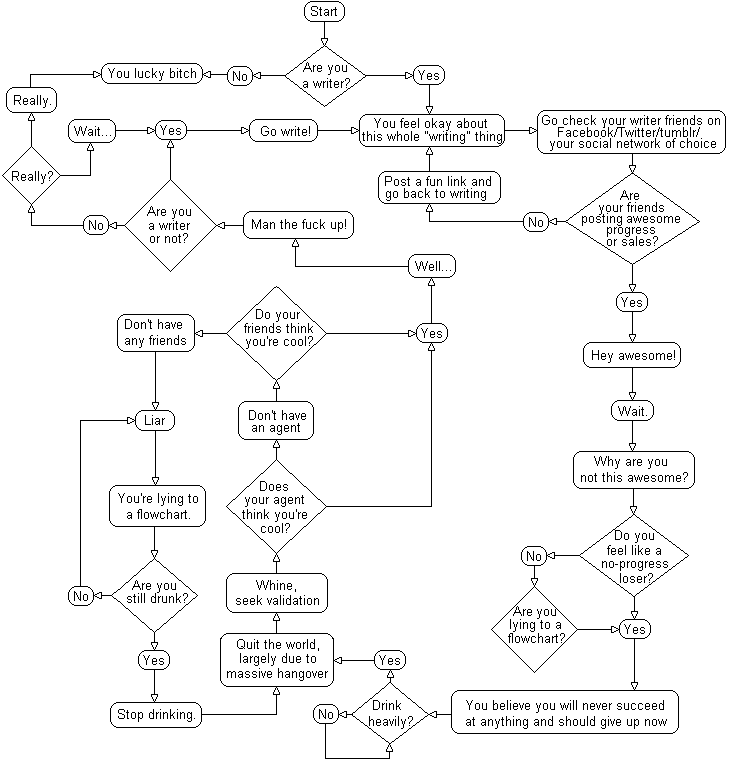
The Writer’s Slow Descent Into Hell: A Flowchart

As a newbie writer fairly low on the totem pole, I am sharply aware of what it’s like to want that fruit of Publication And General Being Amazing dangling from the tree, which so many others seem to pluck without effort. And, being a writer, I’m also excessively neurotic. Lastly, I’m an engineer, which lends itself to an obsession with process and cold assessment of any system I engage with. Combine the three, and you have nightmare-inducing over-analysis of every situation related to my writing career. Most of which will turn into flow charts.

Here is one I made for you.

I believe with every iteration in this flowchart, a writer moves one inch closer to irredeemable madness. At least, that’s how I feel.

Click on the image to view the full thing. Or a link, that works too.

Of course, madness is pretty awful. Best avoided entirely. How do you do it? I ask this honestly, because I have no fucking clue. But I have ways to stave off the madness. It’s a Band-Aid, but it’s served me well enough thus far.

The obvious solution is to not have friends to compare myself to. But this hurts me twofold. One, writing is pretty lonely. Sure, most of us are introverts, I’m no exception, but that doesn’t mean I want to cut off all people from my life. (Typically just the boring ones.) So, having no friends is not a viable solution. And two, without writer friends, who’s going to be willing to beta read my latest DnD-adventure-turned-novel and let me know that maybe I can do without three hundred plus pages of kobold encounters?

Better solution? Well, like it says in the flow chart, I give myself that mourning period, filled with whiskey and Oreos, then I have to man up. I get back to the writing part of writing, not the obsessive stats-checking, self-comparison, self-critical nonsense. I go put words down in the right order. (It’s okay if I get them in the wrong order at first, I can figure that out later.)

The only part I should focus on at this stage is the craft of it. I should be concerned with generating a narrative using the written word that convinces other people I know what I’m doing. Get crits, and learn from them. Submit my work, and forget about it. Write the next thing. Focus my neurotic, obsessive mind on self-improvement, and leave no room for anything else, least of all this specific brand of soul-crippling self-doubt.

But I have to remember, it’s okay if I slip back into the Death-Spiral. I’m a writer. I’m neurotic. It’s what I do. So, I’ll save some whiskey and a big pile of forgiveness for myself, for the next time I spiral to the bottom.

Continue reading

When in doubt, volunteer

Writing is a lonely business. I don’t know about you, but I toiled away for years on my own. Online writing groups helped, but I always knew that there was a larger community out there that was just outside my reach. The genre community seemed to revolve around conventions–I’d never been to any, and my finances didn’t look like they were going to allow it any time soon.

I sat on the outside looking in for years, reading people’s blog posts about the cons, the awards, the launches, the events. The more I read the more rooted in place I felt, the more hopeless it seemed that I could ever become a part of that larger community. The thing about communities is that you have to put something into them. I’d been a taker my entire life, taking stories and ideas and relief from the mundane from the SFF field, and I’d never put anything back in.

Then I found StarShipSofa.

For those unfamiliar, StarShipSofa is an audio magazine, as distinguished from a variety of other podcast formats. It has an editorial, a flash fiction piece, interviews, fact articles, and a featured fiction piece. It is only available in audio form–much like an audio book, only there’s no hard copy to refer to. It is entirely fan-run–everyone involved is a volunteer, including the authors who allow their stories to be “reprinted” there for free. The editor is in the U.K., the flash fiction editor is in New Zealand, the other contributors are from all over the world. It’s an astonishing community effort. I loved it immediately. And lucky for me, Editor Tony C. Smith was looking for narrators. I volunteered.

I’d never done anything like that in my life. My last “performance” was my senior year of high school (which was 21 years ago, I’m not ashamed to admit.) But I can read aloud pretty well, I enjoy doing it, and usb microphones are affordable. So I recorded a story (and re-recorded it, and then re-recorded it again–that first one was REALLY HARD and I was a nervous wreck.) Eventually I turned it in, and suddenly I was a contributing member of the SFF community. I had earned my keep, I had given something back. I belonged.

Since then I’ve repeated that essential step of volunteering for the unknown several times. I volunteered for SFWA, and got to help migrate content from their old site to their new one. I volunteered for Geek’s Guide to the Galaxy, where I wrote the show notes for their first 21 episodes (I still can’t believe it was that many!) I volunteered to do some editorial support work on a couple of anthologies, and I volunteered for Lightspeed. That’s all in one year. Each time I do it I give something back to the community that I’ve taken from for so long and that made me who I am today. But it’s not a straight payment toward that debt, because each time I gain so much from the experience.

If you’re considering raising your hand for an assignment, and are wondering “what’s in it for me?” here’s what I can tell you:

  • Experience. This is the obvious one for gigs like slush reading and web design/implementation.
  • Insight. Many volunteer positions–such as SFWA and GGG–offer an opportunity to see the inner workings of an organization or project.
  • Contacts. So that when you do finally go to a convention, there is at least one person there who you know will shake your hand, have a drink with you, and introduce you to whoever they’re standing next to.
  • Self-esteem. The creative life is a hard one at times, and our egos can take a real beating. Self-esteem comes from doing esteemable things. What volunteering offers that I personally have found most valuable is a sense of accomplishment, of having contributed, of having helped. Every task can be chalked up as a personal Win, and in a sea of rejections and failures sometimes these gigs are what keep me afloat. And when that project I worked on goes on to be a success, I get that vicarious Win as well.
  • Reputation. The world loves reliable people who are willing to help make great things.

There are some things one should not expect to get out of volunteering. Among them are:

  • Public recognition. Scratch that daydream right now, or you will be deeply disappointed.
  • Favors from the people you volunteer for. This varies; some people are more than happy to offer advice in their field of expertise, but never expect it. If you get it, it’s a bonus.
  • Publication. The only thing that will get you published is writing a really amazing story and placing it with the right market.

Volunteering is a great way to get involved. There are always markets looking for slush readers, great organizations like SFWA who could use some administrative help, amazing projects looking for support in the form of content or website maintenance or any number of things.

One last thing: “volunteer” doesn’t mean “optional” once you’ve taken the gig. You have committed, and people are counting on you to follow through. Treat it as if it were a paying job–and in fact, it is, it’s just that you’re being paid in intangibles. It deserves the same level of attention and care that any other commitment in your life would get.

So if you’re a writer on the outside looking in, maybe now’s the time to change that. Step up! Volunteer. You won’t regret it.

Continue reading

Goals vs. Achievements: How not to set yourself up for failure

There are more pitfalls to avoid as a writer than there are in a certain 8-bit Atari video game. I started writing sporadically a decade ago. I would finish a story, send it to a market and wait, my entire identity as a writer hinging on that response. You know that kind of anxiety I’m talking about. Learning the postal carriers route and schedule so you can check the mail as soon as it’s delivered and moping on Sundays.

I’ve seen many solutions offered to counter this problem; many I would describe as the fire-and-forget method — write, submit, and move on to the next story. Sound advice, but I don’t think it addresses the underlying cause of the problem: control.

Consider this list of goals that a reasonable writer may have:

  • Find an agent
  • Write next scene of story
  • Write 750 words/day
  • Submit two stories to markets
  • Get published

We try to set expectations upon ourselves for things that we cannot control and we don’t reward ourselves for succeeding in the things we do. When we fail — and we do — it gets increasingly harder to pick ourselves back up and start over again. This isn’t the same thing as dealing with rejection, which is another topic entirely. This is a problem of goals and achievements.

Goals

Goals are the things that you have the ability to succeed at through direct action or fail at through inaction. Did you write the next scene of your story? Did you meet your daily word count? Did you query the next five agents on your list? These are things you have control over. These are things you are responsible for. Everything else is outside of your control.

Achievements

If you’ve played video games in the last several years, you may already be familiar with the concept of achievements. These are the things that you want to accomplish but you have less influence over. You may even have none at all, but they’re still important to you. Selling a short story or novel. Getting a request for a partial or full manuscript. Receive fan mail. Control? Not yours.

What’s important to you in your career as a writer? Make a list. Once you know what you want to achieve, set goals to work towards that end. Goals should be simple and achievable. If you’re socially oriented like me and want public accountability, post it online. My goals and accomplishments are available for reference.

If you don’t already own Booklife, by Jeff VanderMeer, I highly recommend it. Disclaimer: Jeff was one of my Clarion instructors so I am biased, but I bought and read Booklife months before applying. It helped me rethink the way I was approaching my career.

Remember the golden rule: goals are things only you can control. And revisit your list of goals and achievements regularly. Not only will it help you keep focused, it helps you stay accountable to yourself.

Continue reading

We are the Inkpunks

It is my pleasure to welcome you to the Inkpunks website with this, the inaugural post, to introduce ourselves and outline our mission here.

What can I say about my fellow Inkpunks? Amongst us we have Clarion graduates, editors, podcasters and published authors. We have wide spread interests, varying backgrounds and different passions. Call it fate, call it destiny, but we’ve successfully come together as a close knit tribe of unique individuals. I can tell you, I feel the pressure of speaking for the collective in this first post. To paraphrase Anthony Michael Hall, I’d be crazy to write who we think we are. What we’ve found out, is each one of us is a writer, an editor, a motivator, a creative mind and a critique partner.

Our greatest asset is each other. We support, cheer, listen and uplift one another on a regular basis. When I mention this to other writers, they immediately express the desire to have a similar support group. Now you can. We want to share the things we learn along our own journeys and from those wiser and more established than us.

We don’t claim to know it all, or any of it, to be honest. What we do know is we have the passion, the drive and the backing to be the best we possibly can be. With this website, we hope to share that with you. Our wish is for you to return often (new posts every Tuesday and Friday!) to be inspired, enlightened, entertained and most of all, to be uplifted in your writing journey.

We look forward to getting to know you.

Continue reading

prev posts