Working out

If you’re anything like me, you added “work out more often” to your New Year’s resolutions. And if you’re like me, that means doing writing exercises to further hone your craft.  (If you were thinking I meant stuff like running and doing sit-ups, I should direct you to Sandra Wickham’s blog–I build my physique by lifting progressively heavier coffee cups.)

Now if you are groaning or rolling your eyes, stop. You are never too good to stop doing writing exercises. For one thing, they can help loosen up your writing muscles at the beginning of a writing period.  They can also stimulate your brain into new directions, handy when switching between projects, like moving from editing a short story to drafting pages on your novel.  And what the hell–you never know when you could learn something new.

A number of us Inkpunks own the book Steering the Craft, a collection of writing exercises created by the remarkable (and fellow Oregonian!) Ursula K. LeGuin. We decided to do an exercise and share our results. If you have the book, it is Exercise #3, called “Short and Long.” It’s designed to help you play with your sentence lengths.  Here’s the assignment:

Part One:
Write a paragraph of narrative, 100-150 words, in sentences of seven or fewer words. No sentence fragments! Each word must have a subject and a verb.

Part Two:
Write a half-page to a page of narrative, up to 350 words, which is all one sentence.

Here’s what Jaym wrote:

Part 1:

They left me with so much grief. Once, my people loved me. I was a hero, wise and strong. I searched for the beginning of everything. From east to west, I wandered, silent. If I spoke, my geas would fall. I didn’t dare stop, or think. Great Mother Sea taught me her song. The Wind gave me his tears. The trees told me stories of war. Fire made love to me. Earth folded me in her arms. They were mine. I was theirs. Safe in their hands, I wandered endlessly. I wandered endlessly and I dreamed. And in dreams, the future was born.

Part 2:

I saw many wonderous places on my journeys, places now known only to the Lost Book: proud golden Babylon, with her hanging gardens and labyrinths filled with genetically-altered monsters; white and red Atlantis, built from the bed of the sea itself; Troy, thick and brown and absolutely god-ridden; silver Camelot and her holy knights, El Dorado, with her emerald spires and diamond windows, her birds made of clever gears and bright jewels; unnamed mountains and plains with creatures and half-formed spirits who would later become the gods of those who did not step outside of history and reality.

Reading the short sentences passage, I could help but notice how Jaym used punctuation–the lowly comma!–to make those short sentences breathe. There’s no rush here, which is something you wouldn’t necessarily expect.

Here’s what Morgan wrote:

Part 1:

The new moon kept Wawel in shadows. It kept Nika in shadows. The guards’ candlelight chased her into alleyways. The walled city was a drowsy quiet. No alarms went up. No shrill screams sounded in the night. Nika smiled, and let her body relax. She sighed, her breath ghost-white. Her hands stirred, small, controlled motions. A blood-soaked rag dropped to the cobblestone. Her blade was freshly clean. Another job well done. Flawlessly done, if she said so. Marek certainly would have no complaint. He never did. Cyryl would complain. But Cyryl *always* complained. Well, then, he should brave the cold.

Part 2:

She kept her eyes forward as long as she could, as she had been instructed by so many, as Baba Jaga herself had warned to do, she forced herself not to blink, to keep her eyes open just one moment longer and prove herself strong and worthy, but her mind bent, her body bent with it, and she dropped to the ground, still battling with what she had seen: a man, but a snake, both at once, with a hundred thousand faces, one for every grain of rich soil, for every milk-heavy cow, for every soul he had taken by the hand and led to another world, glowing warm like a banked fire, embers low, beautiful and warm and dangerous and terrifying, and she gripped the moist earth beneath her hands, leaving her ears open to his hollow laughter and his placid question, and though the response rattled in her brain, her mouth could not form the simple words, to say no, she had never seen a god before.

On the other hand, here in the long sentence passage, Morgan uses long lyrical words with fairly simple punctuation to create the feeling of overwhelming stimulation. Both Jaym and Morgan do amazing  jobs keeping that long sentence clear and easy to follow.

I struggled with the first part of this exercise. Why? Because I love, love, love, LOVE fragments. When I hear short, I hear fragments. I could write 27 pages entirely of fragments. Making sentences, however, challenged me. (This was obviously a good exercise for me!)

This was my rather meager attempt:

Pt 1:

The crickets sang their songs. We had run out of chit chat. His elbow pressed on mine. I thought about grabbing his hand.  But I just sat. Creaking, the porch swing arced along. My feet shushed along the floor. Even my toes trembled. He kissed my cheek.

I had less trouble with the long sentence, because I immediately jumped into mind of a long-winded character who might  need her own short story.

Pt 2

There have been trying times in my life, brief painful moments like the day of my father’s heart attack–terrifying in its suddenness, a man in perfect health and so full of his own energy he could silence me with just the power of his eyes–that horrible rending tear in the fabric of my family’s pleasant existence; times, too, that stretched my coping powers over a vast stretch of days, like my college years with their loneliness and endless confusion and all of it unbearable, all lumped solely upon my own bowed shoulders: in all their variety, I have duly noted the difficult periods of my life and tried to learn from them and take some measure of comfort from the knowledge I’ve gained from their study–but upon reflection I can find nothing sensible, nothing edifying, and nothing comforting in the aftermath of the latest zombie attack.

What I liked best about this exercise is that is exposed me to the natural rhythms of my own brain, and reminded me (forcibly!) how those rhythms are changed by the characters who break into my brain and take it over.  The rhythm of writing is one of the most magical and mysterious parts of the craft.  Ms. LeGuin quotes Virginia Woolf on the subject:

“Style is a very simple matter; it is all rhythm. […] Now this is very profound, what rhythm is, and goes far deeper than words. A sight an emotion, creates this wave in the mind, long before it makes words to fit it.”

I can’t help but think this explains why poetry can affect us so powerfully, and why certain stories resonate on and on within our minds.

So go ahead.  Challenge your inner rhythms.  And please:  share your results! We’re hoping to collect your thoughts here–if you try the exercises, let us know how they worked for you!  And if you write anything you’d like to share, post them, too!

Just consider us your personal trainers in the realm of literary fitness.
Continue reading

OMG, did you check out her encyclopedia?!

My first novel attempt was just a trainwreck, like most of them are. I changed so many things that I finally gave up and never finished. The second one was marginally better. The third one? Oh, I tracked that thing to death. I tracked details so well I burned out on details, and decided to do the next one without outline, plotting or, well, anything.

And oh dear god, is it a mess. A disaster. A calamity. I won’t be trying to edit it, I’ll have to chop it up and pretty much rewrite it. And you know what’s really sad? I wrote it that way because the strict plotting and notation of the PREVIOUS novel had me all tied up in knots. But, two years later, I can pick up on INHERENT (the third attempt) at any time. HAVEN? Not so much. And it’s all due to one particular little file.

What am I talking about? My own personal encyclopedia, of course. My Bible. My best friend. My saving grace.

Why? Because it contains my created world, and everything in it. People, places, enchanted swords, critters, the obscure sort of trouser worn by the special forces of the desert kingdom (you think I’m kidding? zar). It’s all in there, and right at your fingertips. Instead of having to skim through the entire novel, it just takes a quick glance through the encyclopedia. It is a lot of work initially, but when the deadlines are bearing down like a herd of angry elephants, the encyclopedia starts looking pretty nice.

How? It’s easy to make one of these, even if you’re already halfway through your project. The maintenance is the tedious part. I set up a system: before starting the day’s writing, I’d read the previous day’s work, note everything in the Encyclopedia, and then I’d be refreshed, caught up, and ready to go.

Everyone will have a different system or organizational pattern, but here’s how I go about mine.

STEP 1

First things first: while I’m plotting a new project, I build two databases. These can be made in Scrivener, Excel, Access, or just a Word document. Why two? Because one is like a rough draft: anything I think of as a potential inclusion will go in there. Did I have an idea for lizard-people? I’ll note that in the Dumps. Cool sparky weapons? Dumps. Nothing goes into the official Encyclopedia until I start writing and actually putting things into the story.

For example:

SHARDS

Tokyo, Alternate Future #5: Ruled by the Imperial Dragon and his kin.

The Wild West

An alien world with six suns and 2 moons (how would moons and suns be attached to a Shard?)

COOL THINGS:

Dinosaur mounts!

The Upside Down Mountain

Silver Sisters

Tea Singers

This gives me somewhere to pull an idea out of if I’m stuck. If I’m having a particularly bad case of writer’s block, I’ll work in the Dumps for a while. That usually sparks something! It’s also a place to put bits of writing exorcised from the official text for whatever reason. (I totally deny that I have about 10 pages of alternate endings for my first attempt at a novel…)

Step 2

When I’m about ready to start writing, I build the framework for the Encyclopedia itself. Categories include: People, Places, Things, World, Language, etc. From there, I break it down into even smaller categories. For example, PEOPLE gets broken into regions, which get broken into: Main Characters, secondary characters, religion, historical people, etc. I’ll also include a reference chart of rulers and other important figures as a subcategory. Basically, anything that can trip me up later on, break continuity, or possibly be a weird artifact will go in here.

Confusing? Yeah. So here’s the visual, based off of the SHARD world:

SHARD: Tokyo, January 2030, Alternate Future #5

Characters

Imperial Dragon: monarch of the Golden Kingdom (pg. 32)

Mei Ling: antiques dealer with ties to the Green Chrysanthemum Syndicate (pg. 21)

Jade Dragon: monk in the Imperial Dragon’s service, keeper of the Archives (pg. 79)

Places

White Lotus Temple: the Imperial retreat. (pg. 42)

Miscellaneous

Sun Dogs: sacred guardians of the Imperial Dragon (pg. 42)

Silver Sisters: ghosts of the Imperial Dragon’s mates. (pg. 3)

SHARD: Unknown, primeval, empty of sentient life

Characters: none
Creatures: none

Places

Bird’s Head: A rocky outcropping over a lake. Azaya drops her heart here.

The Lake: the entry point for this Shard. Brutally cold, fed by a spring from the other side of the Shard, which is arctic.

Anything in a description that has an entry elsewhere will be linked to that actual entry. Every time I add new info for the character or place, it goes into the entry. So a main character might have several pages of back-story, minor interests and other info. This also helps me avoid info dumps that stem from me trying to figure a character out.

As you can see, some of the stuff from the Dumps made it into the official story. Not all of it, for now at least, but maybe it will at a future point. If I use something, and then take it out later, it will go back into the Dumps for possible later use. I’ll also go through and organize each subcategory alphabetically once in a while, just to keep things sorted. Chronologically is probably a better idea, but I don’t work well that way!

(Ok, so the above is off the top of my head, from a Shard I probably won’t use. But I’ve got it all there if I want it.)

Maintenance!

The big thing is to not let it build up endlessly. As I’m writing, I’ll mark anything that needs to go into the Encyclopedia simply by putting it in bold or highlighting it. It’s also a good way to keep track of things that need to be researched more fully, later on.

I once heard a good tip: don’t take time out of writing to research. Mark what needs to be researched, and keep writing. This is especially useful if one is a compulsive Wiki-browser. Likewise, if you can’t come up with the perfect name, use a place-holder, mark it, and keep writing. It’s easy enough to come back and change it later.

It’s a lot of work, a lot of detail, and a lot of upkeep. But for a complicated work, it is absolutely priceless. And trust me, except for those few strange folks who *like* editing (and what is WRONG WITH YOU?!), This will save you a lot of time, effort, tears and chocolate.

Wait, why am I suggesting saving chocolate? Screw that, eat the chocolate while you’re working on the Encyclopedia!

Continue reading

Market Forces

Okay, you’ve done it! You’ve written a fantastic story; your beta-readers have torn the hell out of it; you’ve fixed the weird bits; you’ve trimmed off the fat.  You formatted it following William Shunn‘s excellent advice.  (You did format it using William Shunn’s excellent advice, right?  Maybe you should double check, especially on the section breaks.)  Your story is ready for the big-time. Where the heck do you send it?

The single best place to begin is by studying the SFWA pro markets list. This list gives you the best-paying markets with the most prestige.  Publication in these guys opens the doors to a SFWA membership–which is a little bit like putting a copyright attorney, career advisor and marketing department  in your back pocket–and qualifies you for important awards like the Nebula, the Hugo and John W. Campbell Award for Best New Writer.  You would like one of those, wouldn’t you?

(A word of advice before you embark:  keep track of your subs. Make a little spreadsheet or try some of the excellent software available.  You wouldn’t want to miss out on a single great market, or leave a bad impression on any editors by sending your piece twice. So make a list and stick to it. Chart when the piece goes out and what response you received.)

Once you’ve figured out which of these markets might fit your story best and created your plan, submit to each of them, one at a time.  Nobody actually likes simultaneous submissions, no matter what the guidelines say.  (You did read the guidelines, right? Get back there and read ’em! And while you’re at it, read an issue or two.  Most have free stuff online.) You may as well start with Clarkesworld.  It’s almost tradition to start with Clarkesworld.  You could be rejected before the end of the night!

After Clarkesworld has rejected you (and don’t feel bad; they reject thousands and thousands of stories), you should direct your gaze to any of the magazines helmed by John Joseph Adams–both Lightspeed and Fantasy Magazine will have your submission turned around in about 72 hours. (And I’m not  just saying that because I’m on the team and I love all the people who work there.) The speedy rejections make these places painless submissions.

Once you’ve worked your way through the SFWA pro markets, the choices become more difficult. A quick scan of Duotrope, a fantastic publishing information resource (make a donation!), will give you more markets than you can shake a stick at. To navigate your way through these markets takes a compass, a Magic 8 ball, and the power of Google.  Some questions to ask as you look at them:

  1. What kind of payment does the market offer?
  2. Have they won any awards?
  3. Have you heard of any of the staff?
  4. Haver there been any complaints about this market? You can find this information on sites like Duotrope, Preditors and Editors, and Absolute Write.  Or just ask on Twitter. (You are on Twitter, right?)

In fact, asking other writers about markets is one of the best ways to learn about them. Some markets have turn-around times that make them significantly undesirable. I don’t care how much money Tor.com will pay me–until I have more stories in my pile-to-sell, I can’t afford to send them anything and wait on a response for a year. There are some semi-pro markets in a similar slow-lane, though I won’t mention them, because one of them is hanging on to my story.  Since June.  And yes, I’ve already queried once.

I personally no longer submit stories to anything that doesn’t pay at least 3 cents a word–unless it’s a magazine that’s won an award (go Electric Velocipede!) or if it’s run by people I want to hug (go Crossed Genres!). I would use the same standards to judge an anthology.

If my story fails at all these other places, I trunk it.  My trunk currently has more stories in it than my marketable file, which is a tragedy. Some of these stories are good and will hopefully find a home in a massive compilation of Wendy N. Wagner’s Brilliant Short Fiction Gems. Some of these stories are better off lining the bottom of a hamster cage.

The wonderful thing about the submissions process, which is long and grueling and irritating: once a story’s been rejected 7 or 14 times, you don’t love it with the same protective, motherly love that you did when you first clicked “send.” In fact, the hamster cage looks pretty good by then.

Now get out there and get subbing. Remember–you can’t sell it if you don’t send it!

    Continue reading

    Guest Post by Susan Forest: Inspirational vs. Mechanical Writing

    Today’s guest post is by Susan Forest, editor and award nominated science fiction, fantasy, and horror writer.  Thank you, Susan!


     Ever write in “flow?” Oh, to be transported to that other world, to live there, to have the words pour unconsciously onto the page, coming from some deep, hidden well of the soul. That is a profound delight.

    And later, under the cold light of day, does the work hold up? Often, yes, which is another satisfaction, though we all know that the revision process calls on a different part of the brain: a more analytical, more mechanical process. Here’s where we bring in craft: we know short sentences and short paragraphs convey a sense of urgency in action sequences; we know we have to cut those adjectives and call forth our strongest verbs, and on, and on.

    But what about those days when the writing process isn’t in “flow,” when putting the words on the page is more like pulling teeth? Or, most common of all, I think, just the regular day when the writing’s not tough–it’s good and satisfying–but not transformative? There have been times when I have employed a more mechanical style of writing during the creation process. Are you shocked?

    Here’s how it works: first, I confess, I do write my novel to an outline. I write the opening chapters with only a thin skeleton delineating my ultimate goals, but as I get to know my characters and their problems, the plan becomes clearer. I move back and forth between writing scenes to see who my characters are and how they react, and outlining the book in greater detail. Then, as I come to each chapter, I know what must be accomplished in each.

    So, for example, in my current chapter, the protagonist becomes separated from an important supporting character, discovers the guy is in trouble and helps him out. This chapter is written in 5 scenes:

    • The characters are separated
    • The protagonist hears about the supporting character’s trouble
    • The protagonist locates the supporting character
    • The rescue is enacted
    • The new life stasis is achieved

    When I started scene two, I really didn’t know how I would accomplish it, but as I looked around my world, my thinking went roughly as follows: everything has been so rotten for my protagonist, I thought I needed to show some happy times. I decided to begin with the protagonist as now part of a tiny community of refugees who have come across a great find: a recent battlefield with corpses they can rob! Clothing, pots, coins! A freshly killed horse they can hack up and roast for a real meal! The scene opens with a spellcrafter showing my protagonist a healing herb as they settle in to enjoy their largesse.

    Within a page–let’s face it, good times are not good story–we have the arrival of a stranger (another wandering refugee) who has survived the battle and brings news of the supporting character’s troubles. At first, I thought the stranger would be a bard whose role it was to disseminate news, but where’s the tension in that? No, instead, I upped the tension by making the stranger a young girl who has been raped and terrified (no one is more dangerous than someone who is afraid). So when the enclave offers her food, she takes it–but whips out a knife to defend herself against the “payment” she fears they will force from her in exchange for their generosity.

    Does the scene work? Time will tell. Right now I think so, but I’ll still do my revisions, then go back to this scene in the context of the whole chapter, and later, the whole novel. But what I found to be interesting was how consciously I made the decisions to choose settings, actions, characters and events. I really enjoyed the writing process, and found myself quite inspired in the writing of the scene, but this was in no way “writing in flow.” There was nothing unconscious about it.

    In a different novel, I once wrote a scene in which a character creeps into a room to steal a jewel. I carefully crafted in the floor creaking and the room’s occupants sighing and turning over in bed, and the thief’s sweat and panic. Afterwards, I thought, “Well, everyone can tell this is a crafted scene, not an inspired one.” Then I took it to my critique group and–they loved it.

    So…inspired or mechanical? Is one superior? Is it possible to write excellent prose–and let’s face it, a writer has to be at the top of her game to sell in this competitive market; nothing less will do–mechanically? Or is it a cheat that will never be as good?

    Ah, the writing process…


     Susan Forest was a finalist for the 2009 the Prix Aurora Award in the Short Fiction category (for “Back,” Analog Science Fiction and Fact, June, 2008).  She is a member of SFWA and SF Canada, and works as a fiction editor for Edge Science Fiction and Fantasy Publishers. Her recent sales include “The Right Chemistry” (ONSPEC Magazine, Summer 2010), “The Director’s Cut” (Tesseracts Fourteen) and “Orange” (AE Science Fiction Review, December, 2010). Other stories have appeared in Asimov’s Science Fiction, Tesseracts Ten, Tesseracts Eleven, and Legacy Magazine. She has appeared as a panelist at Denvention, Anticipation, World Fantasy (Calgary and Columbus) and other conventions. Her YA novel, The Dragon Prince, was awarded the Children’s Circle Book Choice Award. You can check out her website at www.speculative-fiction.ca.

    Continue reading

    Creationism vs. Evolution as Metaphors for Writing

    Ever tried? Ever failed? No matter. Try Again. Fail again. Fail better.  – Samuel Beckett

    There are all kinds of cultural narratives that address our place as tiny creatures in this vast and cold universe. One popular story says–and I’m reaching waaay back to my days as a Mormon missionary here–that we humans are the pinnacle of all creation, cut from the divine template, the masterworks of God.

    Evolutionary biologists have a different story. I’m not a scientist, but it’s my understanding that their story tells that our species, as well as every other living thing on this planet, are the products of billions of years of natural selection and genetic drift. And there’s quite the cast of characters: the mate-absorbing anglerfish, octopods that disguise themselves as walking coconuts, and omnipresent tardigrades that can actually survive and reproduce after 10 days in the vacuum of space.

    And then there’s us, homo sapiens, full of wonder. Our hands are complex machines, our processing and memory are aided by 100 billion neurons stuffed into our skulls, and we’re self-aware and we tell amazing stories. But biologists remind us that we’ve got tailbones and appendixes and pinky toes (specially adapted for causing pain) and genes that increase the chances that some of us will die painfully from cancer. And then there are our genetic cousins that didn’t make it: homo neanderthalensis and homo erectus and many others. In fact, for every plant and animal species alive today, there are potentially a thousand that couldn’t adapt, or reproduce, or were killed off by other species. Not only is every success the product of many failures, but each species today contains all kinds of genetic imperfections, and will most likely fail in some future environment.

    I see these narratives as metaphors for how we approach our writing and other creative projects. I’m trying to shake the Creationist approach–in my attempts to become as God, I’ve pressured myself to craft stories without flaw–characters that burn afterimages in your brain, prose like a gaucho’s bolas, plots as perfect as the London Tube map. But I’m not Ted Chiang. And now that I think of it, most of my favorite authors aren’t goddesses or gods, either. As John Ruskin said, “No good work whatever can be perfect, and the demand for perfection is always a sign of a misunderstanding of the ends of art.”

    So here’s a challenge to myself, and to you, fellow writer, to begin to see our craft as an evolutionary process. We need to conceive dangerously, mix with radical ideas, and give birth to utterly divergent stories, products of literary risks and mutations of the imagination. We need to send them out into harsh environments–to critique groups and to editors and to publications, and then we need to prepare ourselves for failure, for harsh critiques, for form rejections.

    But we won’t subject ourselves to total failure–each little death will prepare the way for stronger works, better adapted to the perilous world that is specfic publishing. And some will survive. Some will thrive.

    I’d like to close with a couple of favorite quotes on failure:

    To be an artist is to fail, as no other dare to fail…failure is his world and the shrink from it desertion. – Samuel Beckett, “Three Dialogues”

    To be great, we must attempt so much that not only are in danger of forever failing, but that we do fail, and in the failure create something greater than if we had set our sights lower. – Jeff Vandermeer, Booklife

    Please note that this is not a debate about creation v. evolution, so please don’t turn it into that. But please feel free to discuss them as metaphors for approaching writing and other artistic and creative endeavors.

    Continue reading

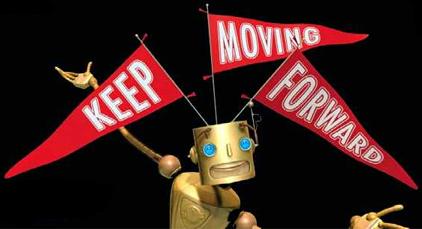
    Organization: Keep Moving Forward

    I had no idea what to blog about for today, so I went to Twitter and asked the hivemind. Amy Sundberg had a really good suggestion, of discussing SFF YA and why it rocks so very hard. Fellow Inkpunk Sandra Wickham had another really good suggestion, of talking about how I manage my hours in a digital fashion. I debated, but then I read this article on Managing Nerds and after I got over the unsettling feeling of having been watched by that guy (every single point he made had me saying “Oh holy Lord has he been following me my whole life?”) I decided workflow and organizations was to be my topic.

    The SFF YA thing is so happening next month, though.

    Me and organization is a funny thing. A big part of it comes from being a nerd. I study systems around me, process data against what I have learned to be true, and find ways to simplify processes and maximize output. It’s the only way I manage a full-time job, a master’s degree, and fearfully dipping my pinkie-toe in this writing business, on top of the other scattered things flying through any spare time I happen to accrue.

    Staying on top of things and staying ahead of or at least along the curve both come down to a few points for me, which I’ll bold and number without priority for your convenience. I managed to keep it to five, which is pretty good, methinks, though one is kind of long.

    I have a lot to say about organization, it seems. But if I’m honest with myself, I’m really only saying one thing a lot of different ways, and that thing is

    Keep Moving Forward

    It’s really the key point. And it took me years of moving forward and falling backward to get to where I am. I’ve listed five things that are important for my organization-ness. They are only loosely in order. But these things have taken me years to manage and internalize. From about 2005 to 2008 I was an unproductive mess. Eventually, things began to click together, but I spent three years floundering. It’s only recently, in the past few years, that I started really moving forward.

    1. Write It Down

    Organization starts with goals and achievements. When I started getting my act together, I wrote down the things I was already doing, and the things I wanted to be doing, both big and small. I sorted them under “long-term” and “short-term.” Finishing a novel, getting a degree, buying property, these are all long-term. Going for a jog, cooking a healthy dinner, reading a book, these are short-term.

    A critical part here: I couldn’t think about how much work I would have to do for these things, be they big or small. The thought of this overwhelming wall of TO-DO left me so emotionally crippled I could do nothing but stare at the list and procrastinate. So I had to cast that from my mind. It’s just a list. It has no power over me.

    Now, each thing I want to achieve has a duration and a process. Going for a run takes a half-hour or so, right? Well, I have to factor in changing clothes, and the warmup, and the shower afterwards, and all that jazz. Ever heard of the Planning Fallacy? (Go read that if you haven’t.) Whatever time I think something will take, I add on an extra 25-30% of time. For giggles.

    Each thing I want to do has a process — especially the big things. Finishing a novel, buying property, getting a degree. I list these because I either have done (novel, property) or am doing (degree) these things. There was an intense, long process for each. So I broke them down into little steps. For buying my condo, I had to first study my expenses versus my income and see what I could afford. Then I had to research what I could buy and where I could buy it. And so on.

    Sometimes, especially with novel writing and publishing, I didn’t know the process. That’s okay. “Research” is usually step one anyway.

    2. Prioritize

    (I was Googling for this matrix-thingy on how to organize your to-do list — priority on one axis, duration on the other, sort of like a Punnett Square of productivity — that I use in my sorting. Don’t know the name of it. If you know it, please say something in the comments, kthx.)

    Once I had a list of things I wanted to do, how to do them, and how long they would take, I had to start organizing it. What was important? What could I do in parallel? What would make me the happiest? From here, I figured out what I wanted to do.

    Then I chose one big thing and started that, and threw the rest away. (Hey, if I want them that badly, I’m not likely to forget them.) The first one I chose was writing. It made me happy, there was no pressure, and I could do it when I had the time, energy, and inclination. Outside of that, I focused on the short-term. Keep the place clean. Play with the cat. Eat. Sleep. Bathe regularly.

    I had everything sorted. I felt ready to start being productive.

    3. Analyze Methods and Gather Tools

    This part is disproportionately long, but I feel like the topics are inextricably linked. So… yeah.

    You know that initial high you get when you have a fresh organizer? That fresh, breezy moment of Armed With My Day Runner, I Will Conquer The World? That’s an epic feeling. It’s also one I’ve abused into exhaustion. I’d take my second wind and sprint until I fell apart, and then do it all over again. Things would get done, and I’d be worn down to nothing, then things would build up to become overwhelming all over again (see figure 1).

    That method? That’s not really a good method.

    The method that works for me? I pick three things to do in a day. Are there a lot of things to do? Yes, always. I pick three things. I write them down, with little check-boxes next to them. Then when I wake up, I see three things. That’s not a lot of things. I can totally do three things. And once I’m done with those three things, I pick tomorrow’s three things and enjoy the rest of my day. (Yes, I could do more in a day. But that’s not the point. Wait until item 5, then you’ll understand.)

    Also? Sleep. Sleep. Go to bed at regular o’clock. Set the alarm for another regular o’clock. I don’t care if it’s 9p to 5a or midnight-thirty to brunch. Pick an hour. Go to sleep at that hour. Wake up eight hours later. Do this Every. Single. Day. I found that my productivity is inversely proportional to how many hours I stay up past my bedtime. If I sleep for 8 hours, the remaining 16 are so productive it’s astounding.

    And the last major thing I do is Write. Down. Everything. Everything. I have so many things that I do, it’s general policy: If I don’t write it down, it doesn’t happen. Write it down, put a date on it, and move forward.

    As I go, I gather tools. I try to keep on top of things via blogs. My Google Reader is indispensable for this. I search for new tools. I keep my ear to the ground. When someone says something is useful, I’ll give it a whirl. When something proves itself useless, I cut it.

    I use Google’s Calendar, Tasks, Reader, Mail, and Docs. I use Dropbox. I use Duotrope. Within Calendar, I have five different calendars for color-coding ease (Social, Academia, Travel, Work, and Writing). Within Tasks, I assign completion dates to every single task I make, right as I make it. In Reader, I have nearly 100 blogs, all sorted by category. I very intensely label and sort and flag and archive and reply to all the mail I get. Every single document in GDocs is filed under a specific folder. Same with Dropbox. My usual method is WIPs go in GDocs, final, submittable drafts go in Dropbox.

    And how useful is this whole mess? Well, let’s take for example GoogleDocs. I have an Agent Spreadsheet in there, for when I was doing my research. I’ve been building the thing for… probably a year now. Nearly 200 agents. All with detailed notes (whatever I’ve gleaned from AbsoluteWrite, WriterBeware, Publishers Marketplace, Preditors and Editors, Agent Query, Google results, following them on twitter, etc, has all been stored in this spreadsheet — because if I don’t write it down, I’ll forget it, utterly). It sounds ridiculous and horrifying and towering and unmanageable… until I realize I spent a year doing this thing. Snatches of spare time here and there, and a year later I have a wealth of data. And I wouldn’t have been able to do this as easily if I had to, say, keep a spreadsheet on a thumb drive. Or, sheesh, write it all down by hand.

    The main point here, though, is that I have one point of contact for my things. Whether I’m on my PC, my smartphone, someone else’s computer, it doesn’t matter. I can see my calendar, manage my to-do list, handle email, and read and edit documents, anywhere I want. I open Calendar, and my appointments and my to-do lists are all on one page. I can manage my week, quickly and effectively.

    One spot. One point of reference. One place to go to keep myself sane, keep moving forward.

    Every so often, I’ll stop and look at what I’m doing. Is there something that I dread? Is there something I’m pushing away constantly? Why am I doing this? Is it because it’s simply uncomfortable (going to the dentist, anyone?) or is it because it’s draining and useless? If I have to do it, but I don’t want to, well, I have to do it. Sometimes life sucks, and teeth need cleaning. But if I don’t have to do it? Screw it. Life’s too short.

    And if a tool doesn’t get used, or another, better tool comes along? I’ll change. It’s all about what works, and what works best.

    If you try these things and they don’t work for you? That’s cool. Try something else. The point is you have to find what works with your particular mindset. Maybe you’re a pen-and-paper person. Go with it. And as you go, keep an eye out for what slows you down (maybe you prefer narrow-rule over college-rule? Don’t settle) and what speeds you up (maybe you like a specific type of pen? Buy them in bulk).

    4. Push Yourself. Challenge Yourself.

    Once I hit a stride, and feel like I have things under control, I add a little something to the list. I started with just “manage the household.” Three months of steady household management, I added “write a novel.” Four months later, I added “buy a condo.” Five months after I had a condo, I added “get a master’s degree.” I added “lose ten pounds.”

    Every time I felt I could add something, I did. Never while things were precariously balanced. Never during, say, finals week. Never during a huge deadline at work. Not even immediately after. I always waited for the opening, and then took it. I made sure I was happy, rested, and enjoying the important things in life, like snowboarding, or my significant other.

    But the point is that I keep moving forward.

    5. Forgive Yourself. Reward Yourself.

    Rewarding myself is important, and it’s simultaneously hard and easy to do. If I have a towering to-do list for the day (like I do right now) I want to just go go go move on get it done. But I can’t. I need to stop after a task is done, and take a moment to just enjoy it. I finished my reading for class tomorrow, and so I made a pot of lychee-flavored oolong (yes, it’s as good as it sounds, maybe even better) and let myself enjoy that sense of accomplishment. I’ll let myself wander around the internet for fifteen minutes or half an hour. I’ll watch a show I like. Maybe I’m energized enough to do more things. That’s not the point. The point is I did my things for the day, and I should enjoy it.

    Because my brain builds on this. It gets addicted to that sense of achievement, and wants to do more. I let it enjoy those little chemicals of “Yay, I did it!” I train my brain not to see task-completion as simply the herald of more shit to do, but as the path to happy hormones.

    Of course, I don’t always accomplish everything I want. Like right now. My list for today was too much. I won’t finish all the items. Several things will go unattended.

    Forgiveness, I think, is the hardest part. Most of my issues with Things Are Overwhelming stem from emotionally beating myself up because I’ve let them get so overwhelming. I fail to do a task, and it’ll simply validate that dark little voice telling me how much I suck. Or I see the towering list of things and think, man, I’ll never do all those things.

    Well first of all, maybe I will. And second of all, what if I don’t? What’ll happen?

    The consequences of my, say, dropping out of my master’s degree is… nothing. Absolutely nothing. There’s no penalty. What if a thing I am doing stops bringing me joy? Then I stop doing that thing. What if I want to be in a band and write and be an engineer and bellydance and breathe fire and bake the most perfect cupcakes you’ve ever seen? Well, maybe I can’t do all those things all the time. But I can do some of those things some of the time. And the rest I will have to forgive.

    And what if I fail to do a thing? What if I’ve accidentally overbooked myself? What if I just don’t have the energy or strength?

    That’s okay. I’m human. I have limits. I just look at how much I planned, how much I achieved, and I adjust. I get up, dust off, and… yeah.

    Keep Moving Forward

    Continue reading

    Lessons From the Slushpile: Good vs. Great

    When I got stuck for a blog topic this week I asked for suggestions on Twitter. Three of you said you’d like to read about what I’ve learned from working for Lightspeed Magazine. This is timely, actually, because January 9 marked one year since I joined the team, initially as a slush reader, and later as an Assistant Editor. I’ve written a little bit about some of the things I’ve learned over at my personal blog–little things about cover letters, and worrying less about why your story was rejected. But today I want to dig a little deeper.

    First off, what I’ve learned is that working for a magazine–even a great one–doesn’t make me an authority on anything. So what follows is only what I think I’ve learned. So far.

    Personally I think we have a pretty high percentage of competent writing in our slush. Most of the people submitting to us are not bare beginners, they’re seasoned amateurs and new professionals. They’ve joined critique groups and been to workshops and know how to give a story a beginning, a middle and an end. There’s a difference, though, between Pretty Good (which does not get past slush), Really Good (which does) and Great (which gets purchased.)

    It didn’t take me long to start seeing the pattern of mediocrity–of Pretty Good–in the slush, and realize that my own work fit in that category. Stories without structure and tension don’t hold the reader’s interest; stories without voice all sound the same. I was–am–one in a sea of Not Quite Theres.

    Once I’d learned to identify Pretty Good from an editorial perspective, I wanted to look at it from a writer’s perspective. I picked them apart some more, the way we do when we’re critiquing. Nothing new emerged from that (I’ve been doing this a while.) It seemed that reading and analyzing mediocre stories wasn’t going to help me get better at this point. So I started reading Great ones–the stories that the Overlord bought–with a closer eye.

    What I learned is that the Great stories have a few things in common. They have structure, they have voice (which is consistent throughout the whole story–every line is colored by that voice, it dictates what the right words are), and they have something to say.

    As writers we get so accustomed to identifying what’s wrong with things. We read and we pick out the things we don’t like about a story, what we think the author did wrong. Maybe it’s time for a new approach: We can go read something great, and then identify what made it great, and how the author executed it. (You can start with the Lightspeed archives, if you like; fully half of the original stories have been picked up for Year’s Best anthologies, which is a pretty astonishing ratio for a new magazine, so I feel pretty confident in recommending at it as a Source of Great despite my obvious bias.) We can ask ourselves what the story was about, and what we learned from it–not about writing, but about life and being a person.

    Look at Adam-Troy Castro’s story, “Arvies.” Look at “Amaryllis” by Carrie Vaughn, or “Cucumber Gravy” by Susan Palwick. Totally different voices, totally different styles, but in each that voice is strong and clear, and the author is addressing something that matters. I come away from those stories thinking, and feeling like I know humanity a little better.

    Reading stories like those, aspiring to that, is frankly intimidating. But we got this far by believing in ourselves and each other, right?

    We can go back to our own stories now, and look for what’s missing. At this stage of our careers it’s probably not a problem of too many adverbs or inconsistent POV. We’ve probably got a beginning, middle, and end. The problem is no longer a question of what to take out, it’s what to put in.

    If we have sales, especially sales we are particularly proud of, we can go back and figure out what made them work. My guess is that we nailed the trifecta of structure, voice, and having something to say.

    So the last thing that I want to address here is this: What comes after competence is craft, and craft takes time*, and care.

    What I’ve learned is that not enough of us take that time. We see so many stories where if the author had taken a little more time, taken a step back from it, come back with fresh eyes and put in what was missing, it would have made all the difference. As writers, we’re in such a hurry to get it out the door that we get it to Pretty Good and submit. Pretty Good isn’t good enough.

    So that’s what I have to offer, a year in. It’s daunting as hell as a writer, but very exciting as an Assistant Editor. Finding a Great Story in the slush is exhilarating, and nothing compares to finding out that the Overlord is buying a story I recommended.

    I can’t wait to find the next one. Maybe it will be yours.

    *Your mileage may vary.

    Continue reading

    Day Jobbery: Who wants to work forever?

    When I was eighteen, I traveled north to Milwaukee and attended my first GenCon in the mid 1990’s with some friends from college. It was the first time I’d experienced anything of the sort. I’d been reading Forgotten Realms and Dragonlance stuff for ages, and idolized Margaret Weis & Tracey Hickman; I’d known I wanted to be a writer for as long as I could remember but this was the first time that I would be able to actually talk to some of my heros. I was so excited I could barely contain my squee and the pain of my disappointment lives with me to this day.

    In truth, they weren’t all bad. I have a great story about meeting making Margaret Weis laugh that I’ll tell occasionally, but it’s the bitterness that often overwhelms the sweet things on our palette. The defining moment that stands out in my mind is when I stopped at one of the author tables and asked the person if he had any advice for someone who wanted to become a writer.

    In hindsight, I recognize him for what he was but at the time I was young and vulnerable. When the bitter, angry-looking man spat out the words, “Don’t quit your day job,” I was devastated. Not in the realistic, Boy, this writing business is hard work sense but what did it do to crush this man’s soul? Reality, I’ve discovered, is somewhere in-between.

    Love them or hate them, day jobs are a fact of life for the majority of writers. Whether you are single or not, you more than likely need money in order to survive. Food, shelter, and clothing are just the beginning. Health care, unless you come from a country with universal health care* and/or have a working partner, is critical unless you’re SuperNonSpecifiedGenderPerson, which most of us aren’t. So how does stay sane while working a day job with an eye towards writing for a living?

    First, let’s define what it means to be a full-time writer. It’s not the romantic notion that you see portrayed on Castle. Oh, how I wish that it were and that I were Captain Tightpants. Writing for a living, or freelancing in any field, involves a lot of hustling. You have to have the right personality and work ethic. You can’t be easily discouraged by failure. It helps if you can live cheaply, budget tightly, and plan accordingly. It’s hard work. It’s far from glorious, but for some, it’s everything.

    With that in mind, here are some things to consider if you have your heart set on writing full-time some day and are willing to make the sacrifices necessary.

    Does your job leave you a creative husk at the end of the day? Maybe you’re in the wrong line of work. You can tell yourself that things will get better, that your responsibilities will get lighter, but in my experience, they rarely do unless you take steps to make it so. Yeah, this is a big change but so is the potential reward.

    Is your cost of living too high where you live? Living in a big city is more expensive than small town living. If you’re in the mood for a new place to live, it’s something to consider. We chose to live in a town of less than 5,000, but off a highway so we could still have access to bigger city amenities as needed at a considerable savings to the house I owned in the city of 100k+, and we don’t feel like we lost out on anything.

    Write early, write at lunch, or write late, but write consistently. Once you’ve made the room in your life to pursue your dream in earnest, don’t drag your feet. Find what works best for you — when you can work with the least distraction from kids, pets, or significant other — and make your word count. Write at home, from the coffee shop after work, on the back of your fork lift during downtime, or wherever feels right.

    If you’re already writing full-time…I am filled with jealous rage and envy. Kidding, mostly. Otherwise, the advice I received lo those many years ago is perfectly valid. Poorly delivered, lacking context but accurate for short-term planning. With dedication, hard-work, and let’s face it, luck, it is entirely possible and feasible to write full-time if, and it’s a big if, you and yours are willing to make whatever adjustments are necessary to home and lifestyle to accommodate the change.

    I’ve been working from home for the past six years, first as a freelance software developer and then a remote full-time employee. One day I’ll make the leap back to freelancer, so I can devote more creative time to writing. What about you? What are your aspirations?


    * And even then there may still be out of pocket costs.

    Continue reading

    The Author’s Voice

    The Author’s Voice

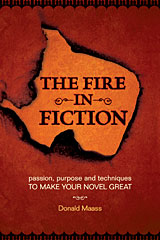
    I recently read “The Fire in Fiction” by Donald Maass (Founder and President of the Donald Maass Literary Agency) and in one chapter he discusses the voice of your novel, something that new authors often struggle with. Donald Maass has this advice to writers:

    “It is when the words on the page demand that I, the reader, take notice that I begin to hear the author’s voice. It isn’t words alone that do that, I find, but rather the outlook, opinions, details, delivery and original perspectives that an author brings to his tale.”


    When I read that, I immediately was reminded of a workshop I attended at the 2008 World Fantasy Convention. I dug up my notes from that workshop conducted by David Morrell, called “The Author’s Voice”. Back then a few things really hit home with me and I thought I’d share some of these points in case it helps anyone else.

    David Morrell said early on in the workshop that the most important thing you need to do in your career is be yourself. Wow! Simple, but so important when you start worrying about who is going to read your work, what genre label it will get, who is going to want to represent you or publish you if you write this way or that way. Be yourself! Okay, got it.

    He also said that most people have a dominant emotion that controls them and how they view the world, his being fear – hence his very scary horror novels! In the workshop he said, “You have a ferret inside you and it doesn’t want to be found”. You have to get as close to it as you can, and that will be what you will write. Whatever it is, you have to figure it out.

    He emphasized you have to trust your ideas, your daydreams, pay attention to that. Another point he made was, “the story is always right, it’s the writer that’s wrong“.

    Most importantly for me, he said, you better have a damn good reason for writing your book. Why are you writing it? Find the books that you were meant to write, he said.

    How do we do that? I think in my short experience, it mostly comes down to trial and error combined with a reading of and feeling out other author’s voices as well as a lot of soul searching.

    Bonus: David Morrell’s keys to getting published:

    1. Talent
    2. Discipline
    3. Determination
    4. Luck

    Have you found the books you were meant to write? If not, what are you going to do about it?

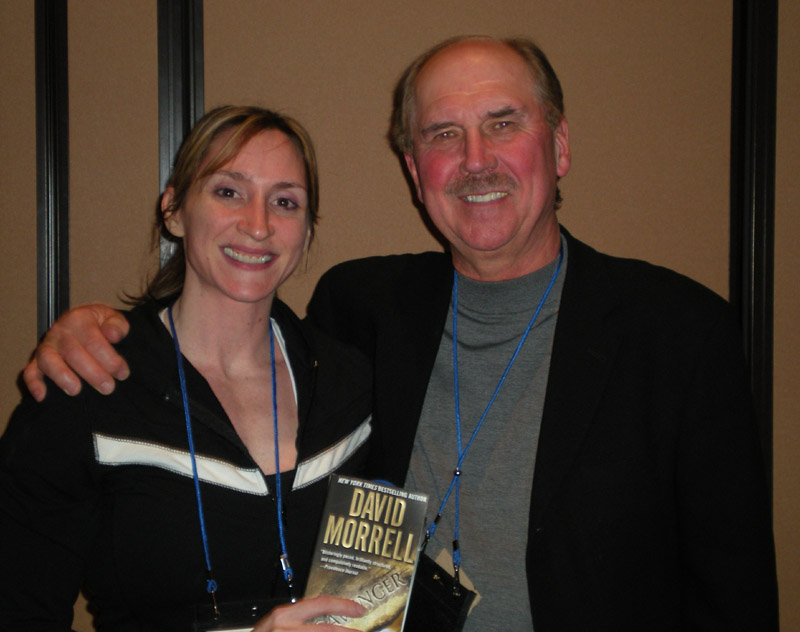
    Sandra with David Morrell, WFC 2008

    * David Morrell is the author of over 32 books, a co-founder of the International Thriller Writers organization, a three-time recipient of the Bram Stoker Award, with eighteen million copies of his work in print and his work has been translated into twenty-six languages.

    Continue reading

    Resolution: organization

    Hellooooooo! Welcome to the new year. If you’re like me, you’ve made some resolutions (you, ten pounds–you’re going down!). If you’re a writing type–also, like me–you’re getting ducks in a row, setting goals and starting new projects. And if you live in the real world (don’t look at me, I just rent on this planet), then you’ve got to balance the new projects with the old. This will require supreme organizational tactics.

    I used to be a disorganized writer. When a project came to me, I threw myself into it and just worked hard to see my way through. That worked well for me when I didn’t have so much on my plate, including plenty of projects that will never be completed. There is always going to be more slush to read. My blog will never disappear. And even though Twitter is mostly entertainment, networking has already proved its worth. I can’t let these things fall by the wayside while I go into a short story-writing frenzy.

    So here are some of the ways I’m planning to keep all my ducks in a row.
    1) Carve off the largest chunk of time for the most important project. By most important, I don’t mean the one with the closest deadline, and that’s something I’m going to have to remind myself about. Writing my new book is the most important thing I can do with my time. Period. A writing career is based on books. If I don’t have books to sell, I’m never ever ever going to be JK Rowling or Stephen King. The writing business is just like the lottery: the odds are against you, but you can’t win if you don’t buy a ticket.  Writing a novel is like buying my lottery ticket.  🙂

    2) Cram small projects into weird spaces of time. Right now, I’m waiting for the oven to pre-heat so I can toss my broccoli-tofu-tahini casserole into the oven. (Let’s hope it tastes better than it sounds.) I’ll check the slush while my daughter takes her bath, and I’ll wash dishes while she reads to her dad.

    3) Cut the fat. I don’t watch tv. And I let myself watch 2 movies a week: one grown-up movie on my one night off with the sweetheart, and one kid movie for Family Friday Movie Night. I read on the bus, or while I eat lunch. And I only mop the floor when it looks the wrong color.

    4) Don’t start projects you don’t plan to complete. This is a hard one for me. I’m prone to starting stories that I don’t finish because I realize they aren’t any good and I’ve wasted plenty of time with novels that go no place.

    • But it’s okay to play around with words. That’s called practice, and it’s critical. But don’t commit serious energy to practice. When you finish an uneventful or run-of-the-mill story or reach the point where you realize you’ve created a great character sketch, don’t worry about editing it into publishable form. You don’t have to submit everything you write. I’ll say it again: YOU. DON’T. HAVE TO. SUBMIT. EVERYTHING THAT YOU WRITE. Writing can be about learning. Learn from a piece that goes nowhere and let it go. Teach yourself to recognize your gems. Spend your energy on them.
    • Approach your projects in an energy-saving fashion. You’ve thought of a cool novel idea. Great! Write a short story set in the same world to test out your world-building–don’t write 40,000 words and realize you forgot to create any memorable characters. Before you commit yourself to a long project, give yourself a chance to make an outline. Look at organizing your materials in new ways. Now would be a good chance to create a Google docs spreadsheet of all your characters and important facts and place, so you have that information backed up. Now would be a great time to think about story structure, and maybe make an effort to build some bones into your project before you get frustrated and decide to kill every character.  And for your own sake, get your hands on something like Dropbox, so you don’t lose your project when you knock over your latte.

    There are a thousand more wonderful ways to better organize your time and spend more energy getting what you want done.  For me, the most important multi-tasking I plan to do is simple:  I’ve put my laptop on my dishwasher so I can stand up to write.  After all, those ten pounds aren’t going to go away on their own, and I’m a writer:  I don’t have the cash to join a gym.

    I’m eager to hear all your organizational tips and tricks if they help me in my quest!

    Continue reading

    prev posts prev posts