Standing Out in the Slushpile: Some Basic Tips

For the past four-and-a-half months, I’ve hardly written anything, focusing instead on four anthology projects (Broken Time Blues, a reprint anthology, a young-adult anthology, and the re-release of Rigor Amortis). Before I get back to writing, and while the business of editing is fresh in my mind, I thought I should post my own version of lessons from the slushpile.

Christie Yant, fellow Inkpunk and assistant editor of Lightspeed has done a few posts on this topic: What Editors Owe [Writers], Cover Letters, and Good vs. Great.  I would encourage you to check these out.

I agree with everything Christie has to say, and also offer the same caveat—I’m just one editor, and these are only my observations and opinions; others may disagree.

So, how can you increase your chances of being plucked from the slushpile? Read on.

Follow the guidelines

Yawn.

I know you’ve heard this (Dr. Evil voice) one mill-ion times before, but some authors still haven’t gotten the message. Not following the guidelines gives an editor an easy excuse to reject your story, probably without even reading it.

In the Broken Time Blues’ slushpile, for example, we received non-speculative stories, stories pasted into the body of an email despite requesting an attachment, stories exceeding the maximum word count, etc. While I won’t reject a story simply because the author double-spaces after periods, blatant disregard for the guidelines irritates me. It makes me feel that the author is spamming markets with little regard for their themes or requirements. Not the first impression one wants to make.

While a few markets have highly particular or idiosyncratic guidelines, most simply require standard manuscript format. Use that.

Get to the speculative element early

You already know that you need a catchy beginning to keep an editor reading, but for most genre markets this means getting to the fantasy/science fiction/horror element early. Six pages of the main character making toast before we learn that she’s an escaped robot monkey is probably too long. Of course there are exceptions, but the writing must be excellent and the tension high to keep me reading if there are no obvious fantastical elements or hints of the same.

Be unique

The most striking thing I’ve noticed in the slushpile (which I suppose should’ve been obvious, but wasn’t, initially) is that people gravitate toward what they know, based either on their own experience or what they’ve often seen or read in the genre. This makes sense and I’m not even sure people do it consciously, but they (we) tend to lean on what’s comfortable. 

If someone were to seek submissions for a vampire anthology, for example, I expect that most of the stories they’d receive would be: urban fantasy (i.e. set in a real world city, present day), take place in North American or western European alleys or bars at night, and feature a cast of straight, white, thin, able-bodied, beautiful, ass-kicking, smart-talking, humanoid characters, probably dressed in black leather. While it’s possible for such stories to be great, there are going to be more of them. It’s a numbers thing. The person who writes about the Greek demi-goddess Empusa, or a future invasion of blood-sucking alien worms, or a vampiric parrot terrorizing a ranch in South America in 1963, is automatically going to stand out. This doesn’t guarantee acceptance, of course, as the quality of writing must be there, but the editor is less likely to reject the story for duplication of content or setting, or for being clichéd.

My advice? When considering a call for themed submissions, jot down the plotlines, settings, and characters that spring immediately and easily to mind, and then go in a different direction (while still honoring the theme and following the guidelines). For great tips on writing what you don’t know, see John Remy’s recent post on the subject.

Don’t be boring

Stories that bore me tend to fall into two categories: a potentially interesting plot is buried in wordy, repetitive, and bland prose; or the gorgeous language and quirky characters fail to make up for the fact that nothing happens. The former are too concerned with the big-picture, the latter with sentence-to-sentence writing. Balance is ideal.

Strangely, it is often the most action-packed stories that are devoid of pizzazz. It’s like the author’s fingers can’t keep up to the pace of the story: There is no time to consider language or detail! This story must be told! Quickly! And with the first words that spring to mind!

But what results is a generic and bloated story in need of significant editing. Pro-tip: editors want to do as little editing as possible.

So what can you do? Pay attention to detail. Have a look at each sentence—can it be shortened and still say the same thing? Are you repeating information or descriptions the reader has already seen? Do you have unnamed and/or stock settings that could be named or changed to something more unique (e.g. pubs, castles, villages)? Same thing with characters—name them and make them come alive with quirks and distinctive voices. And do you use a lot of abstractions, such as “love,” “hate,” “good,” “evil,” etc.? Can you show these things instead of using a shorthand abstraction to tell us? While it is possible to go overboard on detail, detail is what lends richness and a sense of reality to the story. A story lacking in detail reads more like an outline. Outlines don’t get published.

At the other end of the spectrum are authors who focus on prose and form to the detriment of story and substance. There is no arc or structure. These stories read as vignettes or fragments. They leave me scratching my head and wondering if I’ve missed something. I often re-read them only to find my suspicion confirmed: there’s no (or very little) plot.

I’m not suggesting that authors shouldn’t experiment with structure; there are whole sub-genres and markets dedicated to publishing experimental work. But unless you’re aiming for one of those markets, a reader should come away from your story feeling like something happened and that it matters. If they can just shrug their shoulders and say “huh,” you probably haven’t done your job.

Whether your piece is a quiet story of character transformation or a rollicking tale of high adventure, you should pay equal attention to both language and plot/structure. The best stories have both.

Well founded ending

A disappointing ending is one of the most frustrating things an editor faces. You’re reading along, getting excited that you’ve found something great, and then…argh! The story has ended too abruptly, cutting off at a strange point. Or the protagonist does something completely out of character, presumably to create a twist. Or major plot points aren’t dealt with (they don’t have to be wrapped up tidily, but they can’t just be abandoned, either). It feels like the author has become lost, is unsure of what to do, and has thrown his hands up in defeat. The editor will likely do the same.

We shouldn’t be able to see the ending coming, but it should also feel perfect—like the story couldn’t have ended any other way. Don’t send in your story until you’re sure your ending’s just right. Beta readers can help with this.

Good stories get rejected

That’s the unfortunate truth. There’s simply not enough space to publish everything worthy of being published. Stories are rejected because they’re too similar to others, they don’t fit the tone or feel of the anthology, or are simply longer than other, equally good stories (the longer the story, the more exceptional it has to be to justify its cost and space). However, if your story’s good, it’ll probably get picked up somewhere, or you’ll at least get encouraging rejections. Persevere—you’re on the right track.

So, that’s it! Follow the guidelines, get to the speculative element early, be unique and interesting, and write a great ending! Not so easy, I know. But if you work on these things don’t be surprised if you get an acceptance or two.

I’d love to hear your thoughts and tips!

Continue reading

Write What You Don’t Know

On the surface, you’d think that writing what you *don’t* know should come naturally to authors of specfic. I mean, how much does anyone really know about what it feels like to face a Hound of Tindalos, or to download an assassin’s persona into your brain, or to have your body transformed by the effects of polyjuice potion.

But what does it feel like to wake up to a cross burning on your front lawn, or to suffer from chronic depression, or to feel your body ravaged by AIDS? I’ve had a number of conversations with writer friends who struggle with writing outside of their cultural, ethnic, racial, gender, sexual, age, and life experience. These are daring authors who want to push themselves, but who are also sensitive, compassionate people who don’t want to offend or cause unnecessary pain to their readers.

When we write outside of our own experience, even with the best of intentions, we risk creating stereotypes and caricatures, exploiting others’ cultural heritage for our own purposes, and offending others by missing some important point. Actually, let me revise that. Even when we write from our own experience, we still risk this. Writing, especially powerful writing, is fraught with risk.

If any of this sounds familiar to you, I’d like to offer some advice on writing outside of your experience:

1. Do some initial research. In this case, do write what you know. If you obsess over Mexican Dia de los Muertos, or are an Anglophile, or have watched every Chinese martial arts film available on Netflix, write stories inspired by your obsession.

2. Shut down the inner editor on your first draft. If I leave mine on, I would never get anything written. *When* I’ve left mine on, I get stuck in a frustrating cycle of writing and deleting, writing and deleting. Your first draft may be full of the worst stereotypes, unintended slurs, glaring gaps in cultural or experiential knowledge. Save that for your first revision.

3. Again, write what you know in terms of personal experience. Have you been so sick that you had to face your fear of death? Have you suffered discrimination? Have you ever questioned your sanity or your sexuality? Stephen Crane wrote the the classic Civil War novel The Red Badge of Courage. He never experienced battle, but the veterans who read it could relate to the distress, the fear, the rage felt by its protagonist. Crane channeled essential human emotions and experience from other aspects of his life into the battlefields he read about, and the soldiers he created with his pen.

4. Finally, do your research, look for qualified readers and critiquers, and rewrite and revise. Now that you have the basic story down, turn that inner editor dial to at least eight. But remember that you probably will never please everyone. For every issue that you’re concerned about, there are probably multiple blogging communities and academic conferences full of people who live and debate that topic.

I’m trying to follow this challenge myself. Although I’m essentially a straight male, I obsess over gender identity and sexual orientation enough that I tend to write stories featuring queer main characters. Lately I’ve been studying Bolivia obsessively, and my next couple of stories will be set there with Quechua and mestizo characters, instead of in Japan, or in the US with Japanese-American or half-Japanese protagonists.

I’ve acted as a cultural consultant for a published story and a soon-to-be-published novel, each set in Japan and featuring Japanese and Japanese-American characters. Both were wonderful stories, and I believe that both were written by white Americans. I’m glad that the authors and editors took great care to vet the stories, but I’m even more grateful that both authors took the risk to write outside of their immediate cultural experience–the world would be a poorer place without these stories.

In fact, please check out Matthew Sanborn Smith’s moving story set in a future Nagasaki at Tor.com: Beauty Belongs to the Flowers.

I realize that my advice is not for everyone, and may even be problematic. Please comment below if you’ve struggled with similar concerns and please share how you’ve overcome them, or (especially!) if you disagree with me.

Continue reading

Network Security Innovations

Effective network security provides many levels of security to scale with your growing business. If you need to invest in highly secure networks, hire network security experts, or augment existing security measures, you should consider a SAN solution from Seagate.

There are many factors that drive innovation and drive development for technologies like the Hyper-V industry. The details and details of security can make or break the security of our IT infrastructure and associated appliances. The ease of use, lower overall cost, and increased reliability can enable the hosting of major business workloads in your datacenter. Don’t be fooled by the words “better” or “faster” in marketing materials the truly innovative security technologies have the potential to change the security landscape forever.

Best Security Cloud Service Providers for EAPs

Seagate has some of the best value for money storage arrays around. Whether you are the novice or the seasoned enthusiast, we believe you will find Seagate’s Hyper-V platform to be the ideal platform for server and virtualization based data protection. Our products come in two sizes smallest and largest for use in server datacenters, and are suitable for a wide variety of security-sensitive applications., while there are other services like Virtual Cloud Networks (VCN) that help companies manage their networks without physical contact to the network.

We also have a selection of VMware VSCs (virtualized storage controllers) and VNVSS (Virtual Volumes, which are hybrid virtualized software-controlled storage). All are equipped with virtualised SANs and storage controllers that are managed from an operating system.

As Seagate’s storage products for your Enterprise, we have a solution for any single or multi-tier solution. Seagate recently introduced the $699 Seagate Thin Pro (from $999), which is the top of the range storage solution from Seagate for VMs and servers, and the VAPs offer the same high level of service as our San array.

Our second-generation thin-pro based on the latest Silicon Motion SATA 6Gb/s controllers is Seagate Hyper-V storage. Seagate Hyper-V is aimed at all-in-one server-based datacentres where speed, simplicity and high levels of service are key aspects. As always, we have our Hyper-V solutions made from the best available materials and software, including Storage Hardware Promised Land (SHP) vSphere the vSphere Solution, vSphere Integrated Container Services (VCSC) and the Cloud Container Services (CCS).

Our next-generation VNXI array is the smallest and fastest storage platform available that offers the highest levels of storage security, scalability and reliability. With 2x bigger than the San array and able to host multiple virtual machines in a single server enclosure, our VNXI 7.2 Series SSDs are ideal for maximum performance and ideal for heavy work.

Continue reading

An Introductory Primer to the Clarion Workshops

It’s that time of year. Winter has faded, birds are beginning their first tentative tweets, and a new class of Clarion students has been selected. The Clarion Workshops have a reputation for turning out many distinguished writers, like Kij Johnson, Gordon Van Gelder, Octavia Butler, Ted Chiang, Cory Doctorow, Kim Stanley Robinson, and Bruce Sterling, just to name a few. A six-week immersive course on writing genre fiction will influence you, but it’s the people surrounding you, students and teachers, who will change you forever.

Summer seems like a lifetime away and the days will pass with agonizing delay. You’ll be scrambling to work out the details of taking a month and a half away from work or family. Financing the workshop might seem impossible. I know — I was in your shoes in 2010.

By now there’ll be introductions and discussion started on forums, blogs, and twitter, as classmates are getting to know each other. Some of you may shy away from this at first, but really, there’s no need. These people will be like family by the end of your six weeks together and you will mourn the tragedy of your eventual separation. Take advantage of the time you have with them now to build the foundations of your relationships, and your free time during to cultivate them.

Like any family, it can be a bit dysfunctional. You might find that you like some members more than others, and that’s okay. What’s important is that you remember that each and every one of you come from a different background and have unique life experiences. Whether it’s in the common room or the classroom, never assume you know what someone else intended to say. When you’re scrambling to write and revise a story on a tight schedule, sometimes what you mean to say and what the reader perceives are polar opposites. Take that into account when you’re critiquing the story, and never, ever critique the author. That way lies madness.

Clarion is a nerve-wracking event that will make you second-guess yourself. Keep in mind that you were selected for a reason. It was not a fluke! The only person you are there to impress is yourself, and you’re only going to get back from the program as much as you give. Write your heart out. Bleed all over the page, but not literally, please. Those stains are difficult to remove from the carpet and housekeeping will not be pleased.

When your time at Clarion is over, stay in touch with your classmates. My year setup a Google Groups so we could continue to support each other. While you might not see some of them again for years and years, they will always be there for you, as cheerleaders, fellow authors, editors, critiquers and friends, so treat them well.

Continue reading

The Inkpunks Disband

This may very well be the most difficult blog I’ll ever have to write. It is with tears in my eyes and a destitute heart that I bring you the news that the Inkpunks have disbanded.

I have been given the task of delivering this devastating news to you, our loyal friends, fans and followers.

I am even more upset to report that it was not an amicable split. There were many issues, but the pinnacle of all of it was a conflict between those in the group who are editors in addition to being authors and those who are authors.

To clarify:

Editors
Wendy
Jaym
Erika
Christie

Authors
Sandra
Morgan
John
Adam

I dare not tell you all the details, to quote my favourite elf, “for me, the grief is still too near.” There were things said by both sides that perhaps should not have been said, it’s true. Things such as THOSE HORRIBLE EDITORS AND THEIR GATEKEEPING ELITISM and THOSE WHINING MALICIOUS STALKING AUTHORS were perhaps not the most professional expression of emotions, yet, there they were.

Things escalated until it seemed no resolution could be reached. As the one who brought most of us together in the first place, Christie “the evil Overlordess” Yant finally spoke up and lowered the boom of doom upon the group, declaring it disbanded.

Cue the fat lady. This will be the final blog, but not the final word. While I am announcing this on behalf of the entire group, I do not begin to speak for each individual and would invite them to voice whatever it is they wish to express at this time in the comments.

Good-bye, dear readers. To my ex-inkpunks, you are all the most terrible, unsupportive, uncreative, talentless, selfish and uncaring people I have ever met in my life. I hate you all.

Continue reading

Look Where You Want To Be

I’ve been rereading Jeff VanderMeer’s Booklife recently, and trying to apply the things to my life in my own way. In doing so, I’m actually giving name to the ways I already protect myself and my creativity.

There’s an old piece of riding wisdom that I use to guide the majority of my life: “Keep your eyes ahead of the horse. Where you’re looking is where you will end up.”

It’s true, too. Look downwards, your entire body tells the horse to slow down, and you’ll be caught by surprise if there’s an obstacle. Look to the side, you’ll lean that way. Look ahead though, and you’re seeing the obstacles before they get there, the best path to your goal. Your entire body is gathering, transmitting subtle signals to the horse to go go go! It’s already composing itself to be there, not here. In a way, it’s a little like living in the future and existing in the present.

That advice has stood me well! I make plans based on what information and resources are on hand at the moment. I have the next 5 years planned out. I have a mental image of the ultimate goal. I don’t know precisely how I’ll get there, and I try not to commit to anything too strenuously. Flexibility is key for anyone in an environment a stressful and changeable as ours.

Be a ship: Let the winds of change propel you, but control your own course. Spend time conceptualizing where you want to be, and believe that you can be there. Ask yourself why you want to be that future self. Make sure it’s for your own reasons. You should be choosing the path. Go where you want to go, not where someone else wants to go.

In my experience, that’s the best part of Booklife: the whole; the joy that comes from being right where you want to be.

Enjoy.

Continue reading

Why CREEPY is my thing

Zombie-fighter decor in my home. Photo by John Remy.


I wasn’t creepy until I fully embraced my inner writer. That person was born from a depraved childhood in the 1980s. See, we lived so far out in the boonies that we didn’t have nice, clean, FCC-approved television. We had books. And unlike those poor sad children of the 1960s, who parents might have forced them to stick to books with that were clean and safe and approved by The Powers That Be, I got to read anything I damned well pleased.

The church says I'm clean & safe!


And hey, this was the 80s. That could only mean two authors: Dean R. Koontz and Stephen King. I devoured every one of their books our small library system carried. Then I expanded to Ramsey Campbell and Richard Matheson.

Eight year-old children should not necessarily spend all their time eating chocolate moon pies and reading horror novels. It warps parts of their brains, the parts that govern social skills and fashion sense. By the time I was nine, I dressed solely in black and dreamed in text. My teachers constantly sent me to children’s writing conventions and spelling bees. Something inside me had snapped. I’d become a writer without even meaning it.

But years passed. We moved to a town with cable tv. I tried to put my sordid past behind me. I learned to wear pink. I read fashion magazines. I studied science and music and philosophy in college. I joined a sorority.

I almost fully recovered from being creepy.

And then one day, I sat down in front of my computer and began to write about vampires. It passed–I never finished that book–but an inner darkness was released. Words had regained their grip on my soul.

At first I tried my hand at writing fantasy novels. I tried to write a nice adventure story; I don’t know where the melting man or the werewolves came from. I figured I’d outgrow these things, but the more I wrote, the more horrible nasty monsters and people just sprang out of my brain. Witches and demons and mad eco-terrorists eager to lop off the arms of innocent children–these were the people that filled up my stories. And I loved them.

So why am I telling you this? After all, this is a writing blog, not a confessional.

I’m saying it because as an author you have to know yourself. I don’t want to pigeon-hole myself as a horror writer and a horror writer alone. But it’s also okay to embrace the fact that horror inspires me like nothing else.

I spent last year writing terrible science fiction stories. The characters were boring. The plots were contrived. They had moments of wonderful language, but their insides were hollow and flat. I don’t think this is because I can’t write science fiction. I think it’s because last year, I didn’t read any horror after April. (I had some burn-out after being a reviewer on a horror site.)

If there are things that get you excited about being creative, you need to embrace them and find ways to incorporate them in your life. If looking at art gets you fired up, buy a membership to the art museum, or check out art books from your local library. If taking long walks is your ammunition, then you have to find a way to squeeze some walking time into your day. That’s not easy when it’s winter, and it’s cold and dark, but nourishing your creative core is critical.

Last year, there were several times when I found I’d drained all the words out of my word-maker. I’d pushed myself to hit my maximum output: I wrote fourteen or fifteen short stories, drafted a novel, edited two novels, and wrote about 53 story headers, and that was it. There was nothing left at the bottom of the pot. It took me almost three months to recover. At that point, I could write about four hundred words a day  (not necessarily good ones!) and that would tap me out. This was a long, horrible drought. I really began to wonder how I’d ever recover from the blow-out.

And I realized the secret was in re-finding what most deeply inspired me.

For me, being creepy is what nourishes my creative core. Looking at art by Francis Bacon. Visiting haunted houses. Drawing pictures of shoggoth and reading Lovecraft stories. Window shopping on Madame Talbot’s webpage. Planning dream trips to Aokigahara in Japan. Watching zombie movies. My word-well needs this nourishment as much as it needs coffee.

This year, I’ve had to set aside the first novel I started, a children’s science fiction piece that I’d fully outlined and written out about 8,000 words. I’m too busy with Fantasy Magazine to work on anything that doesn’t totally and completely absorb me. Instead, I’ve launched into a new book. I don’t have a solid outline for the project, which scares me, because I’m not sure I’m a good pantser, and I know I hate the editing process. But this book excites me. And it gives me nightmares.

Every day, I’m hungry for the taste of my own words. It’s a sure sign that my word-well has been renewed.

Continue reading

Maintaining a Willingness to Learn

This is a post on editing, rewriting, and being willing to take a critique, and I fear that writers recently edited by me will think this post is about, or aimed at, them. It’s not. Well, mostly not. It’s about my own journey as a writer; the most important lesson I’ve learned from being critiqued and critiquing, and from being (sometimes harshly) edited myself. The best way to learn, in my opinion, is not by reading about theories of writing, dissecting the writing of others, or even writing lots yourself, (though these all have value), but by having your work reviewed by others.

As writers, I think many of us become attached to our words. They’ve taken such effort to eke onto the page, we become reluctant to banish them back into non-existence or fiddle with their just-so-ness. I’d like to say this is more true for newer writers, but I’ve encountered lots of experienced types who seem equally protective of their work.

When facing a disagreeable edit on something more substantive than punctuation or grammar, it can be tempting to fall back on lofty sounding excuses rather than admit weakness. “That may seem awkwardly phrased, or wordy, or unduly repetitive, but that’s my voice–my style;” or “That plot point is not unlikely; it really happened to my friend’s cousin;” or [insert long-winded explanation of what the author meant to achieve, usually involving some sophisticated literary device such as allegory or allusion, thereby intimating that a smarter reader would’ve understood]. Sometimes these are valid reasons not to accept a critique, but often not. If you have to tap dance to demonstrate that something works, it probably means it doesn’t. Put another way: it has to work on the page.

This was the mantra of one of my writing teachers, who brought the point home by telling us her own very personal, very heart-wrenching story. Her first child, while still an infant, was diagnosed with serious health problems that required long hospitalization. Ultimately the baby died. Many years later while completing her Master’s degree in creative writing, she wrote and submitted a fictionalized account of the experience–which was promptly trashed by her instructor. “Not believable,” he proclaimed, and went on to detail a litany of weaknesses in the piece. She patiently listened and then explained that it was believable, because it was a true story. His response? “It doesn’t matter.” Now, while one might’ve wished he’d shown more sensitivity in that moment, what he said wasn’t wrong. Once events are recorded on the page and released into the world, they stop being real life and start being fiction. They are subject to analysis under the cold light of day, by readers with no personal investment. They may not work and one may have to accept that–if one wants to get the piece published (obviously, it’s okay to just write something for yourself). My teacher came to agree with this philosophy, and now espouses it to her students.

And you know what? In a bizarre but fortuitous coincidence, just this morning I got an email inviting me to the launch event for her first published novel. The subject? Young parents faced with a critically ill, newborn daughter.

This is just one–albeit extreme–example of how an author might benefit from divorcing herself to some degree from her work. There are others.  The first way you’ve chosen to express a thought, while undeniably your voice, isn’t always the best way. The glorious world-building in your head might not be fully rendered on the page. And even a “smart” reader might get confused, and this might be your fault.

Of course a certain amount of sticking to your guns is required. You ought not to blindly accept every suggestion that comes your way, or you risk losing the you-ness that makes your piece special. All of us have encountered someone who has told us to do something blatantly wrong or clichéd because they don’t know better. The seriousness with which you take the advice will depend, in part, on how much you trust your beta reader.

But I believe that something can be taken from every critique. Let’s face it: many if not most of our future readers (hopefully) aren’t writers or experienced beta readers themselves, but average readers. Even if you don’t agree with a problem they raise, or view it a different way, it is always useful to consider the critter’s point-of-view. If they stumbled over or questioned something, often someone else will, too. Ask yourself what might be done to address the issue, even if it’s different than what they’ve suggested. Chances are, something can be improved.

Becoming a better writer requires the humility to admit that you’re not perfect and a willingness (the courage?) to consider that even a hard-fought piece might be strengthened by incorporating outside input. We’ve all heard some variation of the quote that there are no good writers, only good rewriters, but I prefer this one:

“Whenever you feel an impulse to perpetrate a piece of exceptionally fine writing, obey it—whole-heartedly—and delete it before sending your manuscript to press.  Murder your darlings.” Sir Arthur Quiller-Couch*

I’d love to hear your thoughts.


*Maybe–although this quote has been attributed to others, including William Faulkner.


Continue reading

Community

I blog a lot about not-writing. Even my one “writing” post looks more like not-writing.

Anyway. Community.

Community
No, not that Community.

I went to FOGcon this weekend, where I got to hang out with fellow inkpunks Jaym and Erika, as well as a swath of friends (Emily, Jeff, Ann, Andy, Amy, Abner (that’s a lot of A’s), and more). From what I’ve heard, panels were fantastic (I only went to one — oops!), and what I experienced of the con was really fun. And what made it fun was the people I was with.

I’ve said, aloud and on twitter, how I’m persistently stunned and amazed by the friends I have, and incredibly grateful that they call me a friend. I’m blessed to know some insanely brilliant (and maybe brilliantly insane), driven, talented, aware, compassionate, hilarious, generous people. And I don’t even want to limit that to writing. I know designers, gamers, musicians, programmers, start-up masterminds, community organizers, all of whom are incredibly thoughtful and kind and welcoming.

The community is what I love. It’s what helps keep me sane when all I want to do is flail about everything that comes my way — good and bad. It’s what smooths down my feathers when I feel like a scattered mess and totally adrift. They celebrate my victories with me, and offer tea in moments of defeat. And they’re the people who, when I see they are stumbling in some way, I want to step in and say, “Need something?”

Community isn’t something you can force. Nobody really invites themselves in or forces themselves on one another. You just happen to squee over the same book or spot one or the other looking a little frazzled and offered a hand, and suddenly, you have a tribe.

Writing isn’t easy. It’s fun (I think it’s fun, otherwise, I’d find something better to do with my time) but it isn’t easy. As I say, all the time, “Words are hard.” It’s frustrating and isolating and so we reach out and go to cons so we can find the party room with the most booze and swill vodka and bitch about the latest Internet kerfuffle. But when you have a really solid community, it helps. Sometimes, you don’t even need to reach out and ask for someone’s ear. Simply knowing it’s there can help.

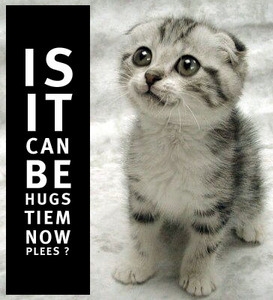
Hugs Tiem
The tl;dr version of this post.

I don’t really have any advice to offer (rarely do). This isn’t about advice. This is just a big hug-fest, or whatever, you know? Sometimes we need to remember that yeah, words are important, but even more than that, the people are important, and deserve high fives for the simple fact that they are awesome. And I just wanted to take a moment to celebrate that.

Continue reading

Motivation, procrastination, and the only thing we have to fear

Once again I put out a call for blog post suggestions, and Charles A. Tan had a few. (We can always count on Charles.) There were some great ones there, including “motivating yourself to write.” I read through them all. Then I checked my Direct Messages and played with the cat.

Not writing.

This is not writing.

So yeah, I thought about that a little bit. How do I motivate myself to write? What’s the relationship between motivation and procrastination? My fellow Inkpunks are all off living large at Rainforest Writers Retreat and FogCon, doing writerly things like drinking, eating chocolate, hiking, networking–and oh yeah, writing. I should be doing that too–I have two short stories and a novel in progress, all of which need attention. But for me, nothing seems more pressing right now than the state of my Catering Quest in Cafe World.

As I write this, I have two of those manuscripts open in other windows. One is nearly a finished draft and I just started the other. I think about them all the time, when I’m working at my day job, or in the shower, or driving somewhere. I solve problems and I itch to get back to them. Then 5:00 p.m. rolls around, or I arrive back home, and suddenly the best I can do is poke desultorily at the keys and hope for a couple hundred words.

Right. BRB. Checking on my Bacon Cheeseburger status. They spoil if you don’t serve them right away, you know.

I never lack ideas. I never lack the longing for a finished, competently written story. What I lack, frankly, is the confidence that I can produce one. I can take a mean cat picture, and I can click little tiny stoves with the best of them, but when it comes to writing beautiful prose…well, let’s just say I have far more cat pictures than I have stories I’d ever let you see.

I should find another picture to include here. Morgan always makes great use of visual aids. Huh, look at that…I haven’t offloaded pictures from my iPhone in forever. I should do that now. Before I forget.

This is also not writing

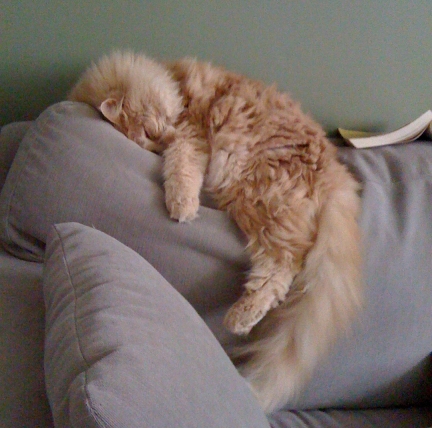
Gratuitous cat picture: Also not writing.

For me the part of writing that I really hate is the first draft. Every sentence feels labored, each page makes me despair. I am not a writer who takes joy in the act of writing–maybe you are, and if so then I envy and am in awe of you. But getting to a complete first draft is total pain for me, and I’m never sure that I can do it. I have so many unfinished stories that tell me I can’t. I would rather do almost anything than face that blinking cursor and the white space that follows it, and fear that I’m going to fail, that I can’t find the right words.

I mean, really, that’s what it’s about: Fear. I have the I Can’t Do Its. I’ll make a dozen excuses as to why I can’t– the kids need to be fed, I’m “stuck,” I’m too tired, I had a bad day and need to comfort myself, I had a good day and need to celebrate it, my feet are cold, my boyfriend’s hot, my desk is a mess–

Wow, it really is. No wonder I can’t get anything done. Who could possibly think in this mess? Let me just tidy up and I’ll be right back.

See, now this is a space a person could write great stories in. Just as soon as I’m done with this blog post.

Still not writing

What a tidy desk I'm not writing on!

But then why be a writer, if it’s all agony? It’s not. The fun for me is in the revision, taking something rough and refining it into something worth reading, seeing it start to take shape and turn into the story that was in my head all along. Unfortunately I don’t get that part without the pain of the first draft.

Bribing myself doesn’t work. Saying “if I write 500 words, I get nachos” sounds great in theory, but in practice, if I want the nachos I’m going to go get the nachos regardless of how many words I write. The inverse doesn’t work, either–denying myself something because I didn’t make my word count is folly, because frankly I’m not going to really do it. I’m going to get frustrated and watch that episode of Hell’s Kitchen anyway, because darn it, I deserve it for the angst of facing the draft.

The only carrot–and the only stick–there is for me is the story itself.

I’ve been observing, analyzing, and documenting my own writing behavior for years now, trying to figure out what “works” and what doesn’t. I procrastinate on the parts that I don’t like, and let’s face it, sometimes that’s every part (because this writing gig is hard.) Underlying that avoidance is always the thought: I can’t do it.

But I can. I’ve done it. So have you. There’s a point in every story when it comes together on the page, and that feeling is better than nachos*, and it’s worth all of the crap it takes to get there. But it’s like anything else worthwhile in life–it’s not free. I haven’t found a way to trick myself into being motivated–everything I’ve tried has really just been procrastination in disguise. A new organizational system, a new system of rewards, a new environment, a new tool.

The best carrot in the world, for me, is a finished story that I made up and executed. There’s a story in my head that wants out, and I’m the only one who can write it, because it’s my story. Turning that terrifying white space into words is easier than I think it is. If it’s bad, I’ll fix it later. All of the defeatist self-talk I do, all of the avoidance and procrastination, needs to just be identified for what it is–fear–and dismissed. I can do it, and so can you. And I will do it.

Right after I check my Twitter feed.

*Not many things are.


Continue reading

prev posts prev posts