A Year in the Inkpunks

It’s been a year since I proposed the idea for this blog and the Inkpunks were formed. A whole year and while the time has flown by, we also can’t believe how much has happened for all us within that year.

We thought we’d take some time to reflect back on the year with the Inkpunks. The most obvious change is that we’ve grown and we’re now at ten members, but that’s not all. We’ve also grown an astounding amount in publishing, editing and slush reading credits, we have increased our readership, have had people asking us if they could guest blog (crazy, right?) and most of all we’ve grown as a group dynamic and as individuals. It’s amazing what can be accomplished by the uplifting force of positive, encouraging people come together to support each other and the writing community. I have learned so much from my Inkpunks, not just about the writing world, but about life in general, that I feel blessed to know each and every one of them.

In the last year, I’ve sold two stories, polished and queried a novel and written another one. Throughout the process, the Inkpunks have been there, to bounce ideas off of, to give critiques and most of all to provide encouragement along the way.

I attended so many great conferences and conventions over the past year, all of them highlights for different reasons, too many to go into in this blog post. I’ve gotten to be on panels at World Horror, World Fantasy and VCon, which I love. The absolute best part was this year I DID get to meet every single Inkpunk in person and give them real hugs instead of virtual ones. Every Inpunk is now the proud (or embarrassed) owners of a handmade scarf from me. I decided to make scarves to match their personalities because we’re all so unique and I love that about us.

Speaking of personalities, I split mine into two. I took my sandrawickham.com website and devoted it to writing and started a new one at sandrawickhamfitness.com that deals with my fitness career. I take this as a good sign, that I have enough going on with both that I needed two websites.

What else? This past year I’ve joined the Functional Nerds as the Fitness Nerd columnist, along with several other Inkpunks who also double as Functional Nerds. I started a podcast series for Bitten By Books where I interview my favourite urban fantasy authors and I’ve been interviewed myself for several podcasts. I’ve also become a slush reader for Lightspeed Magazine.

Another thing I’m proud of is that I’ve stuck with martial arts training. Last year at this time I would’ve been a gold belt, and now I’ve just promoted to my high purple belt. It’s helped me in my writing, I’ve sat on panels about writing about fighting and I can’t wait to keep moving up the ranks.

It truly has been a great year. I know I am probably forgetting things to highlight (we had TWO Inkpunk weddings this year!) but that’s the great thing about having a group behind you, whatever I’ve forgotten, someone else will be sure to point out in their post.

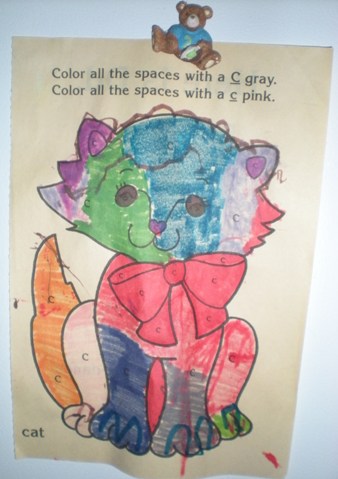
I keep a picture on my fridge that a friend’s daughter, Stephanie coloured. I keep it because it strikes me as an excellent example of how to live life every time I see it. At the top of the picture of a kitten, it clearly states, “Color all the spaces with a C gray. Color all the spaces with a c pink.” Stephanie has proceeded to colour the kitten with all the colours of the rainbow, blue, purple, red, orange, green and I love it. I think the kitten looks much more original, interesting and happy for its multi-coloured fur. That’s also how I think of the Inkpunks. Without them being such a big part of my life, I probably would still be colouring the proper sections with gray and pink. My Inkpunks make me want to colour with blue, purple, red, orange and green, in my writing and in my life and I know I’m a better person for it.

Thanks to the Inkpunks and all of those who support us. We look forward to another great year.

Continue reading

Guest Post: The Slow-Writing Writer’s Guide to Writing Part Time

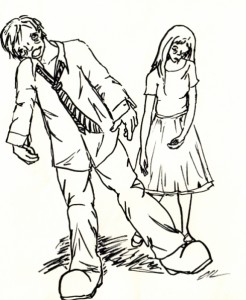
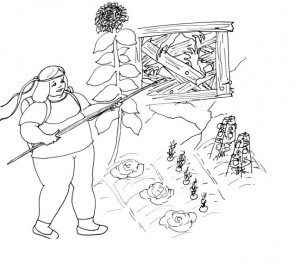
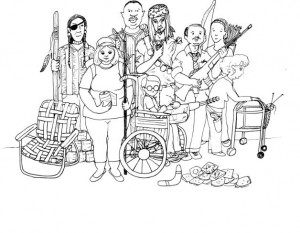
About a year ago an acquaintance whispered in my ear that he had a friend  I *really* should get to know. I took his suggestion and began to stalk B. Fox. (You can too, on twitter @thebranfox).  In her I found a kindred spirit: an artist, a writer, a mother.  (A fellow doodler <3).  She is currently working on a manga inspired by her daughter and collaborating with a friend to write and illustrate a religious satire. When I discovered she had written and illustrated The Slow-Moving Person’s Guide to the Zombie Apocalypse, I could hardly restrain myself.   I asked her if she wouldn’t mind writing a guest post to fill my slot here (complete some illustrations of slow-movers, doing what they need to do.)

………………………………………………………

You, the aspiring unpaid writer, illustrator, creative type – I empathize with you. In this modern world we are distracted from our creative work by day jobs, significant others, and late night sprints to the convenience store for milk so little Timmy can eat breakfast tomorrow. We may have dental appointments to get to. We may have to wash our grandmothers. As joyful as grandmother-washing can be, time drains like these are the enemies of productivity.

Finding time to write or draw when you’re a part-time creative is never as cut and dried as looking at a clock to decide which minute hand configuration you’d like to start on. As I wrote and illustrated The Slow-Moving Person’s Guide to the Zombie Apocalypse, I learned how to fit creative time around my schedule as a home schooling parent, and a freelance writer working for ‘the man.’ Now I offer this semi-preachy advice as a shining beacon of encouragement to you.

Stay Flexible
I’ve seen myriad advice columns for writers that recommend 1. Writing at the same time every day, 2. Writing in the same ‘writing spot.’ (or drawing spot, or yarn-tying spot.) This surely works for people who don’t have to juggle the needs of other people. For those without that luxury, a few adjustments are in order.

Apartment dwellers understand that space can be at a premium. A  designated writing desk/corner/room/special chair may not happen when you have to share that space with others. One way I found to keep working on my projects without a dedicated writing space was to carry my work around. I kept drawings for the SMP Guide in a manila folder along with notes I had made, pens, and the extension cord for my laptop, all tucked inside a carrying bag. This enabled me to take my work from room to room based on whatever spot was free from the sounds of battle on the XBox, the chaos of preparing dinner, or if someone actually wanted to sleep on the bed instead of me using it as an office.

A dedicated writing time may not be feasable, either. I worked around this by writing whenever I could. For example, a paragraph while waiting for the pot to boil, or during the last ten minutes of lunch breaks or between school lessons.

This path to writing success is certifiably slow, but eventually – and maybe it is a long eventually – the project gets done. Consider this scripture from the book of St. Pete the Plodding: “Yea verily, though thou worketh slowly, thou wilt taste the fruits of thine labor after an indeterminate length of time.

Keep at it
Though I couldn’t write at the same time each day, I found it was important to work on my project daily. This helped me maintain a connection to my work, even if it was in the form of skimming a paragraph and changing a few sentences.

We all have days when life is especially chaotic. It’s okay to not get pages and pages done if you don’t have the energy or time, but it is a good idea to try and get something done, however small, in order to keep your project moving forward. Again, I defer to the wisdom of St. Pete the Plodding: “Keepeth thy work at hand and handle it as thou wouldst thy daily bread, for it needeth daily handling.

Breaking the project into small, attainable pieces also helped me get the SMP Guide done. I made daily goals to finish one illustration, revise one passage, or write the rough draft of one new page. This kept me from feeling deflated because I had clear markers of progress. This method also kept me from feeling discouraged about my slow progress toward finishing, or from gazing into the massively wide vortex of despair we call ‘the big picture.’

Be good to yourself
Switching from day job mode, make dinner mode, or haggle over the necessity of doing homework mode to creative mode can be a challenge when time is short, and you want to make some kind of progress on your project by the time you nod off where you stand. There are ways to jump the channels, so to speak, and though these might cut into production time, they’re more than worth it. Try one or all of these:

~Meditating for 10-20 minutes
~Take a 5-10 minute power nap
~Spend 20-30 minutes journaling or free drawing
~Go for a quick walk around the neighborhood
~Take a brisk shower

The object of these activities is to make a mental break between the drudgery of everyday chores, and transition into your creative self. The break doesn’t have to be long, only long enough to quiet your mind and signal your muse you’re ready for a visit. Of course, if bathing your grandmother is what relaxes you, by all means use your time with her for you.

Equally as important to preparing yourself is to reward yourself when you complete the task. The rewards do not have to be physical or monetary, but can be thirty minutes of sinfully banal television, a hot bath, or a bicycle ride. Diamonds and submarines are also fantastic rewards if you have the means. Chocolate bars are nice, too. I rewarded myself with a new isotope of Uranium-235 when I finished the first draft of the SMP Guide.

Slow and steady wins the race
Finishing your book at a slow-writing rate may seem daunting, but it is not impossible. If you are a part-time photographer compiling images for an exhibition, or you have to prepare your indigenous noodle art around a full day job schedule, the key is to keep at it. You’ll get there, even if you have to do it really slowly, and kudos to you for even starting. You deserve a pat on the back or a shiny new nugget of Plutonium; whatever makes you feel like the amazing person you are.

Continue reading

, ,

eReaders & You

If there’s one question that burns at the heart of the publishing industry today, surely it must be, “How do people read their books now?”

eReaders are here to stay and being adopted not just by the tech savvy but hardcore readers everywhere. What’s that? You’re thinking of getting one yourself? Well then, you’re in luck, because we Inkpunks have recently been discussing all the eReader options out there. A big part of writing is reading. We read a lot. There’s a wider availability of eBooks than ever before. And with so many of our favorite magazines offering eSubscriptions now, it’s a good time to consider buying an eReader.

What follows is not a hardcore buyer’s guide (you’ll want to hit up your favorite tech blog for that) but a few key points to help you decide which eReader may be right for you. I’m mainly going to be comparing the “Big Three” (primarily on the basis of their larger online catalog). I won’t be making any specific endorsements though. That’s for you to decide.

Which one to get basically boils down to two questions. First, “How much are you willing to spend?” There’s an eReader for every budget. Second, “Do you mind reading off a computer screen?”

Tablet Devices

If you don’t mind reading off a computer screen, you might want to look at the NookColor, the new Kindle Fire, or the iPad (or any of the other tablets running the Android OS.) Though these all come in various sizes, they are essentially LCD screens like a laptop. Some folks don’t like reading from LCD screens for long periods. And most of us read in bed. Some studies have suggested that staring into a computer screen right before we turn off the lights prevents us from getting a good night’s sleep. Your mileage may vary. I read on my iPad a lot and I haven’t noticed this.

The good thing about color and tablet eReaders is that they are all touchscreen. This makes searching, annotation, and (as long as you have a 3G or wifi connection) sharing your favorite passages through social media very easy. There’s a lot of secondary functionality built into these devices, even if you don’t go with a full tablet like the iPad. Angry Birds, surfing the web, checking Facebook and Twitter. Watching movies. You know, all those things that are supposedly killing good old-fashioned reading…

Speaking of shiny, the screens on all of these devices tend to be highly reflective glass, so you may get quite a bit of glare. Reading outside in full daylight is more difficult (though not impossible). Because of all the bells and whistles, they suck down battery power pretty quick. You’ll be charging them every day.

(You may already have one of these devices if you own a smart phone, btw. If you are okay reading on a much smaller screen, you’ll also have the advantage of accessing the online catalogs of all the different marketplaces. Just pick the app you want to read from…)

Pros: brilliant full color graphics, responsive touch screens, secondary uses like the web, lots of other apps and toys.

Cons: Pricier (from around $199 to much higher with full-featured tablets), possibly harder on the eyes, somewhat shorter battery life, heavier.

eInk Devices

Your other option is to go with en eInk reader. These are typically smaller and lighter than the LCD-based readers. The technology behind the screen creates a static image. It’s not self-illuminated and only displays in shades of gray. But the text is crisp and more like reading from an actual paper book. Most of them (but not all) have touchscreens now. They may not be as responsive or whizbang as the tablets, but they don’t have shiny glass surfaces, either and are perfect for reading outside on a sunny day.

eInk readers do have a few bells and whistles beyond reading. Most have basic internet connectivity and access to apps that look okay in black & white.

They fit better into a pocket or purse and are less fuss to carry around. The batteries last for days, even a week or two if you turn the internet off while you’re reading. (Hint: this is a good idea.) Some even have slots for extra memory cards so you can carry all 500 volumes of your favorite series on vacation with you. Hey, I told you I read a lot!

Pros: Cheaper! (Typically $50-$100 cheaper than the tablet readers), lightweight, easier on the eyes, super long battery life.

Cons: B&W only, limited secondary uses. A little less responsive to navigate on.

Other things to Consider

If you have something like an iPad, you can read books from pretty much any store, but if you get a cheaper (or branded) eReader, you’re choosing the online catalog as much as you’re choosing the reader itself. Amazon has arguably the largest, most diverse selection for their Kindle, but Barnes & Noble is pretty close on their heels. Amazon sells all their eBooks in a proprietary digital format. It’s possible to convert other formats for use on the Kindle, but you’ll have to research which formats before you buy. The B&N Nook reads the industry standard ePub natively, which a lot of third party and independent publishers use. This can offset B&N’s slightly smaller online selection. Weigh these options carefully.

If you have the means to get a full-blown tablet like an iPad or one of the many Android models, you may be able to get a wireless keyboard and have a new machine to write on. I write on my iPad all the time; it’s replaced my laptop in many cases.

One more thing. As with all technology, eReaders are constantly evolving. You can bet as soon as you buy one, within a few months there will be a shinier model. Don’t worry about it. Buy what you’ll be happy with now, and it will serve you well for many years.

Good luck and happy reading!


Continue reading


Running on Batteries: Introverts and Conventions

Introverts… tend to be introspective, quiet and less sociable. They are not necessarily loners but they tend to have fewer numbers of friends. Introversion does not describe social discomfort but rather social preference: an introvert may not be shy but may merely prefer fewer social activities. (source)

Most people think introverts are socially awkward shut-ins who need to be saved from themselves. I would suspect that many people reading this are aware that this common view simply isn’t true. We introverts aren’t uniformly bad at socializing. Introversion and extroversion describe how a person responds to the presence of others. For extroverts, the presence of others is energizing. It’s a cold glass of water on a hot day. For introverts, the opposite is true. Socializing, while enjoyable, is tiring, and we need to recharge our batteries once in awhile.

The problem for me as an introvert is that I really like going to conventions. I enjoy meeting experts and making new friends and hearing what cool things have happened and what cool things are on the horizon. However, conventions are a lot of people. I mean it’s 24/7 people. You wake up, there are your room mates, you go for breakfast, there are people in line who may attempt to converse with you when they see your badge (and some of them are morning people), then panels, more meals, the bar, the dealer room, on and on and on, people and social interaction.

So how does an introvert deal?

Schedule Selfishly

Look at the list of panels to go to. Sort and group them based on criticality. Now think about all the other things that go on at conventions: dinners, happy hour, barcon, parties into the wee hours, random hallway cons, that sudden, intense, five-hour conversation in the hotel lobby, you get the idea. These are things you have to take into account with your schedule. Staying up late at a party might mean taking those first two hours in the morning to yourself instead of going to that panel. Be pro-active where you can be.

And be aware of the implication here: you may not get to do everything you set out to do. That’s true. I run into this problem every year at SDCC. So many panels, such long lines, so little time. So I pick my one must-see panel for a day, allow the rest to fall where they may, and then decide on one singular thing I want to happen to win the con. By setting the bar realistically, I have a blast every time I go.

Keep Creature Comforts Handy

Whatever makes you happy, keep these things in your bag of holding. I carry my iPod, pen and paper, some candy, raw almonds, and random little toys in my purse. When I need a moment to breathe I’ll back away from the crowd, root around in my purse, and pull one of these little things out and it makes me happy. I’ll brush the hair of my mini Pinkie Pie or play with my R2D2 Pez dispenser.

A little sweet treat, a moment of music, jotting down a few notes for a story, all these things can give a fresh burst of energy when the moment begins to overwhelm me but you can’t step away just yet. It’s amazing what a little security blanket can do. And sometimes a quick calorie boost is exactly what the doctor ordered.

To Thine Own Self be True

This is your energy, your mood, your health. Guard your alone-time. Check in with yourself every hour or two, just to make sure you are happy and energized and not needing to get away. And remember, there’s nothing wrong with needing to get away. You’re not missing out, you’re keeping yourself from burning out. If someone’s needling you for a random cup of coffee but you’ve just had a full day of socializing, tell them thanks but you just need a break. If they push, and some people will, either make something up (feeling ill, need a nap to stave off conplague) or be honest (I just really need a little time to myself to relax). Either way, when you’re feeling that need to get away, just get away. Politely, of course, but firmly.

And be prepared for those moments when you’re by yourself, and someone thinks you are sad and alone and need company. I had this exact thing happen to me today. We’re social creatures, and we’re trained to think that when someone is alone, it is not by choice. The people who ask if you are okay while you are sitting alone are being polite and concerned. They may wonder if you are upset or hurt or ill, if you need medical help but can’t get it yourself. All you have to say is, “I’m fine, thanks. Just taking a moment to decompress.”

I’m both a writer and an engineer, the two most cliche occupations of an introvert. I spend a good deal of my day silent. I’d walked away from many conventions with a sore throat and a physical tiredness bordering on sick, until I finally figured out I need to take care of myself, and that it’s okay to enforce some me-time. My socialization capabilities are gathered over time in a reservoir, drained at each convention, and I need to make sure I don’t drain it too quickly.

And with many of us staring down one last convention, World Fantasy, and the oncoming massively-social holiday season, I hope we all remember to pace ourselves and that it’s okay to be an introvert.

Image sources:

Continue reading

, , ,

The net worth of your network

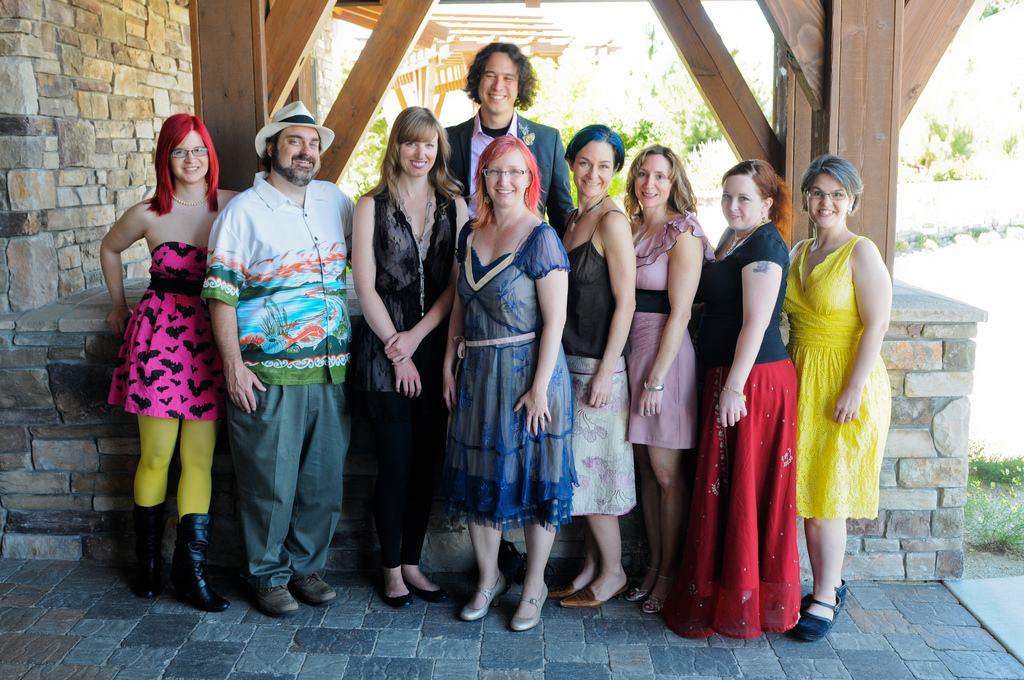
The Inkpunks, minus Adam Israel, who was stuck in Canada

The other day a friend asked me: “How do you network the way you do?” And at first I was like “What? I don’t network. That’s for schmoozers and politicians!” And then I got to thinking about the ways my relationships with other genre writers and editors has changed my life, and I realized that my network of friends has provided me with some amazing opportunities . Here’s a list of experiences that came about entirely through tapping my network:

 Becoming a staff blogger, reviewer, & interviewer on a horror site.

Getting a micropress book deal (which tanked).

Landing a ghostwriting gig.

Working as an editorial assistant for a best-selling anthologist.

Submitting a story to an anthology that was born as a Twitter joke.

Proofreading an anthology.

Reading slush for an anthology.

Landing a story commission to fill a last-minute slot in an invitation-only anthology.

Selling a story to an invitation-only anthology.

Becoming an assistant editor at Fantasy Magazine.

Being invited to submit to an invitation-only market with great exposure.

Being offered a top-secret very cool project from a small press.

Those are a lot of great experiences! And I owe them all to getting to know people–two of the experiences came from connections formed at conventions and workshops, while the rest came from the friendships I’ve made on Twitter. It all came from networking, which is an impressive achievement for an introvert who struggles in a social setting.

So how did I do it?

Well, it didn’t happen overnight. My first steps weren’t too hard. I attended a writing workshop at my local SFF convention. I signed up for Twitter. I followed a lot of people on Twitter and joined a lot of conversations about topics I felt comfortable talking about, mostly about lolcats and desserts. And I just hung out, enjoying my new friends. This was all time-consuming, but it was very fun.

Then, I stepped it up. One of my personal goals is to be a supporter and advocate of genre fiction, and a good member of the SFF community. I decided that I had an obligation to help out somehow, so I began saying yes to opportunities when they arrived. More importantly, I followed through to the best of my ability. Follow through is the absolute key to networking: if you’re not reliable, your reputation and your hard-built relationships can be destroyed. And when people you like are relying on you, you absolutely don’t want to hurt them or your friendship!

If the second step in networking is helping others to help yourself, then the third step is helping others to help your friends. The best part of making all these connections is bringing other people together and seeing them create something great together. One great example of this happened last summer. As the great Twitter joke “#rigoramortis” grew into a real anthology with a call for submissions, John Remy contacted Jaym Gates, the instigating editor of the project. He knew that Galen Dara loved drawing all things creepy, sexy, and horrible, and suggested Jaym tap Galen for illustrations. Rigor Amortis became an illustrated anthology, extremely unique, exciting and successful, and Jaym and Galen have gone on to work on other several other projects together. When friends help friends, wonderful things happen!

To summarize, here’s how you network:

  1. Create relationships with people you like.
  2. Offer to help out.
  3. Follow through with awesomesauce and integrity.
  4. Pay it forward.

Now, I know that #1 can feel a little terrifying at first, but if you take it slowly, you can totally do it. We’re all human, and humans are naturally social creatures. Even if being in social situations is scary for you, just take it easy and focus on lighthearted, friendly approaches. Keep it light at first. And don’t feel badly if you find yourself on a forum or Twitter and just agreeing with someone or telling them that you liked their idea/cat picture/link. You’re showing that you’re friendly and interested in what they like–which is a great way to open doors and get to know people. It’s all about making connections with like-minded, likeable folks, so focus on the people you enjoy chatting with.

So gird your loins with pictures of cute animals and start networking! Your community is waiting for you.

Thanks for the cuteness, Tracie Welser! Let's share it with our new friends.

Continue reading

On Readings, or Oh My God I Made a Fan

So, readings.

If you write and share your written work with others in some form, you will eventually be asked to read aloud. Whether this is to promote a published work, or simply to practice in front of your (hopefully supportive) writing group or mom, you will find yourself before an audience in a coffee shop, bookstore, library, convention hall, living room, or meeting space, clutching papers and preparing to give voice to your words. For some this is a terrifying prospect, for others the easy part—the hard part having been the writing. But no matter which camp you fall into, it has to be done, and what follows are tips as well as an inspirational story

1. Select an excerpt

Two main factors will guide your selection: how much time you’ve been allotted and entertainment value. I tend to prefer short readings, and virtually always err on the side of brevity. Unless you are an exceptional reader, or what you’re reading is exceptionally interesting–or perhaps if you have a devoted fan-base–the audience’s attention will begin to drift after only a few minutes. Better to leave them wanting more than wishing you’d stop talking.

In terms of content, ideally your selection should be reasonably self-contained–requiring minimal context to understand–and also engaging in some way, whether through humor, suspense, emotional resonance, etc. It should also stop at a natural break, but one that piques the listener’s curiosity, inviting them to want to read on.

Other important considerations are the likely audience and the venue. You might choose one excerpt for a Sunday afternoon reading in a library, for example, and something else entirely for a Friday night reading in a lounge. Some material is suitable for everyone, and some isn’t (especially if it contains swearing, violence, and/or explicit sexual content). Give this some thought.

2.  Materials

If you are reading from a published book, decide whether you’ll be reading from the book itself, or from paper or your laptop screen. The advantage of the latter options is that you can enlarge the font size for ease of reading, perhaps allowing for more eye contact with the audience without fear of losing your place. If you do choose to read from somewhere other than the book, make sure you still bring a copy so you can wave it around; it is a promotional exercise, after all.

3.  Practice

Pretty self-explanatory. Read your chosen excerpt out loud numerous times before the actual event. You can time yourself, practice raising your voice or slowing down, look up once in a while, and will see where you stumble.

4.  Reading

I’m by no means an expert reader, but probably the two most important tips are: read loudly and slow down. Nothing is more frustrating for an audience than trying to listen to someone mumble or race their way through a reading. They will tune out. No matter how unnatural it may seem to read at a snail’s pace while practically shouting, this is what you must do.

Aside from that, enunciate and try to add some expression to your voice (i.e. non-monotone) without overacting. There are people who are wonderful actors, and can get away with using different voices, accents, etc. but most of us aren’t gifted in that way and will only fall flat. You want the story to stand out above all.

One other tip I’ve heard is that if your reading is part of a series of readings, it’s nice to begin with a few introductory remarks. This gives the audience a bit of a break and acts as a sort of a palate cleanser between what might be very diverse readings.

5.  Signing

If you are reading from a published work, you will very likely be asked to sign something. I have to say, the first couple of times this happened to me, I was completely flustered. I mean, why would anyone want my signature, and what in the world was I going to say?

Be prepared. Think about what you might write ahead of time. Are you going to go with something simple like, “Hope you enjoy! Thanks so much!” or something specific to your story or novel? Of course, before signing you must ask if the person wants the book personalized (some only want a signature) and where they want you to sign. It’s often nice to add a date and place (e.g. WFC 2010), so the person remembers where and when they met you.


I’d like to finish off by recounting a wonderful experience I had a month or so ago.

In August, there was a convention in Calgary for writers and readers called When Words Collide. The five guests-of-honor, Rachel Caine, Robert J. Sawyer, Jack Whyte, Walter Jon Williams, and publisher Brian Hades (EDGE), were invited to read at the Calgary Public Library. Brian Hades kindly asked me to read on behalf of EDGE, an amazing opportunity for which I am still very grateful; I mean, these were best-selling, award-winning, and highly respected authors! And me! I admit to being intimidated, but wasn’t about to pass up such a fantastic offer. The other authors were extremely kind, generous, and supportive.

We each read very different excerpts, mine being a portion of my young adult, fantasy story in Tesseracts Fifteen. After the readings, we sat behind a table to sign copies of our books. Thankfully my family members bought a few copies of mine, so I could cheerfully sign along with the rest of the folks who had actual fans.

But then something amazing happened. One of Rachel Caine’s teenaged fans, who I of course didn’t know, approached the table with Tesseracts Fifteen and Evolve Two in hand! She said she enjoyed my reading and asked me to sign both books.

I was flabbergasted and flattered that someone, and maybe especially a teenager, who rightly or wrongly I expect to be harder to impress than your average adult, had shelled out money for two anthologies based on my ten minute reading. I’m not sure who felt more shy and embarrassed—her or I—but we got through the moment with a polite exchange, smiles, and a couple of hastily written notes. It was one of the most rewarding and validating experiences I’ve had as a writer so far. I still almost tear up thinking about it. (sniff)


Anyway, that’s what I have to say  on the subject of readings. I’d love to hear your tips and/or stories!

Continue reading

The Power of Creative Collaboration: a Personal History.

I used to be Mormon. My fellow inkpunk Galen used to be Mormon, too.

We became friends because we were atheists who found ourselves stuck in the LDS Church, and we bitched about it on the same online forums.

You may be asking yourselves, that’s all fine (or John, that’s not fine at all), but what does this have to do with writing and creativity?

It has everything to do with creativity, for me, and maybe for Galen as well.

I started my personal blog to hash out the painful and drawn out process of extricating myself from a powerful religious institution. With each post, I realized that there were a lot of folks who were like me. We sought each other out. We craved deep connection to others to replace the embrace of the tight-knit religious communities we were leaving behind.

Over time, I slowly started replacing my anti-Mormon angst-ridden posts with group creative experiments. I started a photography project called “A Certain Slant of Light”, in which group members issued photographic challenges to each other. One challenge was “body writing” and here are my and Galen’s responses:

she who learns... Inscribed (365:002).

As I was winding down my involvement in that project (which carried on without me), I went to a friend’s pumpkin-carving party. I remember how energized and inspired I felt to get my hands dirty and to be sculpting something while in conversation with intelligent, creative people. This was the result:

My Zombie + victim

I came out of there realizing that I could be make art outside of words and photography. It wasn’t great art, but it was entertaining and pleasing to some extent, and deeply satisfying to me.

The next spring, on one of Galen’s visits to Southern California, she suggested we draw together in an collaborative exercise called “Exquisite Corpse.” I felt uneasy because I sucked as an illustrator (and still do). But there is something about this exercise that gave me permission to lean on Galen, and to reach past my comfort zone. We created these pieces over lunch in a veggie cafe, exchanging pieces and adding to them every minute:

Collaborative Art: Galen + John.

If you’re interested in this exercise, Galen has written more about Exquisite Corpse as the Art Nerd, at the Functional Nerds blog. This experience further deepened my desire to explore the limits of my own creative expression, and to see what I could do working with others.

About a month later, I organized a virtual choir to celebrate the coming of Spring by singing Jonathan Coulton’s First of May. It came as no surprise to me that of the eight who responded to my call, from California to Idaho to Virginia, four were fellow ex-Mormons and one was ex-Catholic. (Here’s the post with the final version if you want a listen. Galen starts it out for us, and it picks up around 1:40.)

Since then, I’ve tried a number of group creative experiments and collaborations, but I wanted to draw attention to two more. Last spring, I organized an online experiment in which I drew a Tarot card at random (I captured the shuffling and the selection on video and posted them to YouTube), and then invited everyone who wanted to participate to create works inspired by the card. On the second day we drew the Hermit, and participants created poems, digital art, sketches, music, and even a paper fortune teller. If you go to the post and scroll down to the submissions, you can see works by inkpunks Christie, Wendy and Sandra, as well as by Galen, myself, and others. Here is Christie’s; I selected it because it struck me as deeply spiritual:

299,792,458 m/s

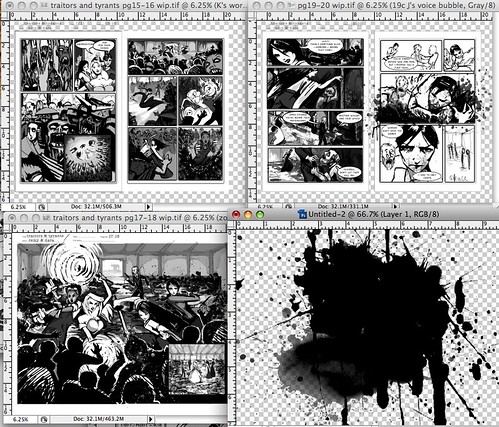
Finally, I’d like to draw your attention to one last collaborative effort. Last Fall, I had returned from the Clarion West workshop, where one of the unexpected benefits I felt was that I had finally kicked Mormonism–for the first time in two decades, I felt the label no longer applied to me, and I no longer needed to obsess over my non- past- ex-relationship to my old religion. Then Galen asked me to collaborate with her on a short graphic novel for a Mormon anthology. I had just turned down an invitation to contribute a piece to a bound collection of essays by former Mormons. She convinced me, and our script and sample art was accepted by the Monsters and Mormons anthology. We just submitted our final work this morning. The publication should be out this winter.

bloody pages

I’ll be honest–this project wasn’t easy. I was going through a divorce and Galen was working long hours on multiple projects. Our combined work style is highly collaborative (we plan to write a post about it later). Galen was heavily involved in ideation and the scripting, and I was continually involved in layout and art decisions. The whole process introduced some strains on our friendship that we had to work through.

Again, what does this all have to do with writing? In exploring my creative, collaborative history, I’ve learned the following:

  • All forms of creative expression feed one another: even though these other expressions take time, and I’m not as proficient at them as I am at writing fiction, they inspire my stories, and open up creative paths that would otherwise be closed to me. In the two years that I’ve begun this creative exploration outside of writing, I was accepted into Clarion West and had my first four story sales.
  • There is power in communal creation: I used to think that writing and art were solitary pursuits. I find that connecting with others leads to greater productivity, inspiration and, perhaps counterintuitively, originality.
  • Creation is a spiritual act: creating art and writing fiction allows me to discover my depths, to find catharsis, to connect more deeply to others and to the universe.

I don’t think these apply universally, but they may apply broadly. And for Galen and I, the creative community has filled the void left by Mormonism, and has become our church and spiritual life, in all the good senses of those words. Working on the Mormons and Monsters project helped me to continue grappling with my Mormon heritage in a productive way. My professional collegiality and personal friendships with many of you, with the inkpunks, with my girlfriend & fellow Clarion West graduate Tracie, and with my creative children have all brought deep healing, inspiration, and artistic output in what could have been a dismal year, otherwise.

I hope you can use the comments and twitter not only to share your own experiences and opinions about creative collaboration, but also to share links to your own creative experiments and collaborative successes.

Thanks to Galen for her help on this post.

Continue reading


Don’t Self-Reject!

Writing is hard. Collecting the library of information necessary to be a successful writer is hard. But maybe the hardest thing for a writer is collecting those inevitable piles of rejection slips. Fear of those rejection slips, however, is a killer.

No, I’m not going to give you a pep-talk about J.K. Rowling or Stephen King or anyone else. What I’m talking about is self-rejection. Humility is a good trait, but writers can take that a little too far. It’s tempting to look at a market and think “I’m not good enough for this market. I don’t have stories published. I don’t have a Name. They won’t accept me.”

Sound familiar?

Well, stop it. Self-rejection is a sure way to be stuck in one place forever. No, you don’t have a Name. You might not have stories published. You’ll never be ‘good enough’ (don’t believe that one? Ask just about any of your favorite authors if they think they are ‘good enough’. Hello, fraud complex!)

You’re facing your fear by writing the stories and submitting them at all, so why not buck up a little and give yourself a chance?

Don’t believe me? I’ve asked a few experienced editors to contribute. John Klima, Douglas Cohen, James Sutter and Samuel-Montgomery Blinn have all stepped up to tell you why they want you to submit to them.

James Sutter
Editor: Paizo

Being a professional author means making peace with your own inadequacies. Not just recognizing them–anyone can do that–but truly accepting them. There will always be someone out there better than you–probably a whole lot of someones. But you’re not competing against Dan Simmons and Neil Gaiman. You’re competing against the rest of the slush pile, and most of those stories are equally chock-full of their own problems. As the old saying goes, you don’t have to run faster than the hungry bear, you just have to run faster than whoever you’re with.

As a writer, you must always be willing to fail, to trade your ego for publication and visibility. If at some point you find that you’ve stopped failing, then you aren’t taking enough chances, and you should set your sights higher. While you should always do the best work you can on a given story, once it’s as good as you can make it, you need to send it out, and not stop sending it out until it’s published. Some of my highest-profile sales have been stories that I was ready to retire after years of rejection, convinced that they’d never sell. Sure, some pieces (especially those that have been kicking around for a few years) might not represent you as well as others. But if an editor buys a story, it means that someone who has built a career out of separating wheat from chaff thought it was pretty good. And if not, you can always try again. The slush pile holds no grudges.

For an author, the biggest danger isn’t that someone might not like your work–it’s that they might never encounter it at all.

Bio:

James L. Sutter is the Fiction Editor for Paizo Publishing, as well as author of the forthcoming novel Death’s Heretic and more than twenty-five short stories for such publications as Apex Magazine, Black Gate, and the #1 Amazon bestseller Machine of Death. His first anthology, Before They Were Giants, pairs the first published stories of such SF luminaries as Larry Niven, William Gibson, Cory Doctorow, and China Mieville with new interviews and writing advice from the authors themselves. For more information, check out jameslsutter.com.

Samuel Montgomery-Blinn
Editor: Bull Spec Magazine

Every one of the major markets will publish new writers. Asimov’s, F&SF, and Analog all do it. Clarkesworld does it. Lightspeed does it, Fantasy Magazine does it, Strange Horizons does it, on and on. New writers are the lifeblood of short fiction, and the most critically-acclaimed anthologists — Ellen Datlow, John Joseph Adams, Jonathan Strahan, Ann and Jeff VanderMeer — are so acclaimed because they consistently put together anthologies with great fiction, including stories from new writers.

But definitely don’t listen to just me. Instead, listen to Robert Heinlein (via Robert J. Sawyer) who in his own rules for writers included a step for resubmitting to new markets after rejection, and to William Gibson, who in a (now decade+ old) interview with The Edge said of getting over his own tendency toward self-rejection: “It was lack of confidence and naiveté. I went from this one semi-professional publication to submitting to what were the top markets at the time, but I was forced to do that by other writers. My initial impulse was to hide it under a bushel and avoid rejection, and I was very fortunate that I had people who came along who beat me up and twisted my arm.”

Consider your arm twisted.

Samuel Montgomery-Blinn is the publisher of Bull Spec, a quarterly print and PDF magazine of speculative fiction out of Durham, NC, whose own great hope is to help discover new, optimistic voices. Bull Spec can be found here.

John Klima
Editor: Electric Velocipede

Self-rejection is unavoidable. A writer will have a story and not send it to particular publication because he or she feels it isn’t right for that publication. In some cases that may be valid. You probably shouldn’t send your paranormal vampire story to Analog, nor should you send your science-heavy story to Realms of Fantasy. But that’s not what I’m talking about, that’s just knowing your markets. I’m talking about where someone has a well-written story, but they say “I won’t send this to Electric Velocipede because they only publish weird stuff and this isn’t weird.” Yes, we publish a lot of weird stuff at EV, but we publish just as much straightforward fantasy, and in fact, many reviewers have commented on the fact that we are more likely the publish straight science fiction than many other small venues. So, send your stuff our way and we’ll decide if it fits.

Often we convince someone to send something that they weren’t planning on sending to EV and then we don’t accept it. This validates to them that they were right in the first place. Let me be clear about this: no it does not. It only means that story wasn’t what we were looking for. Maybe we’ve seen an excess of planetary exploration stories, but we have a dearth of robot stories and you have a robot story that we’d like very much.

And this is where we need to work harder. We don’t provide a lot of feedback on stories as most people aren’t actually looking for it. But, when we exhorted someone to submit a story, then we need to give some feedback. And if we like the person’s writing, we need to say so and re-assert the concept of: we want to see your fiction; we’ll decide whether it fits.

John Klima previously worked at Asimov’s, Analog, and Tor Books before returning to school to earn his Master’s in Library and Information Science. He now works full tme as a librarian. When he is not conquering the world of indexing, John edits and publishes the Hugo Award-winning genre zine Electric Velocipede. The magazine has is also a four-time nominee for the World Fantasy Award. In 2007 Klima edited an anthology of science fiction and fantasy stories based on spelling-bee winning words called Logorrhea: Good Words Make Good Stories. In 2011, Klima edited an anthology of retellings of fairytales for Night Shade Books titled Happily Ever After. He and his family live in the Midwest.

Douglas Cohen
Editor: Realms of Fantasy

(Originally published at the Clarion Blog: Market Insights: Realms of Fantasy. Reprinted with author’s permission.)

  Fantasy is a broad genre, and it’s yet to stop expanding.  In addition to writers, editors are playing a crucial role in defining what fantasy is.  I’ve read a number of stories in our pages that I consider science fiction.  Obviously Shawna felt otherwise, or at least saw enough fantasy-related elements to justify publishing these tales in RoF.  Too often, I hear about authors rejecting themselves from certain markets because their stories are “not a good fit.”  Now, if you’re writing a hard science fiction piece in the vein of Gregory Benford or Isaac Asimov, it’s true that your story most likely isn’t right for us. 

But if there is an element that could be considered fantastical in your sf story, who knows?  We just might buy it.  Did you know John Joseph Adam’s recent dystopian sf reprint anthology has a story from RoF in there?  Did you know we published a story with robots that were clearly inspired by Transformers?  Did you know we had a story about molecule memory that was reprinted in Rich Horton’s Science Fiction, Best of the Year, 2008?  I could go on. 

The point—and this is something to keep in mind for all markets—is that it’s not your job to reject your stories for our magazines.  It sounds like a basic thing, but too often I see authors—including experienced ones—overanalyzing their prospective writing markets.  This is not a phenomenon unique to RoF.  It’s good to know your markets, because that might help you land a sale sooner rather than later.  But don’t be the editor for them.  I can’t stress this enough.  When in doubt, submit.  Let us decide what’s right for the magazine.  The worst that happens is that we say no.  To borrow (and probably mangle) a phrase from John W. Campbell: “How dare you reject your story for my magazine?”

Continue reading

Guest Post – Literary Mercenaries: Is Media Tie-In Writing Right For You?

James L. Sutter returns to Inkpunks today with a guest post on writing media tie-ins. Feel free to ask James any questions in the comments. Thanks for your contribution, James!


Literary Mercenaries: Is Media Tie-In Writing Right For You?
by James L. Sutter

As writers of fiction, most of us follow a time-honored pattern with our work: we write a thing, send it out, get rejected for a while, and finally get it accepted and published somewhere. Yet as familiar as this routine is to most of us, it seems positively insane and masochistic to many other folks who write for a living–the staff journalists, speechwriters, tech writers, and other folks who write on contract rather than on speculation. For them, it would be absurd to start a writing project without the guarantee of payment and publication if the work is good. Imagine: no rejections, no market research, no waiting for years to hear back from a publisher. Just a simple exchange of words for money. Sounds magical, doesn’t it? If only fiction worked that way.

So what if I were to tell you that sometimes it does?

There are a number of fields where work-for-hire is common, but I want to talk here specifically about media tie-in fiction. These are books where authors are contracted to write something specific for a publisher, using an already established brand or intellectual property, such as Forgotten Realms, Doctor Who, Star Wars, Star Trek, Conan, or Halo. You’ve seen this section in the bookstore a thousand times, usually at the back of the SF section with the books organized by brand rather than by author.

It’s no secret that many folks get into fantasy and science fiction literature by way of media tie-in work. There are sometimes hundreds of titles for a single brand, and by their very nature they appeal to new readers. Maybe that’s a Dungeons & Dragons book, which someone buys because they’ve played (or at least heard of) the game. Maybe it’s a Star Wars novel that they pick up because three movies (and yes, in my mind there are only three movies) just aren’t enough. Maybe they buy a novelization of a favorite film, or the further exploits of a comic book or TV character. I know that I read my share of Dragonlance, Star Wars, and Indiana Jones tie-ins growing up.

As we get more experience with the genre, however, a funny thing often happens. We–especially those of us who fancy ourselves authors–often turn up our nose at tie-in work, seeing it as blatantly commercial and therefore somehow beneath us. We figure that any book branded with logos like a NASCAR driver must inherently be of lower quality than a book conjured solely from a single author’s imagination. And yet, whether you like them or not, there can be no question that tie-in books are a major force in the fiction market. There’s a reason folks who’ve never heard of Fritz Leiber and Robert E. Howard know who Drizzt and Raistlin are, and why your favorite author has a few books on a bottom shelf while Halo novels are sold at the grocery store counter. Which should leave every writer wondering: should I try to get in on that action?

Before you answer, there are some important factors you should consider. As someone who’s dealt with tie-in fiction from both sides of the editorial desk, as both an author and the Fiction Editor for Paizo Publishing’s Pathfinder Tales line, I’ve done my best to sum up the pleasures and pitfalls below.

The Fanbase

To me, this is by far the single biggest reason to write tie-in fiction. Being a professional author is all about marketing, and we all know how hard it is to get our names out there. By writing in a shared world, you immediately have access to all of the existing fans of that world. For beginning writers, this also means you’re likely to reach many times more people (and sell many times more books) as you would on your own. The reason bookstores have huge tie-in fiction sections is that it sells–often far, far better than independent titles. A good brand is familiar, it’s got momentum, it’s got non-literary marketing (in the form of films, TV, or games), and it’s got die-hard fans willing to buy and evangelize it. Doesn’t that sound nice?

I’ll use Pathfinder Tales as an example. If I were to take a talented but relatively unknown author–maybe one with some solid short story sales in the indie press market–and publish her first novel, sending it out into the abyss of the SF world, how many copies can she expect to sell right away? A few hundred? After all, most people don’t go to the bookstore and randomly take a chance on an author they’ve never heard of. After friends and family, selling books is a long, hard road of trying to build buzz through reviews, interviews, etc. And more likely than not, the publisher doesn’t have staff or money to throw at advertising and marketing.

Now give that same author a Pathfinder Tales novel. Thanks to the success of the brand, I can know–know–that her book will sell thousands of copies right out of the gate as fans of the game world buy her novel sight unseen.

Seems pretty nice, doesn’t it? But wipe your chin, because this kind of boost has some serious strings attached.

Playing with Other People’s Toys

This is at the heart of what media tie-in writing means. When you write in a shared world, you’re beholden to the rules of that world and the people who inhabit it. Your creativity is inherently limited–sometimes simply by the setting, other times (as in the case of folks writing novelizations of films) to specific characters or plot lines.

For some authors, this is a deal-breaker. After all, we got into this profession to create, right? For these folks, having someone tell you what you can and can’t imagine takes all the joy out of it. Yet for others, these restrictions are liberating. When you don’t have to build the world from scratch, you can focus on the characters and the story. When you’re given a character or plot outline, you can put that saved effort into making the prose in every scene the best it can be. I know that one of the reasons I love themed anthologies is that they remove the paralysis of the empty page and give me direction which sparks my creativity rather than limiting it. Shared world work is much the same. Granted, the more background and continuity a world has, the more research required to make sure you’re not violating existing canon. Yet even this is no more effort than is required from writers of historical fiction or alternate histories.

And of course, we shouldn’t ignore the thrill of playing with a property you’re already excited about. It’s the same urge that drives people to write fanfic. When Greg Bear writes Star Wars or Neil Gaiman writes an episode of Dr. Who, they’re getting to live the dream of every nerd who grew up with those characters–a group in which the authors themselves are undoubtedly included.

Payment and Ownership

Fan love and exposure aren’t the only reasons to write tie-in, however. While I’m sure Mr. Bear and Mr. Gaiman made their decisions for purely fan and artistic reasons, many other famous authors chose to do media tie-in because they’re getting paid–and this is a technical publishing term–a metric buttload.

Not always, of course–the size of the property and its owner makes all the difference, and writing for a tabletop RPG company like Wizards of the Coast or Paizo is going to be very different than writing for a cultural behemoth like Star Wars, Halo, or World of Warcraft. But most companies with legitimately popular properties and brands are going to be big enough to pay their tie-in authors professional rates in a timely fashion. When you’ve sat for years on a novel that keeps getting rejected, the idea of writing a book that is accepted, paid, and published in a timely manner has its own unique appeal.

Case in point: One of my talented author friends sold his first novel (co-written with another well-known author) to a respectable publisher before I started working on my novel Death’s Heretic. Many moons later, Death’s Heretic is on its way to stores across the continent for a November release, and my friend’s book is just now beginning the editorial process.

There’s a flip side to that solid money and prompt payment, however. While most of the tie-in contracts I’ve seen offer at least decent advances and royalties, that money is all you get. You’re playing in somebody else’s sandbox, and that means that, for legitimate legal reasons, they must retain all rights to your creation. (After all, if you’ve done it right, your creation is based completely on their creation.) That means your characters don’t belong to you. If they get popular enough to warrant a sequel, that’s great–but you can’t take them to some other publisher who’ll pay you more. In fact, there’s no guarantee that you’ll be allowed to write that sequel at all, or that someone else won’t get to write it instead of you. You may get royalties on the book–and, if the publisher’s above board, that includes ebooks, foreign translations, etc.–but if your creations get optioned for film, or show up on t-shirts or in a Happy Meal, that money goes to the publisher, not you. You reap the fame, but you can’t build a J. K. Rowling-esque empire out of it. Worse, but far more likely–if the publisher decides to let your book fall out of print, you can’t shop it around or publish it yourself. It’s dead.

This all may sound terribly unfair–after all, that’s your book that’s making all that money–but think of it this way: A construction worker is hired to build a house. He does the job, gets paid, and goes home. He can point to that house with pride–I built that!–but once the check clears, it’s no longer his. The owner can rent it out, flip it and make an enormous profit, remodel it, paint it a hideous color, or burn it down for fun. The construction worker no longer has any claim on it, nor do any of us really think he ought to. When you enter into a work-for-hire relationship, you’re a literary construction worker. You get bragging rights and royalties–and that’s it.

Editing, Conflict, and Author Rights

Authors are artists, and we’re often very particular about our work. That’s not a jab–since our reputation is all we have to trade on, it’s imperative that our work be the best we can make it, and that we consistently put our best faces forward. As such, it’s extremely important for tie-in authors to understand their rights. Fortunately, the list is easy to memorize.

When it comes to tie-in work, you have no rights.

Sure, that’s a bit of an overstatement–there are rights of payment and accreditation and such things stipulated in the contract. But when it comes to creative rights, the tie-in author is totally stuck. He’s no longer an artist negotiating with a publisher for the right to sell his work. He’s an employee, and the IP owner is The Boss. If the publisher requires an onerous change to a work, such as cutting whole sections or revising a plot point or changing the protagonist, the author doesn’t have the option of packing up his toys and going home. He has to make that change. If he refuses, the editors may just make that change themselves without his consent–as is potentially their right in the contract–or else thank him for his time and leave him holding an unpurchased book that he cannot, by law, sell to anyone else.

Again, this sounds horrible, but it comes from a very logical place. The editors or publishers aren’t monsters–they’re just equally bound by their duties to the almighty Brand. The whole reason they’re hiring tie-in writers in the first place is because they’ve somehow created or acquired a piece of intellectual property that has an enthusiastic audience. In publishing, a reliable IP is the goose that lays golden eggs, and the single biggest concern of its owner is not accidentally screwing up and killing the goose.

Go on the internet for thirty seconds, and you’ll see that SF fans–regardless of what they’re fans of–are fickle creatures. As deeply as they may love a given character or series, it doesn’t take much to get them up in arms. If a publisher allows an author to take too many liberties with a character or a setting, it’s entirely possible that they’ll be engulfed in a firestorm of electronic vitriol that will toast their sales and injure both the publisher and the author. (Ask R. A. Salvatore sometime about being “the man who killed Chewbacca”–a decision he didn’t even make.)

As the editor for Pathfinder Tales, my main job isn’t so much tweaking grammar or critiquing plot arcs as it is finding potential continuity bombs. It’s exhausting to scrutinize and cross-reference every detail, but I know that if the author and I don’t, there’s someone out there who’s deeply invested in the Pathfinder Campaign Setting and who will find inconsistencies and feel not just irate, but betrayed. Among gamers especially, there’s a certain subset that wants to see a favorite setting or character as something real and independent of its creators. Playing fast and loose with canon destroys the illusion. By saying no to an author’s choices, I’m actually shielding all three of us–the author, the fan, and me–from blowback.

Of course, not all editorial changes are made for such altruistic reasons. Sometimes a key developer just doesn’t like a thing, or new material comes out that preemptively contradicts part of a novel’s plot, or space constraints require us to reduce wordcount. I’ve been on the receiving end of all of this as many times as I’ve had to dish it out–for instance, the rules for a key magic item in Death’s Heretic changed after the novel was written but before it was published, thus necessitating revision, and I’ve chopped down more of my own game articles than I care to think about. (Such Old Yeller moments are surprisingly common when you’re dealing with magazines or other formats with set amounts of space–I’ve had to chop articles literally in half before.) With all of these changes, the author may not even know about them until after the piece sees print–in the gaming industry, at least, galley proofs for the authors are a luxury, and the idea of running changes by an author before making them seems as ludicrous to some publishers as the homeowner from the last example asking the builder’s permission to redecorate.

These are all worst-case scenarios. At Paizo, I strive to give as much creative control as possible to the authors, and to work with them rather than handling down commands. Thanks to a great deal of work at the outline stage, most of my authors never have to make substantial or egregious changes to their final manuscripts. But the point remains that if the idea of someone messing with your precious words bothers you, stay the hell away from tie-in fiction (and perhaps publishing in general).

Deadlines

One of the biggest differences between writing on spec and on contract is the deadline. When you’re writing for yourself, you can afford to take as long as you need to on a story, even shelving it for months while you work on something else. With work-for-hire, there’s always a deadline–and often an aggressive one. If you’re the sort of author who likes to jot bits of story down as the idea strikes you, and follow your muse only as she arrives and makes herself known, this probably isn’t the right choice for you. If, on the other hand, you’re the sort of author who writes at a steady and predictable rate–and better yet, if you’re the budding pro who needs all the assignments she can get to make writing a career rather than a hobby–then tie-in is a perfect place to get as much work as you can handle.

Stigma

Last but not least, I want to get back to that attitude I mentioned right in the beginning, the idea many folks have that tie-in work is by definition mediocre–the literary equivalent to a fast-food franchise.

Once upon a time, this stigma was a very real problem. Tie-in as a ghetto was just one step above self-publishing, and folks who wrote tie-in were in danger of being trapped there permanently, never to write anything independent. (Or at least, that was the fear–not that it stopped folks like Fritz Leiber, or Nicola Griffith, or any of the million other professional authors who worked a little tie-in to help get experience and pay the rent.) Some old-timers still believe that writing tie-in will make you an untouchable for the big publishers, and it remains true that most literary awards judges will wave away tie-in books without reading page one. So will dabbling in work-for-hire end up hurting your career?

Personally, I don’t think so. Even more than the myriad folks who continue to work happily both within and without the tie-in field–folks like R. A. Salvatore, Ed Greenwood, and Michael Stackpole–I believe that the reason is technology. Back in the day, publishers decided what to publish based on the opinions of their editors–they were the tastemakers, and decided what people read. Nowadays, thanks to Bookscan, publishers are more likely to be taste-chasers: they want the sure thing, the authors that are already selling well. In this regard, all that matters is the number of digits next to your book titles when a publisher pulls up sales reports. And as we already discussed, tie-in novels almost always sell better. Rather than hamstringing your career, I believe that tie-in writing can boost it. Certainly, I know a few “New York Times bestsellers” who ended up there on the strength of their tie-in brands, and whose independent works have never come close.

Conclusion

Ultimately, the decision over whether or not to write tie-in fiction is a personal one. Do you dare exchange elements of creative control for wider exposure and notoriety? Are you willing to trade your high-art sensibilities for the chance to get paid and build up your portfolio? Personally, I believe that you should never let tie-in work completely eclipse your own material–if you’re so busy working for someone else that you never get a chance to write stories that are completely your own, you may eventually find that you’ve missed some valuable opportunities, and you’ll never have the personal superstar power of a Stephen King or J. K. Rowling. But as a reliable gig to help you increase your fan base, your experience, and your bank account–not to mention let you play with some awesome preexisting worlds–media tie-in is a tool that every professional author should consider.


James L. Sutter is the Fiction Editor for Paizo Publishing, creators of the Pathfinder Roleplyaying Game, and the author of the forthcoming novel Death’s Heretic as well more than twenty-five short stories for such publications as Apex Magazine, Black Gate, and the #1 Amazon bestseller Machine of Death. His first anthology, Before They Were Giants, pairs the first published stories of such SF luminaries as Larry Niven, William Gibson, Cory Doctorow, and China Mieville with new interviews and writing advice from the authors themselves. In addition, James has written numerous roleplaying game supplements. He lives in the Ministry of Awesome, a house in Seattle with 4 other roommates and a fully functional death ray. For more information, visit jameslsutter.com or follow him on Twitter at @jameslsutter.

Continue reading
Playing With Structure

Okay, so I’m probably a total freak, but I love structure. This is what gets me through first drafts (which I loathe). It’s what makes a nebulous idea sort itself out in my head. There are some wonderful books on structure out there, and I’d advise you to heed the wise words of writers much more skilled than I–but because I’m having so much fun with it right now, I thought I’d talk about how I apply it.

My first experience with actively applying a structure to a story happened two years ago (many years into my journey as a writer). I had this work in progress that wasn’t quite coming together. It’s a story in two worlds, with two completely different voices. One world was primary, the other was secondary, but they were both essential to telling the story. The primary world needed more words, more time, more attention. The secondary world needed to be terse, fast–only the essential information, so that the reader didn’t get lost in that world before they returned to this one. So I took the draft, printed it out, cut it up, and looked at how long each of those sections was, and then edited it down until it fit a structure that looks something like this:

------------------
--------------
-----------
#
******************
*****************
*****************
******************
#
-----------------------------
-------------------------------
----------------------------------
------------------------------
----------------------------
#
******************
*****************
*****************
******************
#
-----------------------------
-------------------------------
----------------------------------
------------------------------
----------------------------
#
*******
****
***
##

I may be missing a couple of scenes there, but that’s basically “The Magician and the Maid and Other Stories” in visual terms. It sold to the first market I sent it to, and I truly believe that the reason it worked was because I imposed a structure on it.

Since then, it’s become almost a game for me. I get an idea, maybe write a paragraph, and before I do anything else I decide on a structure, and then write to it.

So: I picture the shape of the story. First thing: it’s symmetrical (mostly). I’m pretty sure you could do an asymmetrical story, but I’m not skilled enough for that yet (but gods, now that I’ve said it, I want to do it and pull it off). There’s a rhythm to it. Humans are pattern-seeking animals. We respond to that kind of thing. We respond to rhyme, and rhythm, and shape.

Once I have that decided, I can proceed. I usually have a word count in mind at this point, too. Here’s “This is Not a Metaphor” (currently sitting in a slush pile somewhere). I wanted this one to be between 1000 and 1200 words (it ended up right at 1200). In this one, the narrator is speaking to someone specific about the present in the first and last sections, and more generally about the past in the two middle sections:

---------------
---------------
---------------
---------------
#
*************
*************
*************
*************
#
*************
*************
*************
*************
#
--------------
--------------
--------------
--------------
---.
##

Visualizing that helped me to keep my tenses and themes straight, which for me is tough even at such a short length. It helped me to pace the story, too, because I knew I needed to spend a little more time on the first and fourth sections, and less in the middle, and with a constrained word count I knew how much information I needed to pack into each.

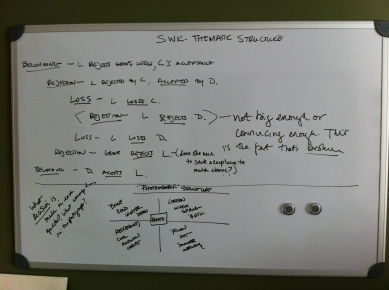
I recently dusted off an old story and decided to rewrite it from the ground up. The new elements I added in the rewrite threw the rhythm of it off completely, and I lost a couple of the thematic threads. I needed to figure out how to bring it all back together again and make sure that the themes run true, all the way through, so that’s it’s satisfying in the end. I settled on html-like tags because it made the most sense to me. This is less about the length of the scenes that it is about the thematic undercurrent that needs to run through them, but to my mind, it’s structure all the same (on my white board they’re in normal angle brackets but WordPress doesn’t like it, so I’ll use square brackets here).:

[BELONGING] L. rejects G., seeks C.'s acceptance [/BELONGING]
   [REJECTION] L. rejected by C.[/REJECTION]
     [ACCEPTANCE] L. accepted by D. [/ACCEPTANCE]
       [LOSS] L. loses C. [/LOSS]
         [REJECTION] L. rejects D. [/REJECTION]
       [LOSS] L. loses D. [/LOSS]
     [ACCEPTANCE] ??? [/ACCEPTANCE]
   [REJECTION] G. rejects L. [/REJECTION]
[BELONGING] D. accepts L. [/BELONGING]

Here’s another work in progress. In this one I’m applying structure to a story told from four different points of view. The characters have their own specific experiences, but they have one thing in common. I want the four scenes to be of equal length, with each character reaching conclusions specific to their experience and POV:

  xxx 000              |          yyy 111
                       |
                     a3 z2
---------------------     -------------------
                     y1 x0
  zzz 222              |          aaa 333
                       |

It helps me to make it visual in this way. Honestly, I blame my early aspirations toward writing comics–I often think in panels and panel layouts. I think the same principle is at work here.

I’ve been told by highly skilled writers that this is a good exercise–something to do for now, but eventually I’ll grow out of this once I internalize it. I believe them! I really do. The thing is, I keep discovering different structures to try, and I can’t see myself internalizing any of them until I run out of new ones. In conversation with Jaym I decided my next project needs to be based on a Venn diagram. Who’s to say that won’t work superbly?

Here’s one I haven’t tried. Maybe we could make it a challenge.

-
--
---
----
-----

Now I’ll be up all night trying to figure out how to write a story like that.

Oh wait. Never mind. I think I just got it. (Seriously, I think I just need one of those toddler shape-sorting toys, and I could write happily forever.)

Maybe I really will internalize all of this, and the whole process will shift for me–maybe I’ll think of a character first, and then a situation, and then the structure will naturally fall out of that. I’m open to that possibility. But for now, this is what’s working for me–but I think that’s because it’s what’s most interesting to me. Of course the real key to writing a successful story is to write what’s most interesting to you, be it a structure, a character, a voice, a theme, a plot, a pace, or a setting.

A good story requires all of that, but where you start is up to you. I’ll be starting at the white board–at least for now.

Continue reading

prev posts prev posts