Serious Thoughts for Serious People

I’d like to thank Sam Sykes for taking time out of his busy life of writing, pillaging and plunging the entire internet into painful bouts of laughter, to do this guest post for us.
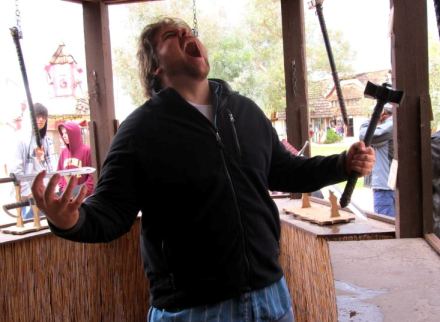
Who is Sam?
Sam Sykes is the author of The Aeons’ Gate trilogy, a vast and sprawling story of adventure, demons, madness and carnage.  Suspected by many to be at least tangentially related to most causes of human suffering, Sam Sykes is also a force to be reckoned with beyond literature.

At 25, Sykes is one of the younger authors to have arrived on the stage of literary fantasy.  Tome of the Undergates and Black Halo are currently published in nine countries.  He currently resides in the United States and is probably watching you read this right now.

Serious Thoughts for Serious People
By Sam Sykes

Above all else I fear about heavenly figures, it is my deepest terror that we are not beholden to a wretched, vengeful god, but rather that we live at the whims of a god with a sense of humor.

Not the harmless, pointless kind of humor one finds in relationship comedies, the kind where the intellectual aspirations never rise above deriving great joy from the fact that two sexes have sometimes incompatible values, if compatible genitalia (women like shopping? Well, I never). No, this god prefers the coincidental humor that breeds ill-informed awkwardness amongst terrible people. This god watches British television and insists its great and you don’t like it just because you don’t get it.

It was clearly this god that, upon seeing me bashing my face against the keyboard in the vain hopes of writing something that wouldn’t get me executed for crimes against humanity and subsequently experiencing the spiral of self-doubt that makes every writer wonder if he can actually do this, sent Sandra Wickham to me, asking me if I wanted to do a bit of verbiage about writing.

So naturally, I said yes.

Because it’s true: whenever I experience hardship in this profession, I start to question myself. When I hit a wall with a scene I’m writing, I wonder if those previous books were just lucky flukes. When my books aren’t as popular as someone else’s, I wonder if it’s an indication of my own quality. When I stare at a blank computer screen for hours, a little black bar flashing next to the word “The” I have just written, I wonder if I’m doing the right thing at all.

Just like I felt when I first started writing. Just like I’ll be feeling moments before my death.

And yet, somehow, here I am. Working again. On this very piece, in fact, which is about a few things you should do should you stumble and fall and think god is playing a cruel joke on you.

Here are a few things you need to realize about being a writer.

Work is hard.

As a matter of course, whenever meeting a new person, I ask what they do for a living. And when they tell me, I nod and say: “You’re a lawyer, huh? I’ve always wanted to do that. If only I had the time.”

Because, at some point in the life of everyone who has ever sought to make a living at spinning lies, the harsh realization that writing is work and work is hard sets in. I don’t mean hard in the romantic way where you spend all day writing the singularly most beautiful sentence in the world and then fall back in your chair and reach for your wine glass.

I mean the harsh, working stiff’s hard. The kind where you slap your greasy palms upon the keyboard because it’s all just shit anyway. You write sixty paragraphs of stuff you hate and go out and say: “what a fucking day.” And your roommate says: “what was so hard about it? I just saw you playing Puzzle Quest at the computer for three hours.” And you’d like to refute that, but you really can’t. And then you go to the toilet and suddenly you realize that you can fix all sixty paragraphs by cutting them down to two and instead of being glad that you solved the problem, you’re mad that it took you this long.

It’s rough. It’s hard. It’s work. And it’ll happen to you more days than not.

This is something you can’t avoid. The time you hope to have will never come unless you make it. There will never be a moment where writing isn’t hard. There’s never going to be a way to make your writing work unless you do it and screw it up a couple thousand times first.

Other People Suck.

We’re always at a bit of a conundrum with other writers. The best writers are often readers, but the best readers are not always writers. Frequently, if you’ve any great desire to write, any success at it will make you fear reading.

You’ll fear reading authors you love because you’ll think you aren’t as good as them. You’ll fear reading successful authors because you’ll think you’ll writhe in envy at their success. You’ll fear reading authors you’re interested by because you’ll think they’ve got something you don’t and never will have.

So that basically leaves you with books you hate written by authors you don’t like.

And thus, you’re left with a world where you either read and feel envy or don’t read at all.

The choice is obvious.

So here’s how you combat that envy: you realize that no one else’s success matters. No matter what they write, what twists they make, what characters they weave, what worlds they build, it doesn’t matter. Because you’re not them. And if you want to be them, you’re not doing it right.

Here’s what most authors and the New York Times alike don’t realize: there is no such thing as a reader that reads only one author. There are people who don’t read often and don’t read anything but the big names, true, but they aren’t important. They’ll find you when your name is big and your name will be big by hearing it from those readers who have read you, amongst many, and like you and talk about what you do.

And you get those readers by writing what they’ll love. And if you’re doing it right, they’ll love what you love. So the only way to do it is to love what you write, not what other people do.

Because I’ll tell you this from experience: even when Author A has sixty times your readership, even when they make more money and have seen more reprints, there is absolutely nothing on earth that compares to hearing someone, just one person, say: “Author A? Yeah, he’s okay. He’s not as good as you, though.”

He On The Toilet.

Wil Wheaton once posted a great saying on twitter: “The muse visits during the act of creation, not before. Don’t wait for it.”

I once posted a bad saying on twitter: “Writing is a lot like being constipated. You sit in one spot for a long time, forcing stuff out and hoping it all turns out okay.”

His is better. But mine is more accurate.

The act of writing can be pretty romantic, in the same way sex can be pretty romantic. When it all goes well, it’s rose petals, perfume and doves flying out the window John Woo-style. And then sometimes it’s people screaming “oh god oh god oh god don’t move no aaaaaaaugh my eyes.”

When you do it frequently, you get one outcome far more than the other. And when you give up and try to start over, you almost always have to clean stuff out of your hair the next day.

But if you do it frequently with something you love, you get better at it. The rose petals are always ready. The sheets are always silk. The doves take your breath with them when they leave.

That’s not to say that those moments when you’ll bash your head against the keyboard will never come. They certainly will, and frequently. But the only way to avoid them is to keep doing them. And like love, it sometimes hurts.

Conclusion.

There will be people who will tell you that there is one way to write. These people are liars.

There will be people who will tell you that they need time, that they need a muse, that they need to learn more from other literary giants. These people are turds.

There will be people who will tell you that they have no idea how to write a good book. These people are usually writing good books.

Trust yourself. Trust your loves. You can do this.
Continue reading

Add a little … character

I bet if you asked people to tell what their favorite books are and why they enjoy them, most people would mention something about loving the characters. For example, I love the Harry Potter books because I adore Snape. When I was waiting impatiently for the seventh Harry Potter novel, I wasn’t wondering what nefarious schemes Voldemort would unleash–I wanted to know what was going on in Severus Snape’s head when he killed Dumbledore. Why did he do it? What was he doing the entire series as Harry’s sometimes-protector, sometimes-tormentor? He was so mysterious and fascinating!

Other characters I’ve adored: Silk, the snarky, sneaky, heroic thief from David Eddings’ Belgariad. Matthew, the sweet and stumbling farmer of Anne of Green Gables. Mrs. Who, Mrs. Which, and Mrs. Whatsit  from The Wrinkle in Time. Sarah Ruth from The Miraculous Journey of Edward Tulane (which is easily one of the five most moving books I’ve read in my entire life). None of them are main characters or POV characters in their stories, but they are the characters that jump out at you and steal your heart forever.

What is it about these characters that makes them so special? How can they be so touching? How can we create characters that are that good at grabbing readers’ loyalty and love?

I’m not sure. But here are a few of my ideas about them:

  • They are well-defined characters with unique voices. Think about the way Matthew starts 90% of his sentences with the phrase “Well, now…” By the third time he’d said it, my daughter was hooked on his humble, folksy speech. He doesn’t use dialect, but when he talks, Matthew words are uniquely his.
  • They have special moral roles. Silk struggles with morality–he’s a thief and a troublemaker. But he always winds up doing the right thing (even if it’s the wrong way). Some characters are especially loving or giving, touching the heart of the protagonist in a way that allows them to grow as human beings.
  • They are funny. I love the Weasely brothers because they are outrageous and ridiculous. And I can’t tell you how many of Silk’s one-liners I had to read out loud to my poor suffering mother while I was in my Belgariad phase.
  • They die in ways that deeply affect the characters. Beth is a wonderful character, but it’s her death, and Joe’s heart-break over it, that makes Little Women such a remarkably affecting tale. (Conversely, does anybody like Gone With The Wind‘s Melanie until she’s dead?)

So it looks like characters that are unique, well-defined, complicated and somehow have a substantive effect on the POV character(s) is a pretty good way to sink a hook in your reader. How can you use this to your advantage? Do you have any secondary characters who could become more morally complex? Are there ways to make a minor character funnier? Could somebody have an interesting (but not too annoying!) catch phrase? Could your POV character have a more meaningful relationship with one of your secondary characters?

Do you have any ideas that would help create more memorable and affecting characters? Please share! Creating lovable characters is my Achilles heel, so any tips would be incredibly, incredibly useful.


Continue reading

, ,

Why do we write?

Lately I’ve been thinking a lot about why I write, or why I started writing in the first place, because over time, these two concepts may diverge. An insidious thing can happen: you can lose sight of what you love about the act, and get caught up in the business of writing: wanting to make your first pro sale, getting your pitch ready for the agent you might meet at a convention, creating an online presence and brand, providing product to your readers on a predictable and timely basis, agonizing over your prose and structure in hopes of attracting critical acclaim, etc. But these things aren’t why we started writing originally, are they? And, for me, they can threaten to rob the act of joy, at times making it downright angst-ridden and painful. It starts to feel a whole lot more like work—though to be fair, writing is some people’s job and I hope one day it will be my job, too, in which case I’ll just have to suck it up and accept the work-like aspects, but at least then I’ll be getting paid. Nevertheless, at this point I think it’s useful to step back and reevaluate why it is that I’m drawn to this art form, and why I should be grateful it’s something I get to do.

So…here it is. I write because:

Story ideas occur to me all the time, everywhere.

I think up interesting characters I care about and want to get to know better.

Creating realistic, fully formed, logically consistent, and plausible worlds is a challenge.

I like drawing maps (though I’m not good at it!).

I learn interesting new things while researching.

It is sometimes cathartic, allowing me to work through issues I haven’t in other ways.

It sharpens my powers of observation in everyday life. I more carefully consider and note body language; quirky manners of dress, appearance, and speech; social interaction; motivation; intention; inequality.

It allows me to empathize with people who are different from me in various ways.

Magic!

Critters!

To touch, or amuse, or engage readers.

I get to hang out with and talk to other writers and creative people, who feel like my people.

From the time I was a child I wanted to be a writer, and it’s something I keep coming back to.

Creating something out of nothing is an amazing feeling.

Occasional visits to the zone, that place of furious inspiration where my fingers can’t keep up to my brain, are intoxicating.

It’s fun.

And there are probably others I’ll think of as soon as I post this.

But that last is what it comes down to, isn’t it? It’s fun. Or it should be, at least on some level. Yes we can make money and garner praise and wave our published books around or at least use them for doorstops—if we’re lucky—but really we do it because it allows us to play and create and express, and this is what we love. Or I do, anyway, it’s probably presumptuous to speak for others.

So, in order to stay in touch with this feeling, this passion, I vow to sometimes write just for fun. To not worry about what market I might submit to, what my critique group might say, or whether what I’m writing about is Important. Some stories or even paragraphs have to be just for me, to remind me what being a writer is really about. If I end up selling them, well, that’s just a bonus. If I stop having fun, that’s a true loss.

What about you? Why do you write? How do you stay in touch with your passion for writing?

Continue reading

Guest Post: Workspace. By Evan Jensen.

Ironically enough, my family is in the process of boxing things up to move at the end of the month. So when illustrator Evan Jensen queried the idea of a guest post on keeping workspace in mind when relocating, I couldn’t wait to read it. Thank you Evan!

********

Do you have a unique, inspiring space to make work happen, whether you work in physical, digital, or literary media? Even if it’s your kitchen table or just a couch that fits perfectly, finding an inviting space to do your art is key. Otherwise, you don’t want to sit down and do the grinding parts of your job, or even the really fun parts. You end up sketching and doodling here and there, thinking about awesome work… but the task of being in your workspace seems onerous. And if you can’t do the work in a cafe or somewhere outside your home, it becomes a bigger problem. Less gets done, and the quality will suffer. There are myriad considerations and small tweaks that can help you carve out a nook in even the most restrictive living situation. Here’s what I and my mate have done to accommodate studio space while living in sometimes-smaller dwellings.

Just after college, I lived in a Washington, D.C. “English Basement” (read: studio flat under a townhouse with free laundry) apartment and before that in a dorm. All one big room, in both cases. I didn’t have any elegant solutions for the dorm room (maybe hang curtains, make the best of it, and get good headphones), but the basement was a peach to arrange in a way that gave me the living area and a work area which didn’t overlap enough to make being home still feel like work. I did my first freelance work here, amid artificial lighting during the day and awful-loud robins next to the wall all night. I didn’t like this very much, though.

Then I moved to a D.C. suburb, in a basement rental with a 5’x8′ space in a utility room with a rug, drafting table, and computer. This was my studio; it was across the basement and separate from my bedroom. At the time, I was freelancing as a graphic designer and illustrator, depending on what paid during any given month. I got a lot of work done in this tiny room with the thin, cruel window near the ceiling. The dimensions of my studio weren’t huge, certainly; and it was cinderblock, below ground, and often cold… but it held my work materials and a place that was different from my living quarters where I could go and get stuff done. Off to my left was the laundry area, so it was often full of pleasant, warm scents. My landlord/roommate barely came down there, so it was also lacking interruption, and I wouldn’t disturb anyone by working those freelancer hours until 5:00 AM.

After moving out of there, I lived briefly in Texas, where I had a larger studio physically separate from my home… but it was Dallas, TX, and no more shall be mentioned. I got less artwork done here, and certainly felt less happy than anywhere else. Support for the idea that the comfort and inspiration of your environment play a huge role in productivity and mental health.

Following that travesty, my mate and I moved to a townhouse in Maryland and set up a joint studio in the dining room. Larger room, still separate from living space. I got some really great work done here; it felt like entering a cool house after a hot day outside. This set-up has lasted almost four years. It’s been alternately empty of Lisa or I, if we have an on-site contract somewhere, but has provided a superb stewpot for personal and client jobs. The balance of at-home-but-divided was enough to make my artwork something I could walk away from or bury myself in as needed. This is my ideal–something which allows the release of tension that inevitably builds up when your home is also your workplace. Plus, we have a cat, who keeps it awesome. One thing I learned, though: you might not want to put your studio in an open-plan space near the TV; it can be distracting. Also consider whether you really need all that furniture. We have a workbench, drafting table, and two desks… but I think we could manage without my desk and chair, since I have a laptop. Eliminating unnecessary items like that can really open up a room. Consider a standing desk to nix a chair, wall shelves rather than cabinets–anything to free up floor space.

Currently, I’m working a long-term contract that has me out of the house and away from my studio everyday. The job location is an awful, draining, windowless office. Come quitting time, even with a full evening ahead of me, I can barely contemplate starting on or making any new work, so thrilled am I to be free of that bunker. During the day, I’ll often have downtime to draw my own work or freelance at the office… but this place doesn’t lend itself or my state of mind to creating cool things, so I end up in a mental impasse where I should work at home, but home now feels too much like escape. As much the fault of the job itself as the workplace, but they all twine together. Still working on a solution.

When Lisa and I started looking into building or finding a place across the country (Did I mention we’re moving to Seattle this year?), we knew we needed to find something that allowed for a great studio space somewhere inside or nearby. This got me thinking about what makes a perfect little nook where you can write, paint, or draw your work in peace without as much outside stress. I must point out that what works for us, might not work for all. Everyone’s comfortable in different environments, so do whatever you feel is best for your workspace. Also, if it’s not working for whatever reason… move stuff around! It’s amazing how simply rearranging a room can change the whole psychological impact.

Our needs are probably different than a lot of yours… Lisa and I both work traditionally, so require a fair bit of storage space for work and materials. As a digital artist, one theoretically might only need a desk for your computer and tablet… but you should still create a space and make it your own, so you don’t fall into ambivalence about sitting down to work! Make the space exciting! Put up some art prints, or hang a tapestry. Shelve some toys you dig, put out candles, whatever. And if you can, separate it out somehow from your everyday living space (assuming it’s not already its own room). Maybe arrange the furniture to create an implied wall–we have a see-through bookcase between our living room and studio. Even just putting down a rug to define the area can be a move toward creating a mental space that feels welcoming and motivational within your actual space. As Lisa and I are aiming for “tiny house” living in the Pacific Northwest, this is of major concern for us, same as if we were going back into apartment life. Finding space can be hard, but I feel like the studio/workspace is one of the most important things you can consider when living as a freelancer, so don’t give it short shrift. Less floor area will obviously mean being more creative to comfortably define spaces, but it can be done even in tight quarters. One of the coolest things I’ve seen is raising the bed in a studio flat into a loft with some basic wood supports, to reclaim that floor space. Bunk beds would work the same way. One place I see neglected a lot is up. People just ignore their overhead. Hang things from or mount them in the ceiling! Especially useful for bikes and lamps, as floor lamps take up a lot of room.

But you personally don’t use much space when you work? That’s cool. I don’t personally know of any people who do all their professional work on their couch or in bed, but they’ve got to exist. And if that works for you, rock on with your bad self! In my experience, though, having a comfortable, defined workspace (even if it’s just a chair and desk facing a corner with some stuffed animals on a shelf) allows you to look forward to your workday while letting go of the home/life stuff that might otherwise distract when you need to buckle down and finish that project. It can let you to forget the surroundings themselves so that there isn’t tension between your environment and your focus on work, as there is if your home feels too much like an escape or your office feels too much like a dungeon. With rodents of unusual size and a creeping shadows around each corner. You just can’t get work done in those kind of places.

Have any interesting solutions I missed? Please share! New ideas make everything better.

********

Evan Jensen is a freelance illustrator who’s repertoire includes hedgehogs, children’s books, roleplaying games, alien rabbits, collectible card games, treasure hunts, genre magazines, and paperback fiction. He drinks coffee, tea, and thaumaturgic elixirs.  His website is fathomlessbox.com and you can follow  him on twitter @eimhinart


Continue reading

, , , , , , , ,

Feedback, please!

Whoah! Yesterday, I went to the first-ever gathering of my new writing group. Yes, a writing group, that meet in person. With physical bodies and everything. It’s a brand-new experience for me. I’ve been lucky enough to have the Inkpunks willing to read my stuff via the power of email, but it’s been about twelve years since I’ve gotten face-to-face criticism. Somehow it feels different.

Over the years, I’ve heard a lot about writing groups. There are those who swear by them. Those who swear at them. Those who have found them useless. Those whose love for their writing group takes them to new heights of rhapsody.

Today, I’m collecting your stories about your writing groups. What advice do you have for new writing groups? What funny stories or positive experiences would you like to share? And hell, what about your horror stories? I want to hear it all, people.

Hopefully, when I get done reading, I’ll still be just as excited about my new writing posse as I was last night!

Continue reading

First Person POV and Developing Other Characters

I’ve been busy reworking my novel. A YA science fiction romp where a couple things blow up. It’s written in first person present tense, in dialect, and there are a lot of strengths and weaknesses to that POV. One major strength is that readers get to know my main character incredibly well. But the flipside of that is it’s incredibly challenging to get to know other characters, unless I make an explicit effort.

This round of edits, I’m focusing on exactly that. I have a handful of important characters who are critical to my main character’s plot. But in previous versions of the novel, that’s kind of where it ended. When they were useful to him, they showed up, and when they weren’t, they kind of wandered off, and there was no real sense of who they were or what they wanted.

It’s hard for me to see this, because I wrote the novel, so of course I know these characters. They’re not side characters to me, they just don’t happen to be the main character. If I wanted to, I could turn around and write the same timeline from their perspective if I wanted to. I see their lives leading up to this book, and their lives after this book. I know what these people would do given certain situations. I know what makes them tick.

Which is cool, you know? But doesn’t do me a bit of good if the reader doesn’t get to see it.

So this round, I’m sitting down with each character and thinking through their story in this story. How did they get here exactly. What do they want. How do their wants change as the story goes on. What are they doing while they’re offscreen. I have to make sure every action they take is true to them. Basically, I’m doing a high-level outline of these characters’ stories, while I work on the detailed outline of my main character’s story.

It’s not enough for me to know these characters, it seems. I have to stop and asses every point in the novel to ensure the characters are staying true to who they are, and not doing things just because they are convenient to the plot. And as I go, I work on ways to make sure these motivations come through, figure out what events need to happen and what details need to be exposed, to ensure their stories come through clearly. It’s time-consuming to be sure, but as I work through this process, I feel like the story is becoming stronger for it.

Does this work? Well so far it feels pretty right! I’ll let you know how the final draft lands.

Continue reading

GUEST POST by Amy Sundberg: The Five Stages of Submission

Stress abounds in the game of roulette that is the fiction submissions process. Whether you are submitting to magazines, anthologies, agents, or publishing houses, it’s a hard slog through the trenches of disappointment, frustration, and sometimes even despair. In fact, sometimes the journey bears an uncanny resemblance to the five steps of grieving:

1. Denial:

  • I’m just never going to submit anything.
  • I’m the best writer in the world, and every editor/agent will be lining up at my door because of this story.
  • There is no room for improvement in any of my work ever.
  • All the markets are publishing stupid stuff anyway, so it doesn’t matter that they won’t buy my stuff. The state of publishing today!

2. Anger:

  • How dare that editor reject my story?
  • Did they even read my story?
  • How am I supposed to improve when they don’t even say why they rejected it?
  • I’m going to send them an e-mail giving them a piece of my mind! (Avoid this one at all costs.)

3. Bargaining

  • If I can just sell one story, I’ll be happy forever.
  • If I can just get an agent, I won’t mind my short story rejections.
  • I’m okay if everyone else rejects me as long as one editor picks up my novel.
  • If I can just make boatloads of money, I won’t care what the reviews say.

4. Depression

  • Why did I ever think becoming a writer was a good idea?
  • No one will ever publish anything I write.
  • I am the worst writer in the entire world!

5. Acceptance

  • I am going to write regularly regardless of how often I get rejected.
  • I am going to submit what I write.
  • I am going to work hard on improving my writing.
  • It’s okay for me to be where I am in my writing career.

We all visit the earlier stages from time to time, feeling down in the dumps after three rejections in a day or visiting Duotrope and obsessing over the response stats from relevant markets. Rejection and the subsequent disappointment is an inherent fact of being a writer, and sometimes we tie ourselves into knots in our efforts to deal with it. However, deal with it we must.

Kristine Kathryn Rusch once said, “If you want to fix the problems in your writing life, fix the problems in your personal life.” I believe this includes your emotional life. Again and again, I read about writers who succeeded after collecting hundreds of rejections, writing ten unpublished novels, querying huge numbers of agents. Those writers succeeded because of their tenacity and determination, and because they found a way to work past the emotional difficulty (those first four steps) of rejection. They found a way to accept the hard work and time it would take them to succeed enough that they could keep writing instead of giving up.

We focus so much on results and end goals that sometimes we forget to find ways to appreciate the process. What drew you to writing in the first place? (If it was to become rich and famous, I’ve got a newsflash for you: there are easier ways.) If you’re anything like me, writing is an avocation. However unpleasant it may sometimes be, it also feels necessary, like there’s something inside that needs to be expressed. I write because I must, because when I don’t I feel like a part of me is missing. This is true regardless of exactly where I find myself in my writing career today.

One final warning: comparing yourself to others is the easiest way to throw acceptance out the window. Every writer has a unique career and a unique process. We all learn in different ways and on different time scales. Just because another writer you know is doing things differently or racking up sales more quickly does not mean what you’re doing is wrong or bad or stupid. It just means that you are not them, and thank goodness, because having a distinctive voice is one of the biggest assets a writer can have.

Get a rejection in your e-mail today? Keep writing. Have disappointing sales on your last book? Keep writing. Get a critique that will mean a massive rewrite? Keep writing. Keep writing, keep writing, keep writing! Take breaks if you need them (and sometimes you will), but with the intent of returning to writing once you can. As long as you continue to write and accept your process, you’re doing just fine.

Amy Sundberg is a SF/F and YA writer. Her short fiction has appeared in Daily Science Fiction and is upcoming in the Fantastic Tales of the Imagination anthology and Redstone Science Fiction. She is a passionate blogger at practicalfreespirit.com and has been a guest blogger at the SFWA blog. She lives in California, dividing her free time between her little dog, her piano, and determinedly reading as many books as possible. You can follow her on twitter at @amysundberg.

Continue reading

Flash Fiction Friday: Pacing

The best insight comes when you least expect it. I was in Toronto a couple weekends ago, at Ad Astra. I sat in a room on Sunday afternoon with twenty other writers, staring at a piece of flash fiction I wrote for their annual writing contest. I hadn’t won, and while I waited to talk to the judges to get my critiques, I was re-reading my story to figure out what didn’t work. I used all the prompts, it was well-written, but something wasn’t quite right. It hit me a minute before my first critique: I blew the pacing.

Pacing is like cooking, in a way. The preparation and presentation of food affect the experience of the diner just like text informs the reader. Pace is the heart of performance.

If you’re preparing an amuse-bouche to serve your guests, you want to create a flavor that will unravel on the palate, tell a story, and leave them satisfied. A big idea within a small body of work. Flash fiction in a nutshell. One self-contained bite.

Scene breaks signal the end of service, a place for the reader to pause while we refill their wine and set the table for the next course. I was using them like I might in short fiction but instead the reader was forced to stop and spit out a bone from their salmon tartare.

In hindsight, it doesn’t surprise me that the judge who pointed out the pacing problem also works in theatre. I don’t usually think of writing as a performance art. We don’t write in front of a live audience, but the end result is still being performed in front of one.

Continue reading


GUEST POST, by Mae Empson: Speculative Poetry 101

Today, the Inkpunks invited me to talk about speculative poetry.  April is National Poetry Writing Month  in which poets often try to write a poem a day.  Like all writing, poetry benefits from continued on-going practice, so I encourage you, if you are interested in writing poetry, to set yourself goals.  A poem a week might be more realistic, though.

In this blog, I’ve tried to answer some questions that I think might be on reader’s minds about speculative poetry.  If I don’t address a question that is of interest to you, put it in the comments and we can keep the dialogue going.

What is speculative poetry?  Any poem that addresses a topic that could be the subject of a speculative short story is going to fit into this category.  So that includes:  a poem about a character who is recognizably part of any speculative fiction genre (sci fi, fantasy, horror, fairy tale, magic realism), a poem that describes an event or object that implies the existence of magic or the supernatural, or a poem that is set in a place that is recognizably other (2nd world fantasy, another planet, etc). 

Do speculative poets have an organization?  Yes, SFPA —The Science Fiction Poetry Association.  Note that this group covers all speculative poetry, and not solely science fiction.  This organization selects each year’s Rhysling Awards.

Which markets publish speculative poetry?  There’s a great list of markets  at the web-site for SFPA at.  Some key markets which accept open submission include Stone Telling, Goblin Fruit, Strange Horizons, The Pedestal Magazine, Mythic Delirium, and Eye to the Telescope.   Also, keep an eye out for anthologies that accept poetry on the usual market search engines, like Duotrope.

What makes a good speculative poem?  This is subjective, like all writing, but one of the reasons I highlighted the markets that publish speculative poetry is to encourage you to read work that others have found worth publishing, so you can see for yourself.  The use of powerful images – sharp unexpected vivid description – is one key. 

What makes a poem sell?  This relates to the quality of the poem, but there are a few more tips to consider here.  Like with short fiction, assume that each market and associated editors have their own preferences.  Look at what has been published previously by that market.  Do they seem to prefer free verse or form, or do they publish a mix?  Most markets will tell you what their length preference is.  For example, Ink Scrawl only accepts poems of ten lines or less.  You may also see a preference for a particular genre, or subject matter.  Also, look for “theme” issues, and be sure that you follow the theme. Remember that the brilliant poets with whom you compete for any given market may not have something in their trunk for a very specific call, so that can be an opportunity.  Examples of recent theme calls related to the type of poem include:  persona poetry and ekphrastic poetry.  Don’t be intimidated if you aren’t initially familiar with the type; the internet will give you plenty of relevant examples.  Ekphrastic poetry, for example, addresses a work of visual art.  The poem that I published in the current issue of The Pedestal Magazine was written specifically for that call.  As another example, Eye to the Telescope is currently looking for a topic theme: LGBT, gender-neutral, and intersexual themed speculative poems, due by June 15.

How do you write a formal poem?  (And, why bother if you can just write free verse)?  A formal poem follows a known poetic form.  This creates constraints related to the number of lines, the stresses and/or syllables per line, the use of rhyme, and the use of repeated words or lines.  For me, writing a formal poem is similar to writing a short story to a very specific submission call – the specificity forces you beyond your first idea and into something new that you might not otherwise have written, and there is beauty in what happens when you are working within constraints.  Common forms include:  haiku, tanka, villanelle, sonnet, and sestina.  Less common forms include:  acrostic, pantoum, triolet, terzanelle, and terza rima.  When formal poetry works well, the form does not seem intrusive.  It shouldn’t feel like an idea is getting contorted into an uncomfortable shape – it should feel like there is something about the form that reinforces the idea.  For example, I used a sestina for Future Lovecraft because, to my mind, there is something evocative of madness and of Lovecraftian writing in general in the repetition of a few key words over and over.

How did you learn to write poetry?  Practice is key, but I will confess that I’ve had more practice than most people.  I come from a family of amateur poetry writers, so we wrote poems for birthdays, and graduations, and funerals, and other celebrations.  I also studied poetry writing as an undergraduate at the University of North Carolina at Chapel Hill, which included training in many poetic forms. 

I hope aspiring poets have found this overview helpful.  I do think the practice of writing poetry will also improve your short fiction.  So, even if you never publish a poem, it may be a useful craft to practice. 

Good luck!

Mae Empson

Bio:  Mae Empson has a Master’s degree in English literature from Indiana University at Bloomington, and graduated with honors in English and in Creative Writing from the University of North Carolina at Chapel Hill, where she received the Robert B. House Memorial Prize in Poetry in 1995.  She lives in Seattle, Washington.  Her poems have been or will be published in anthologies from Prime Books and Innsmouth Free Press, and on-line in The Pedestal Magazine. Follow Mae on twitter at www.twitter.com/maeempson.  Read Mae’s blog at http://maeempson.wordpress.com.

Continue reading

Guest Post: What NOT to do with your Website, By Lisa Grabenstetter

I’ve been doing some soul searching lately on the topic of websites, very aware that I need to streamline my online presence. So when illustrator Lisa Grabenstetter decided to write her guest post on the subject, I could not have been more pleased. Thank you Lisa!

********

A Brief History Of The Internet, or How To Learn From The Geocities of Yesteryear

The web has changed a hell of a lot since I first got here. I was 12, and through my parents’ Windows 3.1 PC each website appeared as a crowded pastiche of pixellated colors. I remember, that at the time, you had to go through a litany of processes to create a website, let alone create a directory listing website. Compressed serif fonts peppered with underlined blue links, tiled backgrounds, and animated gifs were the face of the web. You put up with a lot more in those days, and the much-derided short attention span of internet users hadn’t developed yet–you needed three or four minutes just to decode what a website was about in the first place. You didn’t have the luxury of a short attention span because the entire internet looked this way.

Yes, things sure have changed. All of us are better designers than the average Angelfire user of 1996, and the available blog and website templates are massively superior. Better yet, we creatives all woke up in 2005 to discover a new brain implant that contained information on how to properly market our work using these brilliant new web technologies!

Or maybe that last part I made up. Maybe it’s 2012 and not only are websites still pretty tricky to build and maintain, but they don’t even teach basic SEO in grade school. The future is only partly here, and it’s confusing.

Let’s talk about marketing yourself as a creative on the web.

The biggest mistake internet mistake your can make is lack of clarity. Remember those flaws of 1996 cyberspace I mentioned at the top of the article? We want to do the opposite of what everyone was doing back then. Your website needs a hook, and that hook is you. Your name is the title of your page, and your vocation is right under it. If you’re an artist, you need to put clear examples of your art right there on the front page. If you’re a writer, feature your writing–blogs make good front pages, accompanied by links to your published work. Be sure that you are the first thing that visitors notice, and tone down any advertising of others until that’s the case. Treat your website like it’s your business card for people who might never meet you. And of course, what use is a presentable website if people can’t find it, right? That’s why it’s also important to increase your site’s visibility and rankings online with the help of SEO experts like yourveganmarketer.com.

In the same vein, don’t overwhelm your audience! Not all pertinent information needs to go on the front page. If your hook is effective, visitors will mosey on over to your links to learn more. Visual artists, keep that portfolio trim–only 12-20 pieces of your best work, showing cohesiveness of style and diversity of subject and composition. You can use a separate ‘past work’ section if you can’t bear to completely cull your favorite old work, or you can divide your portfolio into sections that target different markets.

Writers, you don’t need links to everything ever published either. Keep only a handful of links/book covers on your front page, with minimal text and a separate page for your full bibliography. You get less than half a minute to impress visitors and dissuade them from closing the tab (less if they’re a busy agent or art director). Make it count.

Consider these points while choosing your design. Whether making it from scratch yourself, hiring a designer, or selecting a promising WordPress template, strive for readability. Make sure that your design doesn’t compete with your content, and leave plenty extra of negative space to lend emphasis (and prevent eye cramps in your readers). Thinking of your website as a book page with margins is a good way to go about it.

And finally, bring your network together. Link all of your professional social media presences to your website, and maintain a cohesive and accessible web presence. People are more interested in other people than they are in brands, so make friends and network with both customers and other creatives. The future of the internet is about simplicity and interaction, and you as a creator are expected to embrace it. Now go forth, and delete your dancing baby gifs!

Basically, if you need a refresher, don’t do this.

Now as a palate cleanser, some great examples of author websites: Cherie Priest , Tobias Buckell, and Justine Larbalestier.

And artist websites*: Vera Brosgol, Sam Bosma, and Brynn Metheney

*Ok, a lot of artists have more than 20 images in their portfolios! I still wouldn’t recommend it. Clean out your old stuff, folks! 😛

********

Lisa Grabenstetter was raised by trees. Or among trees, depending on how you’d like to phrase it. As a youngster, she had great hopes of becoming a Paleontologist. Eventually she realized that being a paleontologist didn’t mean what she thought it meant, and if she wanted to be the one drawing the dinosaurs she’d better become an artist. Her love of dinosaurs and other monstrous and winged things has not departed, and continues to show up in her work.
Lisa draws inspiration from artists of the symbolist movement, from art nouveau, and from contemporary fantasy and comic book illustrators. Her work is primarily in ink, graphite, and watercolor. Occasionally she has the good luck of being asked to print something.

Her website is www.magneticcrow.com and you can follow her on twitter @magneticCrow

Continue reading

,

prev posts prev posts