Howard Tayler is the writer and illustrator behind Schlock Mercenary, the Hugo-nominated science fiction comic strip. Howard is also featured on the Parsec award-winning “Writing Excuses†podcast, a weekly ‘cast for genre-fiction writers. Howard’s artwork is featured in XDM X-Treme Dungeon Mastery, a role-playing supplement by Tracy and Curtis Hickman, as well as in the board game “Schlock Mercenary: Capital Offensive” coming in May 2012 from Living World Games.
His most recently published work is Schlock Mercenary: Emperor Pius Dei. He lives in Orem, Utah with his wife Sandra and their four children.
“Satisfactory Sub-plots.” That might seem like a nice, narrow topic, but I think it’s still too big. If I’ve learned anything from three years of fifteen minute podcasts, it’s that a tight focus is king. So I’m going to talk about character sub-plots, which are probably the most satisfying kind anyway.
We’re going to do this with pictures. Hopefully that means that what would otherwise be a giant column of tl;dr will keep your attention all the way to the end. Also, this will allow me to talk to you about why I do things they way I do them while simultaneously showing you exactly what I did.
First, a helpful dichotomy: a sub-plot either ends with the character achieving their objective, or failing to achieve their objective. This is particularly useful when you want to create something gritty that has a happy ending. Your main plot can be resolved to everyone’s triumphant satisfaction, while one or more sub-plots end in disaster. This juxtaposition (success in the main plot :: failure in a sub-plot) can also let you create a moment of true heroic sacrifice in which one or more characters give up achieving their own goal in order to save the day.
Let’s look at what I did while I talk about why I did it. The examples are going to come from Longshoreman of the Apocalypse (one of 2010’s losers for the Best Graphic Story Hugo Award), and will feature two characters: Aardman and Para Ventura. I’ll try to do this with as little back-story as possible, without contaminating the sub-plot with a discussion of the big plot. Why? Because if the sub-plot can tell a story without the big plot, it’s probably a solid story.
We’ll begin with introductions. Both of these characters enlisted with the company towards the beginning of the book. Here’s Aardy’s first appearance.
(Note: If the text is too small, you can click on any of theses image to pop ’em into a new tab or a new browser window.)
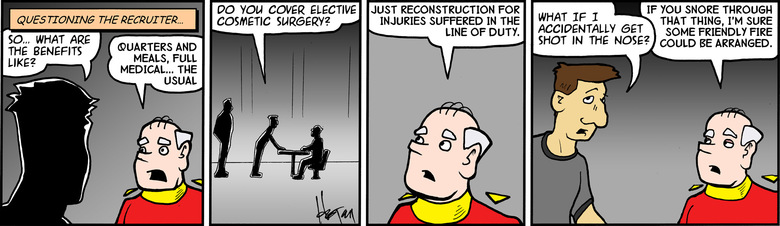
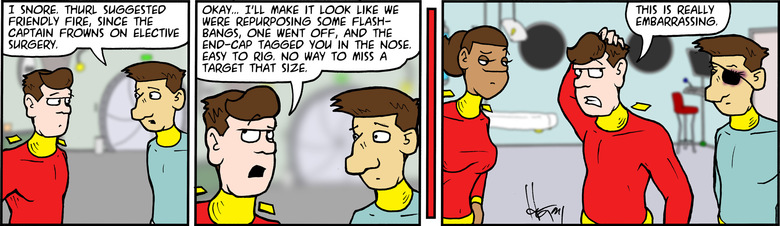
What we have here is the beginning of a running gag. Or, if you want to get technical about it, it’s the beginning of a try-fail cycle. Aardy is going to try to get surgery for his nose. Let’s look at Aardy’s first try-fail iteration…
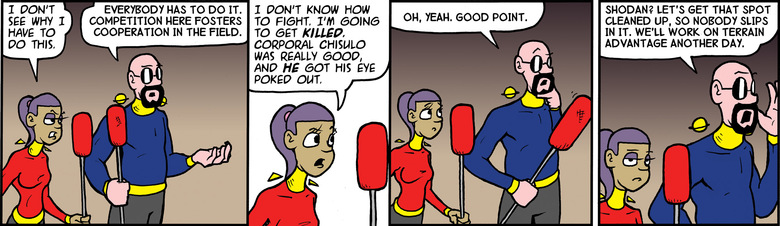
Now let’s look at Para. I’m going to skip her first appearance, and cut straight to one of her goals which is “stay out of combat.” She’s a world-class roboticist, not a grunt.
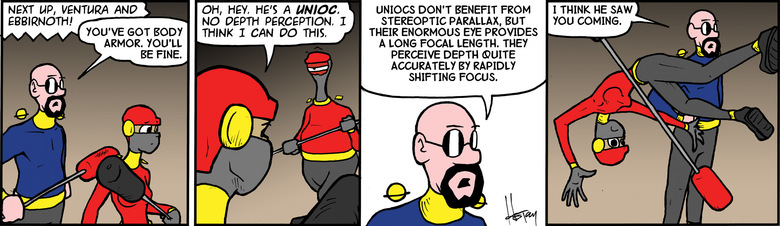
The story moves immediately into the first iteration of her try-fail cycle…
Let’s pause for a moment. Why am I bothering to give these brand-new characters their own goals? Why add the complexity of a try-fail cycle to a character who was just introduced, when there are plenty of beloved characters in the story who already have hopes, dreams, failures, successes, and ongoing character arcs?
The question should answer itself. I want more beloved characters. You might argue that this is because I’m a heartless monster who wants additional leverage over the reader in order to inflict anguish, but maybe it’s because I want more ways to portray triumph. Maybe I want to sweeten victory by having more characters able to share it.
Or maybe I’m getting ready to kill somebody off, and I need fresh meat.
Moving on, let’s look at Aardy’s next failure…
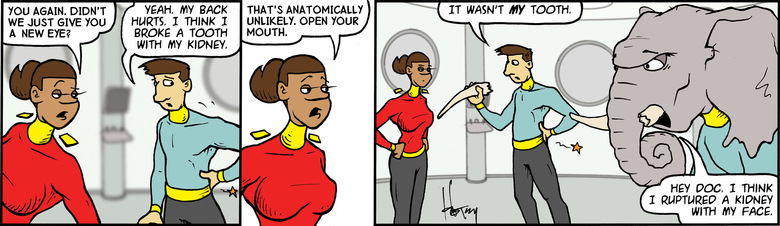
This one wasn’t the aftermath of an attempt at facial damage — it was a plot-related disaster with other implications. This is a handy way to keep readers engaged by making sure the sub-plot has connections to the main plot. At any rate, since Aardy was injured I was able to take just a moment to switch gears and iterate his try-fail cycle again.
Of course, it comes across as a running gag, which is fine since the epic science fiction I’m writing must maintain the “just a comic strip” disguise.
Back on task… I chose these two sub-plots in for this essay because one of the reasons they’re satisfying is that I managed to tie them together for additional reader satisfaction. Here’s the pair of strips where that happens:
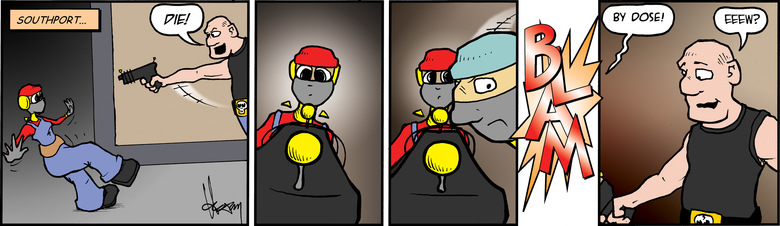
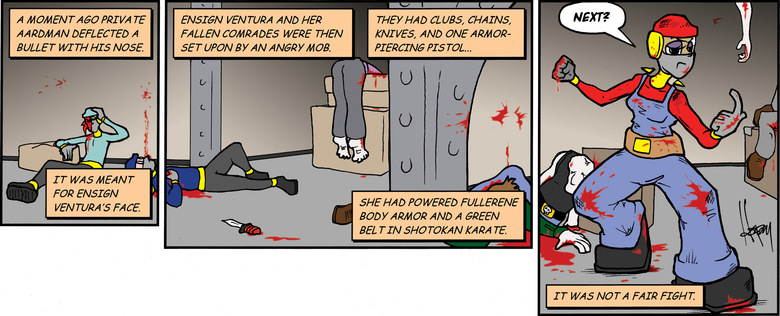
There are several directions I could have taken these, and at first glance the option to turn the clever, petite technician into a killing machine might seem a bit hackneyed. At the very least, the trope has its own name (warning: TV Tropes will eat your soul.) But there’s more to come. I wanted to convey the idea that violence yields consequence, and Para’s story continues in that vein. The “killing machine” moment is nicely triumphant in the context of the rest of the story, but it’s not the end of Para’s story.
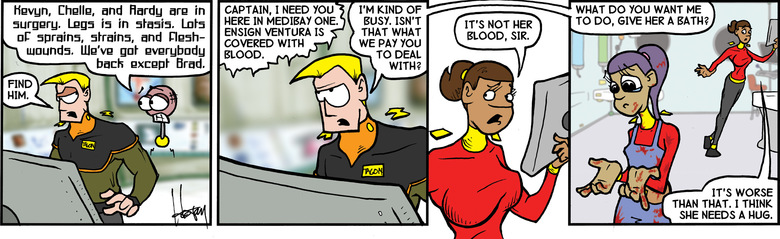
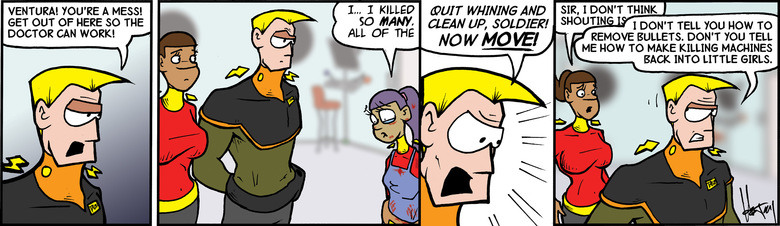
By the way, there’s an adjacent sub-plot regarding Captain Tagon. He needs to be awesome. Sometimes that means he’s a bad-ass, and sometimes it means he’s just a really good commanding officer. Right here his arc is running up into Para’s, and it’s one of my favorite moments in the strip. Go ahead. I’ll wait.
Finally, here is the payoff for Para’s sub-plot in this book. If you recall, she wants to do robot stuff, not kill people.
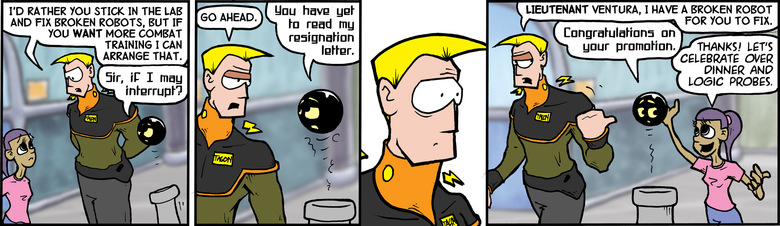
But our discussion (and this book) wouldn’t be complete without payoff on Aardy’s arc, strengthened by the running together of the two.
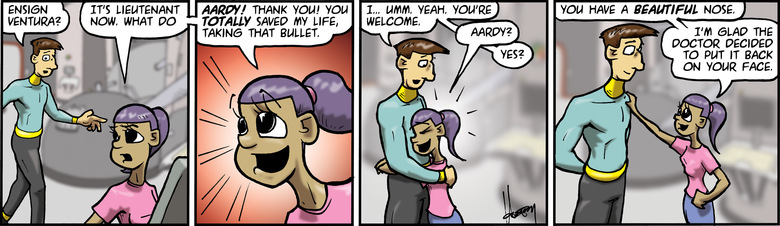
So, Para gets what she wants (permission to play with the company’s robots), and Aardman gets what he needs (acceptance for his enormous nose.) Both of them made heroic sacrifices — Aardy took an enemy bullet instead of a friendly one, and Para traumatized herself by killing an angry mob. Gritty! Also, a long-standing character mentioned in one of the strips above turns out to be dead.
Of course, the story continues to move on, and Para’s arc in particular affords me all kinds of good story fodder. During Force Multiplication we learn that Para Ventura now suffers from post-traumatic stress disorder, and will freeze in combat. Again, I decided to tie her sub-plot into other things to enhance reader satisfaction. Her big moment in that book is another of my favorite pieces of work. No, I’m not going to link directly to it. You want it? Start here, and work for it. You’ll enjoy it more.
I hope this has been helpful. I also hope it serves as a nice introduction to my work, which you can enjoy absolutely for free on the internet through the magic of what I like to call the “Free Content Business Model,” but that’s the subject of an entirely different essay.
14/03/2012 at 5:33 pm Permalink
Pictures are distracting, Howard 😉
Also, you put a link to TV Tropes. I suspect lots of people clicked on that and were never seen again…
I do think this was a pretty good primer to “what you do” for those poor souls to never have tried Schlock Mercenary…
14/03/2012 at 5:35 pm Permalink
Having read SM for many years, I’m aware that you keep a significant buffer of drawn strips ready. How far into the future do you have your stories planned, and to what degree of detail?
14/03/2012 at 5:39 pm Permalink
Right now I’ve got a very skeletal outline that should carry me through the next four or five books. I’ve got a firmer outline to carry me through the end of this book, which is sometime in December, or maybe next March. This includes several sub-plots, and notes about the “hooks” I need to set for future plotting.
Actual jokes don’t get written down until the day I draw the strip, which is usually about a month before it airs.
14/03/2012 at 10:35 pm Permalink
 And it is almost always, “Surprising, yet inevitable.”
😉
14/03/2012 at 5:36 pm Permalink
Howard, thanks SO much for your blog post. I’m sure people are just too blown away by your brilliance to come up with a comment right now…
14/03/2012 at 6:49 pm Permalink
You’re very welcome. It was a joy to write, even if it was a bit tedious getting all the HTML in place for the images. But this kind of illustrated essay is what the web is best at.
14/03/2012 at 5:40 pm Permalink
Good writing advice and something I’m going to point to the next time says something silly like “comics are simple”!
14/03/2012 at 5:41 pm Permalink
That was delightful! Because sub-plots are the bane of my freaking existence: do you chart them? write any of it out before hand? let it come organically on wings of angels?
14/03/2012 at 5:57 pm Permalink
I chart and outline them. Sometimes an element gets discovery-written as the story unfolds.
14/03/2012 at 5:43 pm Permalink
Such an excellent article for anyone writing long-form comics, or any other kind of story for that matter!
14/03/2012 at 5:53 pm Permalink
Really great examples of side plots and supporting characters. Depth doesn’t have to mean a character’s entire life story and resolution doesn’t have to mean their story ends.Â
14/03/2012 at 6:27 pm Permalink
k, i’m supposed to say what a great discussion on character sub-plot this is, (and it IS!). But what I really want to say is “I heart Para!” <3
Thank you Howard, for this most excellent guest post!
14/03/2012 at 6:39 pm Permalink
“Because if the sub-plot can tell a story without the big plot, it’s probably a solid story.” Excellent point! Thanks for the reminder that subplots need to be complete stories, too.
14/03/2012 at 8:14 pm Permalink
One problem with a daily strip is that you can lose elements of the various plots and subplots because of forgetfulness.
You should always go back and reread a story arc once it has completed so you can catch all these fine details
14/03/2012 at 9:38 pm Permalink
I’m such a huge fan of Writing Excuses!!! (I just had to say that straight off…) And I love the point you make early on about how your sub plots can mean failure for your beloved secondary characters. I spend so much time trying to resolve everything for every character I like that I miss this great technique.
15/03/2012 at 8:13 am Permalink
I like it, thanks Howard. Â Someone recently said each sub-plot should be it’s own story with a beginning, complications and ending. I think what you said here dovetails nicely with that.
Good, good stuff. Â Thanks again.
15/03/2012 at 7:28 pm Permalink
so, these are some of the reason I really like Schlock!
17/03/2012 at 9:38 am Permalink
Damn you howard, now you made me want to go back and read your comic from the very beginning all over again. Here’s to another weekend spent productively. You’re an amazing writer, and your stories are what have kept me following your comic for almost 10 years now. from one aspiring comic artist/writer to the master of story, thank you so much for these blogs and your stories over the years.